Laser Hair Removal Machine Buying Guide: How to Choose the Right Device for Your Clinic (2026)
Buying a professional laser hair removal machine is a $2,000–$15,000 decision that will define your clinic's revenue for the next 3–8 years. Choose right, and you'll treat 8–16 patients per day at $250–$500 per session with near-zero consumable costs. Choose wrong, and you'll face patient complaints, regulatory issues, and a machine that collects dust in the corner.
This guide walks you through the complete procurement process: from deciding which technology fits your clientele, to verifying the specs that actually matter, to avoiding the 8 most common traps that cost clinics thousands.
1. Decision Tree: Which Technology Should You Buy?
2. 13-Point Specification Checklist: What to Verify Before You Pay
| # | Specification | What to Look For | Why It Matters |
|---|---|---|---|
| 1 | Laser bar brand | COHERENT, DILAS, or Jenoptik bars rated 50–100M shots | Generic Chinese bars last 5–10M shots; a premium bar lasts 100M — 10x the ROI before replacement |
| 2 | Wavelength(s) | 808nm minimum; 755+808+940+1064nm multi-wavelength is gold standard | 808nm alone treats Fitzpatrick I–IV; adding 1064nm extends to V–VI; 755nm adds fine/light hair capability |
| 3 | Peak power (not "rated power") | 2,000–3,000W peak power; verify with manufacturer spec sheet, not marketing copy | Peak power determines penetration depth and follicular destruction. "Rated power" on the label ≠ actual output. Ask for the test report. |
| 4 | Spot size range | At least 3 configurations (e.g., 6mm circle + 12×12mm + 12×24mm + 12×36mm) | Small spots = precision (upper lip, fingers). Large spots = speed (back, legs). One-spot machines limit your treatment menu. |
| 5 | Pulse frequency | 1–20Hz (higher = faster treatment) | At 20Hz with a 12×36mm spot, you cover a full back in 12 minutes. At 10Hz, it's 24 minutes. Over 8 patients/day, this difference is 1.6 extra hours. |
| 6 | Cooling system architecture | Multi-mode: DCS (semiconductor + compressor + air + water + TEC) vs single TEC | Single TEC at 0–5°C provides basic epidermal protection. DCS at −45°C to 5°C enables high-fluence treatment on dark skin without burns — and reduces pain perception significantly. |
| 7 | Handle design | Weight <350g; ergonomic grip; interchangeable spot tips or fixed | Operators hold the handle for 4–6 hours/day. A 450g handle causes wrist fatigue, slower treatment, and inconsistent results by end of day. |
| 8 | Shot counter / RFID authentication | Factory RFID-tagged handpieces with authentic shot counting | Prevents third-party refurbished or counterfeit handpieces — which deliver sub-spec energy and void your FDA compliance. |
| 9 | FDA 510(k) clearance | Verify at accessdata.fda.gov — do NOT accept a certificate alone | "FDA registered" means the factory is listed — NOT that the device is cleared. 510(k) clearance requires clinical data review. Check the K-number yourself. |
| 10 | CE marking (EU MDR) | CE under MDR 2017/745 with NB (Notified Body) number | Pre-2021 MDD certificates are expiring. MDR requires clinical evaluation reports. A CE mark without a 4-digit NB number is self-declared — not valid for medical devices. |
| 11 | ISO 13485 certification | Valid ISO 13485:2016 certificate with scope covering laser manufacturing | Required for import into most regulated markets. Verify the certificate number at the issuing body's database — fake ISO certificates are rampant. |
| 12 | Warranty terms | Minimum 2 years on laser bar and power supply; on-site or depot service | Laser bar failure after 1 year = $2,000–$4,000 out of warranty. Demand at least 2-year bar coverage. Ask: "Where is the nearest service center to my clinic?" |
| 13 | Consumable / maintenance cost | Ask for 3-year TCO (total cost of ownership) estimate | A $6,000 machine with $2,000/year in cooling system maintenance costs more over 3 years ($12,000) than an $8,000 machine with $200/year maintenance ($8,600). |
3. Price Tiers & ROI: What You Get at Each Level
Single-wavelength diode or IPL multifunction
- 808nm single or IPL 400–1200nm
- 1–15Hz, basic TEC cooling
- 5–10M shot bar life
- Fixed spot size(s)
- Best for: startups, low volume
ROI: 4–8 months
Monthly revenue: $4,000–$8,000
Multi-wavelength diode or dual-wavelength alexandrite
- 2–4 wavelengths
- 1–20Hz, multi-mode cooling
- 50M+ shot bar life
- 4 interchangeable spots
- Best for: established clinics
ROI: 6–10 months
Monthly revenue: $8,000–$16,000
Top-tier diode with DCS cooling, AI features, 100M bar
- 4-wavelength (755+808+940+1064nm)
- 1–20Hz, DCS 5-in-1 cooling (−45°C)
- 100M shot bar life
- 4 interchangeable spots + smart sensing
- Best for: high-volume flagship
ROI: 5–9 months
Monthly revenue: $12,000–$24,000
4. Certification & Regulatory Compliance Checklist
| Market | Required Certification | How to Verify | Common Fraud |
|---|---|---|---|
| United States | FDA 510(k) Clearance (Class II medical device) | Search K-number at FDA PMN Database. If the manufacturer cannot give you a K-number, they are not cleared. | "FDA Registered" ≠ cleared. Registration is a $5,000/year facility listing — no device review. Always ask for the K-number. |
| European Union | CE Mark under MDR 2017/745 with Notified Body number (4 digits) | Check the NB number at EU NANDO database. Certificate must reference MDR 2017/745, not MDD 93/42/EEC (expiring). | Self-declared CE (no NB number) — invalid for medical devices. Expired MDD certificates. Fake NB numbers. |
| International (base) | ISO 13485:2016 (Medical Device QMS) | Verify certificate number at issuing body (SGS, TÜV, BSI, etc.). Check scope includes "design and manufacture of laser equipment." | Fake certificates with real certificate numbers copied from other companies. Always cross-check with issuer. |
| Electrical Safety (global) | IEC 60601-1 (CB Scheme preferred) | Request CB test report and certificate. This is often required for import customs clearance. | Incomplete test reports covering only some clauses. Demand the full test report. |
5. 8 Common Procurement Traps (And How to Avoid Them)
The "Rated Power" Trick
Manufacturers advertise "3,000W rated power" but the actual peak power delivered to tissue is 1,200W after electro-optical conversion losses. Always ask for peak optical output power measured at the handpiece aperture, not the electrical input power at the wall plug. A 3,000W input machine may deliver less effective power than a properly engineered 2,000W machine with higher conversion efficiency.
DC Glass Tube Posing as RF Metal-Ceramic Tube
DC-excited glass CO2 tubes cost $100–300 and last 1–2 years. RF-excited metal-ceramic tubes cost $600–1,200 and last 3–5 years. A machine advertised as "RF tube" at a suspiciously low price may actually contain a DC tube. Verification method: ask for a photo of the tube label showing manufacturer and excitation type. Legitimate RF tube manufacturers (Coherent, Synrad, Universal) label every tube.
Shot Count Inflation
"50 million shots guaranteed" — but the fine print says the bar is considered failed when output drops to 50% of rated power. By 20M shots, your treatment efficacy may already be compromised. Ask: "At what shot count does output drop below 80% of rated power?" A quality bar maintains >80% output through 80%+ of its rated life.
The Missing Wavelength
A machine advertised as "4-wavelength" may have four LED indicators on the panel but only two actual diode bars installed. Verification: request a photo of the handpiece aperture showing all wavelengths firing (each wavelength produces a visible beam at different color temperatures). Or request the diode bar serial numbers for each wavelength.
Refurbished / Third-Party Handpieces
A machine ships with genuine OEM handpieces. Six months later, replacement handpieces arrive in unbranded packaging at half the price — these are third-party clones with inferior diode bars and no FDA traceability. Protection: demand RFID-authenticated handpieces; buy handpieces only from the OEM; check the RFID chip data against the manufacturer's database.
No Local Service Infrastructure
The machine ships from China. When it needs repair, there is no service center within 3,000km. You ship it back (3–6 weeks) or find a local technician unfamiliar with the model. Before buying: ask for the nearest authorized service center address and phone number. Call them. Ask how many of this model they service per month.
Expired or Fake CE / FDA Certificates
Common scenarios: (a) CE certificate under the old MDD directive (expired); (b) FDA "registration" presented as "clearance"; (c) certificate belongs to a different model; (d) certificate is a Photoshop job. Always independently verify certificate numbers in the issuing body's public database before paying.
The "Free Shipping + Free Training + Free Everything" Bundle
When the machine price is far below market and includes "free" shipping, training, spare parts, and an extended warranty: these costs are either (a) built into an inflated price elsewhere, or (b) the machine quality is low enough that they can afford to give away a second one when the first fails. Realistic pricing: a quality diode laser costs $5,000–$12,000 FOB. If the quote is $2,500 with free worldwide shipping and a "lifetime warranty," the machine likely costs $800 to manufacture.
6. Winkonlaser Product Recommendations
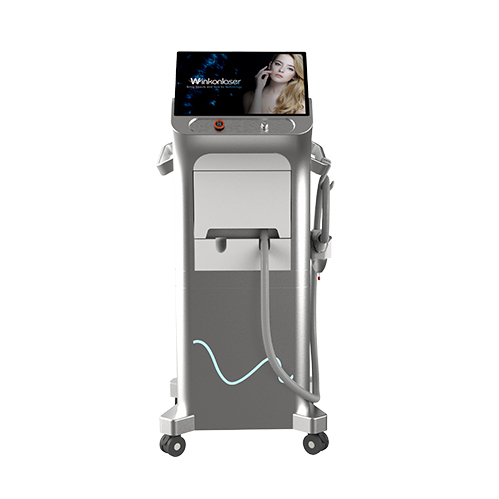
AresLite DM60 — 3000W 4-Wavelength Diode Laser
- 4 wavelengths (755+808+940+1064nm) — treats Fitzpatrick I–VI, fine hair to deep terminal hair
- 1 handle with 4 interchangeable spots (6mm / 12×12 / 12×24 / 12×36mm)
- DCS 5-in-1 cooling (−45°C to 5°C), 100M shot bar
- FDA 510(k) K241860, CE, ISO 13485
- Best for: High-volume clinics, diverse skin types, premium positioning
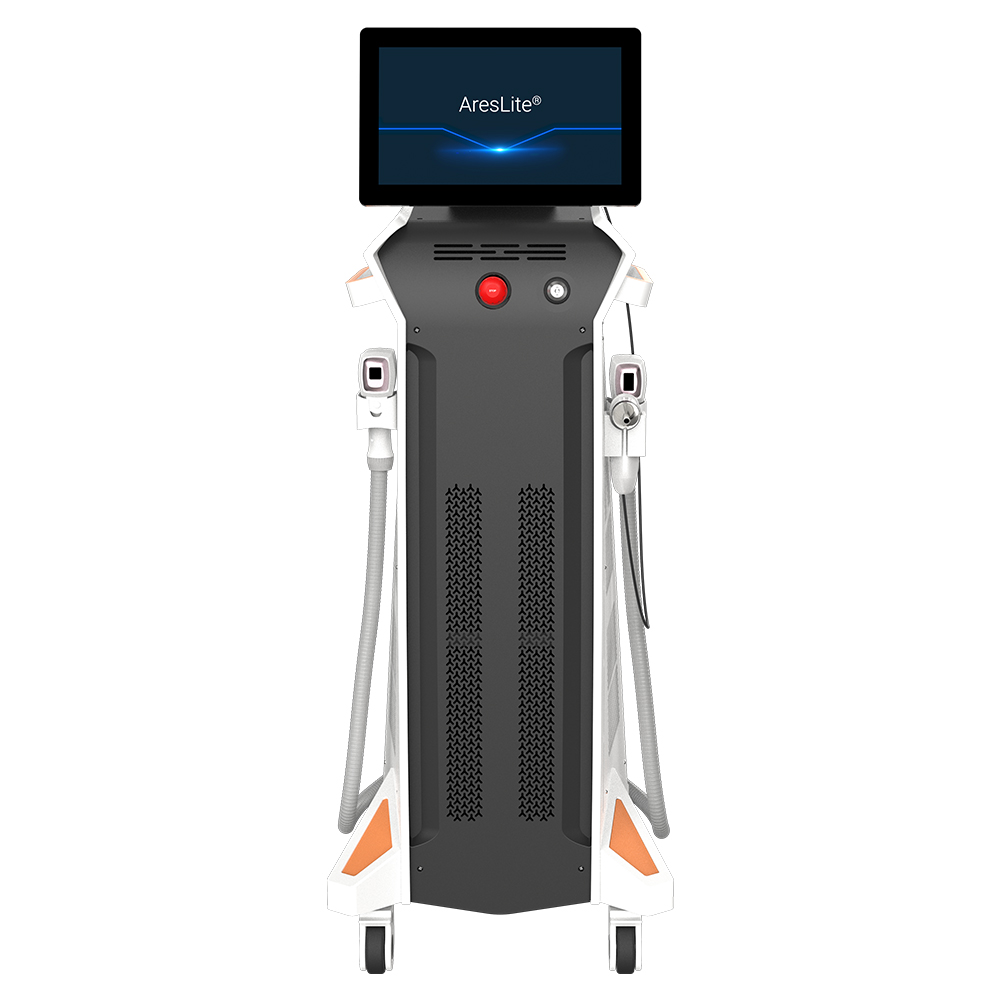
AresLite DM40P — 2000W 4-Wavelength Diode Laser
- 4 wavelengths (755+808+940+1064nm), 2000W — same wavelength coverage as DM60 at lower power
- 2 handles with fixed spots (12×12mm + 12×24mm) — no interchangeable tips needed
- DCS 5-in-1 cooling (−45°C to 5°C), handle-integrated touch screen
- FDA 510(k) K241860, CE, ISO 13485
- Best for: Startups, budget-constrained clinics, second-room device

CL300 — Professional Dual-Wavelength Alexandrite Laser
- 755nm alexandrite + 1064nm Nd:YAG — premium option for Fitzpatrick I–IV clinics
- Spot sizes: 3/12/16/18mm (standard); 6/10/24mm (optional)
- Air cooling system
- FDA, CE, ISO 13485
- Best for: Premium clinics serving Fitzpatrick I–III, fine/light hair specialist
1.jpg)
ML600 — 5-in-1 IPL, RF, Nd:YAG, Diode & SHR Platform
- 5 technologies in 1 chassis — IPL (400–1200nm) + RF + Nd:YAG + Diode 808nm + SHR
- Interchangeable filter heads for hair removal, skin rejuvenation, vascular, acne
- Multi-cooling: air + water + semiconductor + sapphire contact
- CE, ISO 13485
- Best for: Beauty salons needing multi-service capability from one machine
Diode Laser vs IPL vs Alexandrite — Complete Technology Comparison (12 dimensions, clinical data, decision matrix) →
7. Frequently Asked Procurement Questions
For a new, quality diode laser from a reputable manufacturer: $5,000–$12,000 FOB (Free On Board, before shipping and import duties). Add 10–15% for shipping, customs clearance, and local electrical certification. Entry-level single-wavelength diode: $2,000–$4,000. Multi-wavelength flagship: $8,000–$15,000. Warning: machines priced below $2,000 new almost certainly use generic diode bars with 5–10M shot lifespan and minimal after-sales support. The initial savings will be consumed by replacement costs and downtime within 18 months.
If hair removal is your primary revenue driver: buy a diode laser. It delivers 80–90% clearance in 4–6 sessions vs 60–80% in 6–10 for IPL, treats all Fitzpatrick types (I–VI), has near-zero consumable costs, and commands higher per-session pricing ($250–500 vs $100–250). If you're a beauty salon adding hair removal to an existing service menu: an IPL multifunction machine (like ML600) at $3,000–$5,000 is a pragmatic entry point. It won't match diode efficacy, but it adds five treatment categories for the price of one — useful for filling a light schedule until you can justify a dedicated diode machine.
After-sales service infrastructure. Most buyers focus on specs and price. Then, 14 months in, the cooling system needs maintenance and there's no authorized technician within 3,000km. Before you buy: (1) Ask for the nearest service center address and phone number. (2) Call them and ask how many of this model they service monthly. (3) Ask about spare parts availability — are common parts (handpiece, cooling pump, power supply) stocked locally or shipped from the factory? (4) Understand the warranty process: depot repair (you ship, they fix, they return — 3–6 weeks) vs on-site (technician comes to you — days). A $1,000 savings on purchase price disappears the first time your machine is down for a month.
Go to the FDA PMN Database. Enter the K-number provided by the manufacturer (e.g., K241860). Verify: (1) The device name matches the machine you're buying. (2) The applicant company matches the manufacturer. (3) The clearance date is valid. If the manufacturer won't give you a K-number — they are not FDA cleared. "FDA registered" is a separate, lower-bar process (facility listing only) and does NOT mean the device is approved for clinical use in the US.
Yes — if you perform due diligence. China is the world's largest manufacturer of aesthetic laser equipment, and the top-tier factories produce machines that match or exceed Western brands in specifications at 40–60% of the price. The risk is not country of origin — it's manufacturer quality variance. Due diligence checklist: (1) Verify ISO 13485 certificate independently. (2) Request FDA 510(k) K-number and verify. (3) Ask for 3 references in your region who bought the same model 12+ months ago — and contact them. (4) Video call the factory floor, not just the showroom. (5) Pay 30% deposit, 70% after video inspection of YOUR specific machine (with serial number) operating. (6) Use Trade Assurance or Letter of Credit for first order. The gap between a top-tier Chinese manufacturer and a bottom-tier one is wider than the gap between a top-tier Chinese manufacturer and a Western brand.