EMS Sculpting vs Cryolipolysis: Build Muscle or Destroy Fat — Which Body Contouring Technology Does Your Clinic Need? (2026)
Body ContouringEMS Sculpting (HIEMT) and Cryolipolysis (Fat Freezing) represent two fundamentally different philosophies in body contouring. EMS builds muscle and burns fat simultaneously through supramaximal electromagnetic contractions — it's for patients who want to look stronger. Cryolipolysis selectively destroys fat cells through controlled cooling — it's for patients who want to look slimmer. They are not competitors; they are complementary tools targeting different tissue layers, different patient goals, and different clinical endpoints.
This comparison analyzes both technologies across 12 dimensions: mechanism of action, tissue layer targets, treatment protocols, clinical efficacy data, patient selection, revenue models, and Winkonlaser product recommendations.
| Dimension | EMS Sculpting (HIEMT) | Cryolipolysis (Fat Freezing) |
|---|---|---|
| Energy Type | High-Intensity Focused Electromagnetic (HIEMT) — induces supramaximal muscle contractions; often combined with RF for thermal synergy | Controlled cooling (−11°C to 4°C) — triggers selective adipocyte apoptosis without damaging overlying skin, nerves, or vessels |
| Primary Target | Skeletal muscle layer (rectus abdominis, gluteal muscles, biceps/triceps, quadriceps) | Subcutaneous adipose tissue (fat layer at 1–3cm depth) |
| Secondary Effect | Fat reduction (50% in treated area via metabolic lipolysis from extreme muscle activity) | None on muscle — purely adipocyte destruction; some skin tightening from cold-induced collagen remodeling (minor) |
| Mechanism | 20,000–36,000 supramaximal contractions per 30-min session → muscle hypertrophy + fat apoptosis via supraphysiologic metabolic demand | Cooling to −11°C crystallizes lipid droplets in adipocytes → caspase-3 mediated apoptosis → macrophage clearance over 8–12 weeks |
| Invasiveness | Non-invasive — applicator placed on skin; no needles, no suction | Non-invasive — vacuum suction + cooling plates; temporary suction marks (resolve in hours) |
| Session Duration | 30 minutes per area | 35–60 minutes per area (depends on applicator size and cooling protocol) |
| Sessions Required | 4–6 sessions, spaced 2–3 days apart (intensive) or 1 week apart (standard) | 1–2 sessions per area, spaced 8–12 weeks apart |
| Results Timeline | Visible at 1 week; optimal at 4–8 weeks post final session | Visible at 4 weeks; optimal at 8–12 weeks post-treatment |
| Best Indications | Abdominal definition (rectus abdominis), buttock lifting, "gym alternative" for toning, post-partum core restoration | Stubborn fat pockets (love handles, lower abdomen, inner/outer thighs, upper arms, double chin, bra fat) |
| Machine Price Range | $8,000–$25,000 (single applicator); $15,000–$40,000 (dual applicator + RF) | $3,000–$12,000 (single applicator); $8,000–$20,000 (multi-applicator + 360° cooling) |
| Consumable Cost | Low — no disposables (reusable applicators); occasional gel/contact pads | Low–moderate — anti-freeze membrane/gel pads per session ($5–15); applicator replacement after ~2,000–5,000 cycles |
| Per-Session Revenue | $300–$800 (single area); $600–$1,500 (abdomen + flanks package) | $400–$900 (single area); $800–$1,800 (multi-area package) |
| ROI Timeline | 6–12 months (higher machine cost, rapid patient turnover, 4–6 visits per patient build cumulative revenue) | 4–8 months (lower machine cost, 1–2 visits per patient requires higher marketing spend to maintain pipeline) |
1. Mechanism of Action: Two Completely Different Biologies
EMS Sculpting — Muscle First
HIEMT field penetrates skin and fat without resistance. Magnetic pulses trigger depolarization of motor neurons → supramaximal contractions (intensity that voluntary exercise cannot achieve). 20,000+ contractions per session = metabolic equivalent of 20,000 sit-ups. Muscle hypertrophy + extreme metabolic demand drives adjacent fat lipolysis.
Cryolipolysis — Fat First
Controlled cooling (4°C to −11°C) crystallizes cytoplasmic lipid droplets within adipocytes. Fat cells are more cold-sensitive than skin, nerves, or vessels → selective apoptosis. Crystallized adipocytes undergo caspase-3 mediated programmed cell death. Macrophages engulf and clear cellular debris over 8–12 weeks. Treated fat cells are permanently eliminated — they do not regenerate.
1.1 EMS Sculpting (HIEMT): Building Muscle While Burning Fat
The Physics of HIEMT Muscle Stimulation
HIEMT uses a rapidly alternating magnetic field (up to 2.5 Tesla at peak) to induce electrical currents in motor neurons. These currents trigger supramaximal muscle contractions — contractions that exceed the maximum voluntary contraction achievable through exercise. During a 30-minute session, the targeted muscle group undergoes 20,000–36,000 contractions at intensities that voluntary training cannot replicate.
- Muscle hypertrophy: Clinical results show 35% increase in muscle thickness after a 4–6 session protocol. This is visible as improved muscle definition (abdominal etching, gluteal lift) — not bulk, but tone and contour.
- Fat reduction: The extreme metabolic demand of 20,000+ contractions forces adjacent adipose tissue into lipolysis. Results show 50% fat reduction in the treated area — a secondary but clinically significant effect.
- RF synergy: Many EMS platforms (including Winkonlaser FE60) combine HIEMT with monopolar/bipolar RF for simultaneous electromagnetic muscle stimulation + RF skin tightening in one session. The RF component targets the dermal layer to stimulate collagen contraction and neocollagenesis, improving skin laxity over the treated muscle area.
- No voluntary effort required: The machine does the work — the patient lies still while the magnetic field stimulates muscles at intensities impossible to achieve voluntarily. This is a key selling point for patients who cannot or will not exercise.
Clinical performance: The Winkonlaser FE60 HIEMT + RF platform achieves 35% increase in muscle thickness and 50% reduction in subcutaneous fat after a 4–6 session protocol. The 15 Tesla electromagnetic field induces 20,000+ supramaximal contractions per 30-minute session — equivalent to the metabolic output of 20,000 sit-ups or squats. The integrated bipolar RF provides dermal collagen contraction and neocollagenesis for visible skin tightening over the treated area. Waist circumference reductions of 4–5cm are typical after a full treatment course.
1.2 Cryolipolysis: Selective Fat Cell Destruction
The Biology of Cold-Induced Adipocyte Apoptosis
Cryolipolysis exploits a simple biological vulnerability: adipocytes crystallize at higher temperatures than surrounding tissue. When subcutaneous fat is cooled to 4°C to −11°C for 35–60 minutes, the cytoplasmic lipid droplets undergo phase transition from liquid to crystalline. This crystallization triggers irreversible caspase-3 mediated apoptosis specifically in adipocytes, while the overlying skin (rich in collagen and elastin, with higher freezing resistance), blood vessels, and nerves remain undamaged.
- Permanent fat reduction: Apoptotic adipocytes are NOT replaced — the body does not generate new fat cells in adulthood (adipocyte number is fixed after adolescence). Weight gain after cryolipolysis expands remaining fat cells, not new ones. The treated area will always have fewer fat cells than before.
- 360° surround cooling: Newer platforms (like Winkonlaser HS1000C) wrap the cooling surface around the treatment area rather than using flat applicators. This increases the contact surface by ~40%, shortening treatment time and improving contour uniformity.
- Delayed results: The inflammatory clearance process takes time. Visible fat reduction begins at 4 weeks, accelerates through weeks 8–10, and peaks at 12 weeks. This is NOT a "walk out skinny" procedure — patient education on the timeline is essential for satisfaction.
- Paradoxical Adipose Hyperplasia (PAH): A rare adverse event (0.025–0.05% incidence) where treated fat cells hypertrophy instead of undergoing apoptosis. More common in male patients and with older flat-applicator devices. 360° cooling appears to reduce PAH risk through more uniform temperature distribution.
Clinical data: A 2021 meta-analysis of 16 studies (n=1,445) reported a mean fat layer reduction of 20.4% after a single cryolipolysis session (measured by caliper at 12 weeks). A second session on the same area (8–12 weeks later) yielded an additional 10–15% reduction. Patient satisfaction was 82% at 12 weeks. Adverse events were mild and transient: erythema (99%), numbness (68%), bruising (12%) — all resolved within 2 weeks. PAH incidence across all studies was 0.03%.
2. Patient Selection: Who Is Right for Which Technology?
| Patient Profile | EMS Sculpting | Cryolipolysis | Best Choice |
|---|---|---|---|
| BMI 22–28, wants abdominal definition / "six-pack" | ★★★ Ideal | ★ Minimal effect | EMS — builds rectus abdominis visibility |
| BMI 25–32, struggling with love handles despite diet/exercise | ★ Limited | ★★★ Ideal | Cryolipolysis — eliminates stubborn fat pockets |
| Post-partum, wants core restoration + abdominal tightening | ★★★ Ideal | ★★ Good | EMS — addresses diastasis recti + muscle tone; Cryo optional for residual fat |
| Fit/athletic, near goal weight, wants muscle definition | ★★★ Ideal | — Not indicated | EMS — best results in patients with low baseline fat, visible muscle |
| BMI >30, significant subcutaneous fat | — Not indicated | ★★ Moderate | Cryolipolysis (with caveat: BMI >30 patients need realistic expectations; this is spot reduction, not weight loss) |
| Double chin / submental fat | — Not indicated | ★★★ Ideal | Cryolipolysis — small applicator specifically for submental |
| Buttock lifting / "Brazilian butt lift alternative" | ★★★ Ideal | ★ Minimal | EMS — gluteal muscle hypertrophy creates lift; Cryo cannot build volume |
| Upper arm "bat wings" / bra fat | ★★ Moderate | ★★★ Ideal | Cryolipolysis — fat reduction is the primary need; EMS for triceps toning as add-on |
| Inner/outer thigh fat | ★ Limited | ★★★ Ideal | Cryolipolysis — classic cryo indication; EMS limited on thighs without muscle belly |
3. Treatment Economics & Revenue Comparison
| Business Metric | EMS Sculpting | Cryolipolysis |
|---|---|---|
| Avg package price (abdomen) | $1,800–$3,200 (4–6 sessions) | $800–$1,800 (1–2 sessions) |
| Avg revenue per patient hour | $600–$1,600 (one 30-min session) | $400–$900 (one 35–60-min session) |
| Patients per day (single machine) | 8–12 (30-min sessions, quick turnover) | 5–8 (35–60 min sessions, longer turnover) |
| Daily revenue capacity | $2,400–$12,800 | $2,000–$7,200 |
| Repeat visits per patient | 4–6 visits (high retention, predictable pipeline) | 1–2 visits per area (new patient acquisition dependent) |
| Marketing cost per acquired patient | $80–$200 (competitive; EMS awareness is rising) | $60–$150 (established consumer awareness) |
| Machine cost amortization | ~$200–$500/month over 36 months | ~$80–$250/month over 36 months |
| Break-even patients/month | 8–12 | 5–8 |
3.1 The Combined Model: Why Clinics Offer Both
The most financially successful body contouring clinics offer both EMS and Cryolipolysis. Here's why the combined model works:
- Different patient entry points: Cryolipolysis attracts the "I want to lose this" patient (high volume, lower price point). EMS attracts the "I want to look defined" patient (lower volume, higher price point). Together they cover the full body contouring demand spectrum.
- Cross-selling is natural: A cryolipolysis patient who has lost fat may want EMS to reveal the muscle definition now visible. An EMS patient who has built muscle may notice residual fat that cryolipolysis can address. The average combined patient spends $3,500–$6,000 across both treatments.
- Schedule density: EMS's 30-minute sessions fill gaps between cryolipolysis's 60-minute slots, maximizing treatment room utilization.
- Male market access: Cryolipolysis has traditionally been 85%+ female. EMS attracts significantly more male patients (30–40% male in many clinics) because "muscle building" resonates with male aesthetic goals in a way that "fat freezing" often does not.
4. Winkonlaser Products for Each Technology
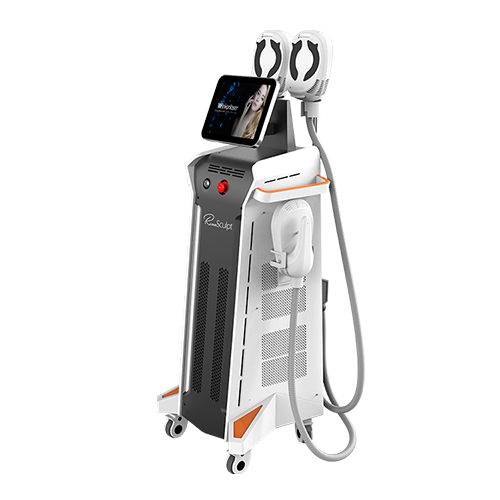
Renasculpt FE60 — 15 Tesla HIEMT + RF + EMS Body Contouring System
- Technology: 15 Tesla HIEMT electromagnetic field + bipolar RF + EMS — triple-action muscle building, fat reduction, and skin tightening in one platform
- Applicators: Dual-handpiece design — treat abdomen + flanks simultaneously (cuts session time by 50% vs single-applicator systems)
- Intensity: 0–100% adjustable (0–15 Tesla), enabling progressive treatment protocols from beginner to elite athlete levels
- RF skin tightening: bipolar RF targets the dermal layer for collagen contraction and neocollagenesis — tightens skin over the treated muscle area for a more contoured appearance
- Session: 30 minutes; 4–6 sessions recommended; results visible at 1 week, optimal at 6–8 weeks
- Best for: Medical spas and body contouring clinics targeting the premium "muscle definition" demographic; excellent for combined EMS + Cryo treatment plans
- Certification: FDA, CE, ISO 13485
.jpg)
Mixslim HS1000C — Professional 360° Surround Cooling Cryolipolysis Platform
- Technology: 360° surround cooling (not flat-plate) — cooling panels wrap around the treatment area, increasing contact surface by ~40% and reducing treatment time to 35 minutes
- Multi-applicator: 4 independent channels — treat 2 large + 2 small areas simultaneously (e.g., abdomen + love handles + arms in one session)
- Temperature control: −11°C to 4°C, ±0.5°C precision across all 4 channels independently
- Safety: Built-in freeze detection + auto-shutoff; anti-freeze membrane protects skin; 360° design reduces PAH risk vs flat applicators
- Session: 35–60 minutes per area; 1–2 sessions per area recommended; results visible at 4 weeks, optimal at 12 weeks
- Best for: Clinics entering body contouring at a lower price point; ideal as companion device alongside FE60 for combined EMS + Cryo treatment plans
- Certification: CE, ISO 13485
5. Final Verdict: EMS, Cryolipolysis, or the Combined Model?
Decision Matrix by Clinic Profile
| Your Clinic Profile | Best Technology | Recommended Machine | Rationale |
|---|---|---|---|
| Premium body contouring clinic, high-income demographic | Both | FE60 + HS1000C | Full-spectrum body contouring; EMS for muscle definition, Cryo for fat elimination; combined average spend $3,500–6,000 per patient |
| Fitness-oriented clinic / "gym alternative" positioning | EMS Sculpting | Renasculpt FE60 | "Build muscle without the gym" is the strongest marketing hook in body contouring; attracts male patients (30–40% of clientele); premium pricing justified by visible results |
| Startup medspa, limited capital, broad appeal needed | Cryolipolysis | Mixslim HS1000C | Lower machine cost; highest consumer awareness ("fat freezing" is the most recognized body contouring brand category after CoolSculpting); 4 channels = treat multiple patients simultaneously |
| Post-partum / women's health focus | EMS Primary | FE60 | Post-partum core restoration (diastasis recti) + abdominal toning is a high-demand, emotionally driven purchase; EMS addresses the "mommy tummy" better than any non-invasive technology |
| High-volume chain, price-sensitive clientele | Cryolipolysis | HS1000C | Lower per-session price point attracts volume; 4 independent channels maximize daily patient throughput; established brand recognition reduces marketing education cost |
| Male-focused aesthetics clinic | EMS Sculpting | FE60 | EMS is the #1 body contouring technology for men — "ab definition" and "muscle building" resonate with male aesthetic goals; male EMS patient satisfaction rates (91%) exceed female rates (87%) |
6. Frequently Asked Questions
It depends on what's causing the belly. If the primary issue is subcutaneous fat (pinchable belly fat, "love handles"), cryolipolysis is the better choice — it directly destroys fat cells with 20–25% reduction per session. If the primary issue is muscle laxity (loose abdomen, post-partum "pooch," lack of definition despite being lean), EMS is the better choice — it builds muscle that pulls the abdominal wall tight and creates visible definition. For patients with both excess fat AND muscle laxity (very common), the combined approach is optimal: cryolipolysis first to reduce the fat layer, then EMS 8–12 weeks later to build and define the musculature now visible underneath.
EMS-induced muscle hypertrophy is physiologically identical to exercise-induced hypertrophy — the muscle fibers are real, not simulated. However, like any muscle gain, it requires maintenance. After a 4–6 session treatment course, results are maintained for 6–12 months with normal activity. Without maintenance (either continued EMS sessions every 2–3 months, or regular exercise), gradual atrophy occurs over 6–12 months. This is why clinics typically sell a "maintenance package" of 1 session/month or 1 session/quarter after the initial course — it protects the result and generates recurring revenue.
The treatment has three distinct phases of sensation: (1) Initial suction — the vacuum pulls the fat bulge into the applicator; this feels like strong pressure/tugging for 2–5 minutes until the area numbs. (2) Cooling plateau — the area is numb; patients feel cold but not pain. Most read, use their phone, or nap during this 30–50 minute phase. (3) Post-treatment massage — the treated area is massaged for 2 minutes to break up crystallized fat cells; this is the most uncomfortable part (moderate soreness) but brief. Post-treatment: the area feels numb, bruised, and sore for 3–7 days (similar to post-workout soreness). Numbness can persist for 2–4 weeks as nerves regenerate — this is normal and expected.
No — they should be separated by at least 8–12 weeks when treating the same area. The reason: cryolipolysis triggers an inflammatory cascade for fat cell clearance that peaks at 4–8 weeks. Adding EMS-induced muscle inflammation on top of this creates an excessive inflammatory burden that may compromise results from both treatments. The evidence-based protocol: Cryolipolysis first → wait 8–12 weeks for full fat reduction → then EMS to build muscle definition in the now-leaner area. If the patient wants to start with EMS, do the EMS course first (4–6 sessions over 4–6 weeks), then wait 4 weeks, then do cryolipolysis. Different body areas (e.g., EMS on abdomen + Cryo on thighs) can be done concurrently without interference.
Traditional EMS (electrical muscle stimulation) uses surface electrodes that deliver low-frequency electrical current (typically 50–100Hz at 20–50mA) across the skin to stimulate superficial muscle fibers. This is the technology used in physical therapy and consumer "ab belts." It cannot penetrate deep enough (typically <1cm) to stimulate the full muscle belly, and the current density is too low to induce supramaximal contractions. HIEMT (High-Intensity Focused Electromagnetic Therapy) uses a magnetic field (not electrical current) that penetrates through skin and fat without resistance, delivering 2.5+ Tesla pulses that depolarize motor neurons at any depth. This induces supramaximal contractions — 100% of muscle fibers contract simultaneously at an intensity no voluntary effort or traditional EMS can achieve. The difference is analogous to a flashlight (traditional EMS) vs a laser (HIEMT) — one is diffuse and superficial, the other is focused and penetrates to depth.