HIFU vs RF Microneedling: Which Skin Tightening Technology Fits Your Clinic? (2026)
Skin TighteningHIFU (High-Intensity Focused Ultrasound) and RF Microneedling (Radiofrequency Microneedling) are the two dominant energy-based technologies for non-surgical skin tightening and facial rejuvenation. They operate on fundamentally different physical principles, treat different tissue layers, and excel at different clinical indications. Choosing between them — or deciding to offer both — is a strategic decision that determines which patient demographics you can serve and at what price point.
This comparison analyzes the two technologies across 13 objective dimensions, including treatment depth profiles, collagen remodeling mechanisms, pain management protocols, session economics, and machine specifications — all grounded in published clinical data and Winkonlaser product specifications.
| Dimension | HIFU (High-Intensity Focused Ultrasound) | RF Microneedling (RF + Mechanical Needling) |
|---|---|---|
| Energy Type | Focused ultrasound — acoustic/mechanical energy converted to thermal at focal point | Radiofrequency — electromagnetic energy delivered through insulated microneedles into dermis |
| Treatment Depth | 1.5mm (dermis), 3.0mm (deep dermis), 4.5mm (SMAS layer); body HIFU up to 13mm | 0.2–7.0mm adjustable (mechanical needle depth); RF thermal zone extends ~1–2mm around needle tip |
| Target Temperature | 60–70°C at focal point (thermal coagulation) | 55–65°C at needle tip (controlled thermal injury + coagulation) |
| Mechanism | Thermal coagulation points (TCPs) at precise depths → neocollagenesis and tissue contraction over 3–6 months | Mechanical micro-injury (needling) + RF thermal zones → immediate collagen contraction + long-term remodeling × 3–4 sessions |
| Invasiveness | Non-invasive — no needles, no bleeding, zero downtime | Minimally invasive — microneedles penetrate epidermis, pinpoint bleeding, 24–48h erythema |
| Pain Level | Moderate (deep, dull ache at SMAS depth); topical anesthetic optional | Low–moderate (with topical lidocaine 30 min prior); insulated needles protect epidermis |
| Sessions Required | 1–2 sessions (results peak at 3 months, sustain 12–18 months) | 3–4 sessions (spaced 4 weeks apart; cumulative collagen remodeling) |
| Best Indications | Face/neck lifting, jawline contouring, brow lifting, submental fat, body contouring | Acne scars, surgical scars, wrinkle reduction, skin texture, large pores, stretch marks |
| Contraindications | Active infection, open wounds, metal implants in treatment area, pregnancy | Active acne/infection, keloid tendency, anticoagulant therapy, pregnancy, metal allergy (needle material dependent) |
| Machine Price Range | $3,000–$12,000 (cartridge-based); $6,000–$18,000 (multi-depth platforms) | $4,000–$15,000 (needle + RF); consumable needle cartridges $20–60 per patient |
| Consumable Cost | HIFU cartridges: $50–$150 per cartridge (25,000 shots each) | Sterile needle tips: $20–60 per patient (single-use, infection control requirement) |
| Per-Session Revenue | $800–$2,500 (full face); $1,500–$4,000 (face + neck) | $400–$1,200 (full face); $600–$1,800 (face + neck per session) |
| ROI Timeline | 5–9 months (high per-session price, low consumables, fewer sessions per patient) | 6–10 months (lower per-session price but repeat visits × 3–4 per patient build cumulative revenue) |
1. Treatment Depth & Tissue Interaction: The Core Difference
The single most important distinction between HIFU and RF Microneedling is where in the skin the energy is deposited — and consequently, which clinical problems each technology solves best.
HIFU — Outside → In
- Ultrasound passes through superficial layers without damage
- Energy converges at focal point only
- Epidermis and upper dermis remain intact
- SMAS layer contraction = surgical-level lifting
RF Microneedling — Inside → Out
- Insulated needles bypass epidermis (no surface burn)
- RF energy released from needle tip outward
- Thermal zone forms around each needle penetration
- Mechanical channels + thermal coagulation = dual remodeling
1.1 HIFU: Thermal Coagulation at the SMAS Level
How HIFU Creates a Surgical Lift Without Surgery
HIFU delivers focused ultrasound beams that pass harmlessly through the epidermis and dermis, then converge at a sub-millimeter focal point at a predetermined depth (1.5mm, 3.0mm, or 4.5mm). At the focal point, acoustic energy is converted to thermal energy, instantly raising tissue temperature to 60–70°C.
- Thermal Coagulation Points (TCPs): Each ultrasound pulse creates a 0.5–1.0mm³ ellipsoid zone of coagulated collagen. Hundreds of TCPs are placed in a grid pattern across the treatment area.
- SMAS targeting (4.5mm): This is the depth of the Superficial Musculoaponeurotic System — the same layer tightened during a surgical facelift. HIFU is the only non-invasive technology that reaches this depth with thermal precision.
- Delayed results: Collagen remodeling and neocollagenesis begin immediately but visible lifting typically appears at 2–3 months post-treatment, peaking at 3–6 months, and sustaining for 12–18 months.
- Body HIFU: At 6mm, 9mm, and 13mm depths, HIFU targets subcutaneous fat for body contouring — a completely different application from facial HIFU.
Clinical data: A 2020 systematic review of 12 studies (n=438) reported 62–78% of patients showed clinically significant brow elevation after a single HIFU session, with an average lift of 1.7–2.3mm at the brow and 28–32mm² reduction in submental area. Patient satisfaction rates ranged from 67–89% at 90-day follow-up. Adverse events were mild and transient: erythema (94%), edema (57%), tenderness (36%) — all resolved within 48 hours.
1.2 RF Microneedling: Dual-Action Dermal Remodeling
How RF Microneedling Combines Mechanical and Thermal Injury
RF Microneedling uses an array of gold-plated or stainless steel microneedles (typically 25–64 needles) that mechanically penetrate the skin to a precise, adjustable depth (0.2–7.0mm). Once at target depth, each needle emits bipolar or monopolar RF energy at 1–2MHz, creating a 1–2mm thermal coagulation zone around the needle tip.
- Insulated vs non-insulated needles: Insulated needles (e.g., gold-coated) emit RF only from the tip, protecting the epidermis. Non-insulated needles emit along the entire shaft, treating the full tissue column — useful for certain scar types but with higher epidermal risk.
- Dual-frequency systems (e.g., TM80): 2.2MHz for insulated, deeper penetration (fractional RF, collagen remodeling at 3.5–7.0mm); 700KHz for non-insulated, shallower heating (conductive RF, surface texture at 0.2–2.5mm).
- Mechanical + thermal synergy: The physical penetration creates micro-channels that trigger the wound-healing cascade (TGF-β, PDGF release). The RF thermal component adds controlled coagulation, denaturing collagen fibers which contract immediately and remodel over weeks.
- Repeat treatments: Unlike HIFU's "one and done" approach, RF Microneedling requires 3–4 sessions at 4-week intervals for optimal results, with cumulative collagen deposition building over the treatment series.
Clinical data: A 2021 meta-analysis of 9 RCTs (n=312) on RF Microneedling for atrophic acne scars reported a mean improvement of 47–68% in scar appearance after 3–4 sessions (Goodman & Baron qualitative scale). For wrinkle reduction, a split-face study comparing RF Microneedling vs fractional CO₂ laser found RF Microneedling achieved 41% wrinkle improvement vs CO₂'s 53%, but with significantly shorter downtime (1.5 days vs 6.3 days) and lower PIH risk (3% vs 18%).
2. Clinical Indications: Which Problem → Which Technology
| Clinical Concern | HIFU | RF Microneedling | Best Choice |
|---|---|---|---|
| Face/neck skin laxity (mild–moderate) | ★★★ Best | ★★ Good | HIFU — SMAS-layer tightening |
| Jawline contouring / jowl reduction | ★★★ Best | ★ Limited | HIFU — 4.5mm depth = structural lift |
| Brow lifting (non-surgical) | ★★★ Best | — Not indicated | HIFU — only technology that can target brow at 3.0mm |
| Acne scars (boxcar, rolling, icepick) | — Not indicated | ★★★ Best | RF Microneedling — gold standard non-laser scar treatment |
| Surgical / traumatic scars | — Not indicated | ★★★ Best | RF Microneedling — depth-adjustable, treats scar base |
| Periorbital wrinkles (crow's feet) | ★★ Good | ★★★ Best | RF Microneedling — shallow 0.5–1.5mm can treat thin periorbital skin safely |
| Nasolabial folds / marionette lines | ★★★ Best | ★★ Good | HIFU — structural support from SMAS tightening |
| Skin texture / large pores | ★ Mild | ★★★ Best | RF Microneedling — superficial needling + RF tightens pore walls |
| Stretch marks (striae) | — Not indicated | ★★ Good | RF Microneedling — depth targeting of dermal撕裂 |
| Submental fat / double chin | ★★★ Best | — Not indicated | HIFU — body HIFU at 6–13mm targets adipocytes |
| Active acne | ✕ Contraindicated | ✕ Contraindicated | Neither — treat acne first, then scars |
3. Patient Experience & Practice Workflow
3.1 Treatment Day Comparison
| Workflow Step | HIFU | RF Microneedling |
|---|---|---|
| Pre-treatment prep | Cleanse skin, apply ultrasound gel, mark treatment grid | Cleanse skin, apply topical lidocaine (30 min), remove, disinfect |
| Treatment duration (full face) | 30–60 minutes | 25–45 minutes |
| Patient sensation | Deep, dull ache + occasional sharp prick at SMAS depth; tolerable without anesthetic for most | Mild vibration + warmth after lidocaine; virtually painless with proper topical |
| Immediate post-treatment | Mild erythema + edema, resolves in 2–24 hours; patient can apply makeup immediately | Pinpoint bleeding + moderate erythema, resolves in 24–48 hours; no makeup for 24h |
| Downtime | Zero — "lunchtime procedure" | 1–2 days — social downtime (redness, micro-crusts) |
| Post-care instructions | Sunscreen, avoid extreme heat/cold for 48h, normal skincare after 24h | Sunscreen mandatory, avoid actives (retinoids, AHA) for 5 days, gentle cleanser only for 48h |
| Follow-up schedule | Optional touch-up at 12 months; one session is a complete treatment | Return every 4 weeks × 3–4 sessions; each session builds on the last |
3.2 Patient Selection Guide
4. B2B Procurement Guide
4.1 HIFU Machine — Critical Specs
- Cartridge type and line count: Look for cartridges with at least 25,000 shots each. More lines = more patients per cartridge = lower per-patient consumable cost. Verify cartridge is factory-sealed (sterile) with RFID or QR traceability.
- Depth options: Minimum 3 depths for facial HIFU (1.5mm, 3.0mm, 4.5mm). Body HIFU adds 6.0mm, 9.0mm, 13.0mm for fat reduction. Multi-depth cartridges reduce swap time between depths.
- Transducer frequency: 4–7MHz for facial; 2–4MHz for body. Higher frequency = shallower focus, tighter TCPs. Lower frequency = deeper penetration, larger TCPs.
- Imaging integration: Some premium HIFU platforms include real-time ultrasound imaging to visualize the SMAS layer before firing — reduces operator error and improves patient safety.
4.2 RF Microneedling Machine — Critical Specs
- Needle insulation: Insulated (gold-plated) needles are mandatory for safe epidermal bypass. Non-insulated needles have niche uses but significantly higher PIH risk. Verify the insulation extends to within 0.1–0.3mm of the needle tip.
- Needle count and array: 25–64 needles per tip. More needles = faster treatment of large areas (cheeks, forehead). Fewer needles = better precision around eyes, nose.
- Depth adjustment: Must be motorized and precise to 0.1mm increments. Look for systems that calibrate depth automatically (vacuum sensing or impedance feedback).
- RF frequency: 1–2MHz is standard. Dual-frequency systems (e.g., 2.2MHz + 700KHz) offer different tissue penetration profiles — the higher frequency for fractional deep coagulation, the lower for superficial conductive heating.
- Sterile consumable workflow: Single-use, factory-sterilized needle tips are a regulatory requirement in most markets (FDA, CE MDR). Reusable tips pose cross-contamination risk and are not compliant.
5. Winkonlaser Products for Each Technology
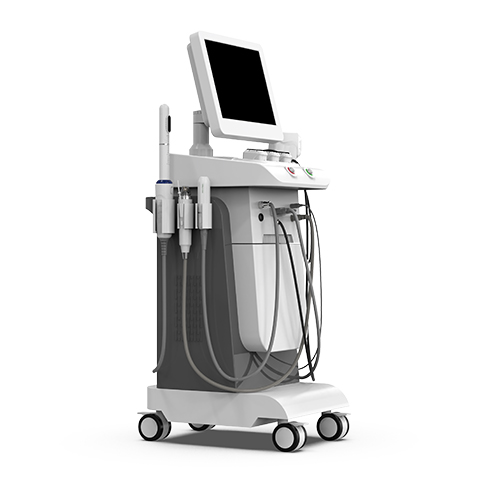
HU700 7D HIFU — 4-in-1 Anti-Aging & Body Sculpting Station
- Technology: 4 treatment modes — HIFU with 7 transducer cartridges: 1.5mm, 3.0mm, 4.5mm (facial SMAS lifting) + 6.0mm, 9.0mm, 13.0mm, 16.0mm (body contouring & fat reduction)
- 7D advantage: 4-in-1 platform covering face lifting, body sculpting, skin tightening, and vaginal tightening — eliminates the need for separate HIFU machines per application
- Cartridge capacity: 25,000 shots per cartridge; factory RFID-tagged for authenticity and shot counting
- Frequency: 4MHz (facial) / 2MHz (body) — optimized for each treatment depth
- Best for: Clinics offering premium non-surgical facelift + body contouring combo; medical spas targeting the 35–55 anti-aging demographic
- Certification: FDA, CE, ISO 13485
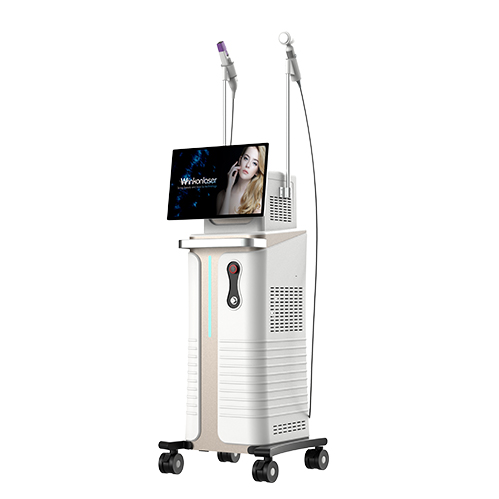
TM80 — Precision Dual-Frequency Gold RF Microneedling System
- Technology: Dual-frequency RF — 2.2MHz (insulated, fractional deep coagulation) + 700KHz (non-insulated, conductive surface heating)
- Depth range: 0.2–7.0mm motorized adjustment with ±0.1mm precision — covers everything from superficial periorbital treatment to deep scar revision
- Needle array: 25 gold-plated insulated microneedles; RFID-authenticated single-use sterile cartridges
- Intelligent vacuum sensing: Auto-detects tissue resistance and adjusts RF output in real time — prevents over-treatment on thin skin (periorbital) and under-treatment on thick skin (cheeks, back)
- 13 medical-grade cartridges: Multiple needle configurations for different indications (scar, wrinkle, skin texture, stretch mark)
- Best for: Dermatology clinics and medical spas focused on scar revision, skin texture improvement, and anti-aging with repeat-visit revenue model
- Certification: FDA, CE, ISO 13485
6. Final Verdict: HIFU, RF Microneedling, or Both?
Decision Matrix by Clinic Profile
| Your Clinic Profile | Best Technology | Recommended Machine | Rationale |
|---|---|---|---|
| Medical spa, anti-aging focus, 35–55 demographic | HIFU | HU700 7D HIFU | "Lunchtime facelift" marketing drives premium pricing ($1,500–2,500/session); zero downtime = high patient acceptance; single-session model simplifies scheduling |
| Dermatology clinic, scar revision expertise | RF Microneedling | TM80 RF Microneedling | Gold standard for acne scar treatment; repeat-visit model (3–4 sessions) builds patient loyalty and cumulative revenue; medical-grade procedure positioning |
| Full-service clinic — want both lifting + texture | Both | HU700 + TM80 | Complementary indications — HIFU handles lifting/laxity (outside→in), RFMN handles scars/texture/wrinkles (inside→out). Combined, they cover 90%+ of non-surgical facial rejuvenation demand. Total investment: ~$15,000–25,000 for both platforms |
| Startup clinic with limited capital | RF Microneedling | TM80 | Broader indication range (scars + wrinkles + texture + stretch marks) = larger potential patient base. Repeat-visit model generates predictable recurring revenue. Consumable cost is manageable at $20–60/patient |
| Body contouring clinic adding facial services | HIFU | HU700 7D HIFU | HU700 covers both body (6–13mm fat reduction) and face (1.5–4.5mm lifting) in one platform — ideal for body-focused clinics expanding into facial anti-aging without buying two separate machines |
| Asian market clinic (Fitzpatrick III–V, high PIH risk) | HIFU Primary | HU700 | HIFU has near-zero PIH risk (no epidermal injury). RF Microneedling can be used cautiously with insulated needles, but PIH risk is real (3–8% in Fitzpatrick IV–V). Start with HIFU, add RFMN once experienced |
7. Frequently Asked Questions
It depends on the type of tightening needed. For structural lifting — jowls, jawline definition, brow position — HIFU is superior because it reaches the SMAS layer (4.5mm depth), the same plane tightened during surgical facelifts. For dermal tightening — fine lines, pore size, skin texture, mild laxity — RF Microneedling is comparable or better due to the combined mechanical + thermal stimulation at the dermal level (0.5–3.0mm). In practice, many clinics offer both: HIFU for the "framework" (SMAS lifting) and RF Microneedling for the "surface" (dermal quality). This combination approach is the closest non-surgical equivalent to a facelift + laser resurfacing.
HIFU: 1 session is a complete treatment for most patients. Results appear at 2–3 months and peak at 3–6 months. A maintenance session at 12–18 months is optional. RF Microneedling: 3–4 sessions, spaced exactly 4 weeks apart, are required for optimal results. Each session adds cumulative collagen deposition. Maintenance is typically 1 session every 6–12 months. The total treatment journey: HIFU = 1 visit, results at 3 months; RF Microneedling = 4 visits over 12 weeks, results at 4–6 months.
Yes — with a caveat about treatment order and intervals. The recommended protocol: perform HIFU first (clean skin, ultrasound gel, no epidermal disruption), then wait 2–4 weeks before performing RF Microneedling (to allow the HIFU-induced inflammatory cascade to initiate without interference). Same-day combination is not recommended because: (1) HIFU requires intact epidermis for ultrasound transmission; (2) the combined inflammatory burden may exceed the skin's healing capacity; (3) it's difficult to isolate which technology contributed what to the result (and to manage complications). Staggered combination (HIFU → 4 weeks → RFMN session 1 → 4 weeks → RFMN session 2 → 4 weeks → RFMN session 3) is the evidence-based protocol.
HIFU: Zero social downtime. Mild erythema and edema resolve within 2–24 hours. Patients can return to work, apply makeup, and resume normal activities immediately. This is why it's marketed as a "lunchtime facelift." RF Microneedling: 1–2 days of social downtime. Patients experience pinpoint bleeding immediately post-treatment (resolves within minutes), followed by moderate erythema and micro-crusts for 24–48 hours. Makeup is contraindicated for the first 24 hours. Sunscreen is mandatory for 2 weeks post-treatment to prevent PIH. For patients who cannot tolerate ANY visible recovery period, HIFU is the better choice.
Both technologies generate strong ROI, but through different revenue models. HIFU ROI: Higher per-session revenue ($1,500–2,500) × fewer sessions per patient (1–2) = high revenue per patient encounter but less frequent visits. Machine cost recovery in ~5–9 months at 3–5 patients/week. RF Microneedling ROI: Lower per-session revenue ($400–1,200) × more sessions per patient (3–4) = cumulative revenue comparable to HIFU ($1,200–4,800 per patient course). The repeat-visit model creates predictable scheduling and builds longer patient relationships. Machine cost recovery in ~6–10 months. The combined model wins: HIFU attracts premium single-session patients; RF Microneedling fills the schedule with recurring visits. Revenue per square foot of treatment room is maximized when both technologies are available.