Tattoo Removal Machine Buying Guide: Picosecond or Nd:YAG? (2026)
A tattoo removal laser is a $4,000–$25,000 investment. The right machine clears tattoos in 3–5 sessions and generates $200–$1,000 per session. The wrong machine takes 10+ sessions for the same result — or can't treat certain ink colors at all. The core decision: picosecond (photoacoustic shattering, 350ps pulses, 3 wavelengths, all ink colors) or Nd:YAG Q-switched (photothermal vaporization, nanosecond pulses, 2 wavelengths, black/red ink only).
1. Decision Tree: Picosecond or Nd:YAG?
2. 10-Point Specification Checklist
| # | Spec | Picosecond | Nd:YAG Q-Switched | Why It Matters |
|---|---|---|---|---|
| 1 | Pulse duration | 300–500ps (350ps EL950) | 5–20ns | 1,000× shorter pulse = photoacoustic shattering, not thermal vaporization. Determines ink particle size after treatment. |
| 2 | Wavelengths | 532nm + 755nm + 1064nm minimum | 532nm + 1064nm | 755nm is mandatory for green, blue, purple inks. Without it, these colors will never clear. |
| 3 | Peak energy | 1064nm: 100–1,200mJ; multi-pulse up to 3,000mJ (EL950) | 1064nm: up to 1,000mJ; 532nm: up to 400mJ | Energy determines penetration depth for dense professional ink. Multi-pulse mode stacks energy for deep, stubborn tattoos. |
| 4 | Work modes | Standard + Long + Multi + Dual Pulse minimum | Standard Q-switched | Different ink types and skin tones require different pulse modes. 4 modes = treatment customization for every patient. |
| 5 | Spot size | 2–10mm adjustable | 2–8mm adjustable | Small spots = dense professional ink, precision. Large spots = amateur ink, faster coverage. |
| 6 | Frequency | 1–10Hz | 1–10Hz | Higher frequency = faster treatment of large tattoos. |
| 7 | Fractionated handpiece | Available (skin rejuvenation add-on) | N/A | Pico with fractionated handpiece = skin rejuvenation revenue ($200–500/session) between tattoo patients. |
| 8 | Aiming beam | Adjustable intensity red diode | Adjustable red diode | Visible aiming beam ensures precise spot placement. Weak or misaligned aiming beam = overlapping spots = double-treatment burns. |
| 9 | Cooling | Integrated skin cooling (air or contact) | Integrated air cooling | Epidermal cooling between pulses reduces pain and thermal injury. Essential for patient comfort during multi-pass treatments. |
| 10 | FDA / CE | FDA 510(k) Class II; CE MDR. Verify independently. | Tattoo removal lasers are Class II/IIb medical devices. "Aesthetic use only" classification = cannot legally claim tattoo removal. | |
3. Price Tiers
- 532nm + 1064nm dual-wavelength
- 5–20ns Q-switched
- 5–10 sessions for black ink clearance
- Best for: black/red amateur tattoos
ROI: 4–8 months
- 532nm + 1064nm picosecond
- 350–500ps, 2–8mm spot
- 3–5 sessions for black ink
- Best for: portable pico, budget pico
ROI: 6–10 months
- 532+755+1064nm picosecond
- 350ps, 4 work modes, 10mm spot
- Multi-pulse up to 3,000mJ
- Best for: all ink colors, PMU, skin rejuvenation
ROI: 8–14 months
4. 7 Procurement Traps
Nanosecond Sold as "Picosecond"
The most common tattoo laser fraud. A Q-switched Nd:YAG with a "pico mode" button that delivers the same nanosecond pulse — the button just changes the display, not the actual pulse duration. Verification: demand an oscilloscope screenshot of the actual pulse waveform, with time scale in picoseconds. If the manufacturer cannot produce this, it's not a picosecond laser.
Missing 755nm Wavelength
Picosecond machines sold with only 532nm + 1064nm — missing the 755nm alexandrite wavelength. This is a "2-wavelength pico" that cannot treat green, blue, or purple ink. A true full-spectrum picosecond laser has 3 wavelengths: 532nm + 755nm + 1064nm.
Ink Darkening with Nd:YAG on PMU
Cosmetic tattoo pigments (microblading, lip blush) often contain iron oxides and titanium dioxide. Nd:YAG's 1064nm pulse can cause an exothermic reduction reaction that turns these pigments black — permanently. This is irreversible without further laser treatment. If you treat PMU, you need picosecond with 755nm.
Fake Energy Ratings
"1,500mJ" advertised — but measured at the laser cavity, not the handpiece aperture. After optical losses through the articulated arm, actual delivered energy may be 40% lower. Ask: "What is the energy at the handpiece tip, measured by an external energy meter?"
Articulated Arm Misalignment
Pico and Nd:YAG lasers use an articulated arm (mirrors in joints) to deliver the beam. After shipping, arm misalignment causes 30–50% energy loss. Before accepting delivery: have the technician align the arm and demonstrate energy output at each spot size with an external meter.
Counterfeit Handpieces
Fractionated handpieces (holographic lens arrays) are precision optical components. Third-party clones produce uneven spot arrays — some spots get 100% energy, others get 40%. Result: checkerboard pattern of over-treated and under-treated skin. Buy handpieces only from the OEM.
No PMU Training
Cosmetic tattoo removal requires different protocols than body tattoo removal — lower energy, smaller spots, and knowledge of pigment chemistry (iron oxides, titanium dioxide, organic vs inorganic). If you plan to offer PMU removal, demand PMU-specific training from the manufacturer. Generic "tattoo removal training" does not cover this.
5. Winkonlaser Product Recommendations
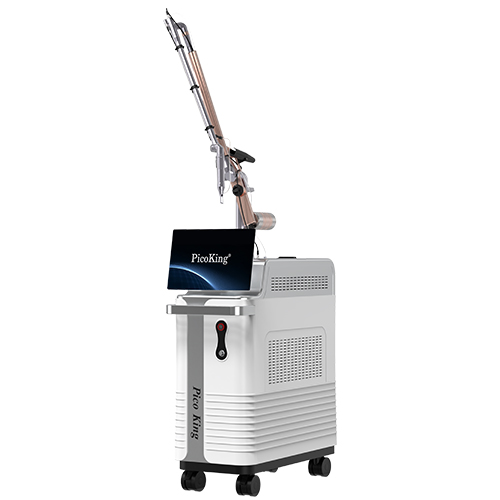
EL950 — Professional-Grade Picosecond Laser
- 350ps pulse, 3 wavelengths: 532nm + 755nm + 1064nm — all ink colors
- Energy: 1064nm: 100–1,200mJ; 532nm: 50–600mJ; multi-pulse: 100–3,000mJ
- 4 work modes: Standard, Long, Multi, Dual Pulse
- Spot size: 2–10mm; frequency: 1–10Hz
- FDA, CE, ISO 13485
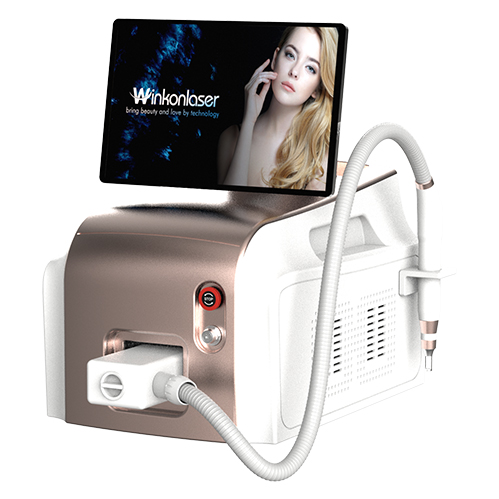
EL400 — Q-Switched Nd:YAG Laser
- 532nm + 1064nm dual-wavelength — black, dark blue, red, orange
- Up to 1,000mJ at 1064nm
- 2–8mm spot, 1–10Hz
- FDA, CE, ISO 13485
- Best for: Black/red amateur tattoos, budget-constrained clinics
Picosecond vs Nd:YAG — Complete Technology Comparison →
6. FAQ
The only definitive test: request an oscilloscope trace of the laser pulse, with the time base set to nanoseconds or picoseconds. A true picosecond laser shows a pulse width of 300–900ps. A nanosecond laser shows 5–20ns. If the manufacturer cannot produce this measurement, walk away. Other red flags: "pico mode" as a software setting (pulse duration is hardware, not software); picosecond machines priced below $6,000 (genuine pico laser cavities cost more than that to manufacture).
Professional black ink: 3–5 sessions (pico) or 5–10 (Nd:YAG). Multi-color professional: 5–8 (pico) or 8–15 (Nd:YAG, green/blue may never fully clear). Amateur black: 2–4 (pico) or 4–7 (Nd:YAG). Always quote a range, never a guarantee. Manage expectations: "Most patients need X–Y sessions, but every tattoo responds differently based on ink depth, density, and composition."
Yes — picosecond lasers with a fractionated handpiece (holographic lens array) deliver Laser-Induced Optical Breakdown for skin rejuvenation, melasma, and acne scars. This is a significant secondary revenue stream. Nd:YAG has limited skin rejuvenation capability beyond basic 1064nm toning. Pico skin rejuvenation commands $200–500/session.
Tattoo removal lasers have lower consumable costs than most aesthetic devices. No disposable tips, gels, or cartridges per patient. Main costs: (1) Annual articulated arm calibration ($200–500). (2) Flashlamp replacement every 2–5 years ($500–1,500). (3) Fractionated handpiece replacement if lost/damaged ($1,000–3,000). Budget $1,000–2,000/year total for a moderately busy clinic.
Portable pico/Nd:YAG lasers (under 15kg) serve a specific niche: mobile tattoo removal services, multi-location clinics sharing one device, or clinics with very limited treatment room space. Trade-offs: lower peak power (portable power supplies are smaller), smaller spot sizes, and usually fewer wavelengths. For a fixed-location clinic doing 5+ tattoo patients per day, a cart-based system with a full articulated arm is the better investment.