CO2 Fractional Laser Buying Guide: How to Choose a Skin Resurfacing Device (2026)
A CO2 fractional laser is the most powerful skin resurfacing tool in aesthetic medicine. One session can deliver 53–69% improvement in acne scars and deep wrinkles — results that no non-ablative technology can match. But that power comes with responsibility: 5–10 days of patient downtime, a significant wound-care protocol, and a machine whose core component — the laser tube — determines whether you get 1–2 years or 3–5 years of consistent performance. The single most important decision in buying a CO2 laser is RF tube vs DC glass tube.
1. Decision Tree: Which CO2 Laser for Your Clinic?
2. 10-Point Specification Checklist
| # | Spec | What to Look For | Why It Matters |
|---|---|---|---|
| 1 | Laser tube type | RF-excited metal-ceramic (USA/German) OR DC glass (Chinese) | This one component determines 80% of your machine's long-term reliability and treatment consistency. See Trap #1. |
| 2 | Power output | 70–100W for professional use; 30–50W for entry-level; verify at handpiece | Higher power = ability to do aggressive single-pass treatment = fewer sessions. FC300 offers 70W/100W options. Power at the tube is not the same as power at the tissue. |
| 3 | Operation modes | Fractional + CW + Super Pulse minimum for a 3-in-1 platform | Fractional = resurfacing. CW = lesion excision (warts, skin tags). Super Pulse = high peak power, low thermal spread — safer for deep scar treatment. |
| 4 | Fractional density | Adjustable 5–40% coverage; independent spot pitch and scan shape control | Higher density = more aggressive treatment, more downtime, better results. Must be adjustable per anatomical area: 5–10% for periorbital, 20–30% for cheeks, 30–40% for body scars. |
| 5 | Scan pattern options | Square, rectangular, circular, and linear scan shapes | Different body areas need different scan geometries. Linear for surgical scars. Square for full-face. Circular for spot treatment of individual icepick scars. |
| 6 | Pulse duration / dwell time | 0.1–10ms adjustable; shorter = less thermal spread | Longer dwell time = more coagulation = more hemostasis but wider thermal damage zone. Shorter = cleaner ablation, faster healing. Adjustable = tailor to patient skin type. |
| 7 | Spot size / pitch | 0.1–1.5mm spot pitch (distance between MTZs) | Tighter pitch = more MTZs per cm² = more collagen stimulation. But too tight = confluent thermal damage = delayed healing. Adjustable pitch is essential. |
| 8 | Articulated arm | 7-joint balanced arm with <5% transmission loss per mirror | CO2 laser beams are delivered through an articulated arm. Cheap arms lose 20–30% of power at the handpiece. A quality arm with <15% total loss ensures therapeutic energy reaches the patient. |
| 9 | Smoke evacuation | Integrated smoke evacuator with HEPA/charcoal filter | CO2 ablation produces laser plume containing viable viral particles and cellular debris. Integrated smoke evacuation is an OSHA/CDC requirement, not an optional accessory. |
| 10 | FDA / CE certification | FDA 510(k) Class II; CE MDR with NB number | CO2 lasers are Class II/IIb medical devices. Verify independently. A CO2 laser without proper certification is a legal liability — ablative devices are not "cosmetic only." |
3. Price Tiers & ROI
- 30–50W DC glass tube
- Fractional mode only
- 1–2 year tube life, $300 replacement
- Basic scan patterns
- Best for: low-volume, budget-constrained
ROI: 3–6 months
But: tube replacement costs at month 12–18
- 40–70W RF metal-ceramic tube
- Fractional + CW modes
- 3–5 year tube life, stable output
- Adjustable density + scan patterns
- Best for: established clinics, reliable ROI
ROI: 4–8 months
- 70–100W USA RF tube
- Fractional + CW + Super Pulse
- 3–5 year tube, 7-joint articulated arm
- Full scan pattern library + smoke evac
- Best for: high-volume, premium positioning
ROI: 5–8 months
4. Certification & Downtime Management
CO2 fractional is an ablative procedure. Your clinic must be prepared for: (1) Medical-grade wound care supplies (occlusive ointment, non-stick dressings). (2) Staff training on post-ablative wound management and infection recognition. (3) Patient education materials showing the 5–10 day healing timeline with daily photos — set expectations before treatment, not after. (4) Fitzpatrick screening protocol — CO2 is contraindicated on Fitzpatrick V–VI and high-risk on IV. (5) Informed consent documenting PIH risk, scarring risk, and infection risk.
| Market | Required | Verify |
|---|---|---|
| US | FDA 510(k) Class II | FDA PMN Database with K-number |
| EU | CE MDR 2017/745 + NB number | EU NANDO database |
| International | ISO 13485 + IEC 60601-1 + IEC 60825-1 (laser safety) | Issuer database cross-check |
5. 7 Procurement Traps
DC Glass Tube Sold as "RF Tube"
This is the #1 CO2 laser fraud. The machine label says "RF tube" but the actual tube inside is a DC glass tube — worth $100–300 instead of $600–1,200. Verification methods: (1) Ask for a photo of the actual tube label inside the machine showing manufacturer and excitation type. RF tube manufacturers (Coherent, Synrad, Universal) label every tube. (2) RF tubes are metal-ceramic (gray/silver metallic); DC tubes are glass (transparent with visible electrodes). (3) RF tubes weigh 2–3× more than equivalent DC tubes. If the price seems too good for an RF tube machine — it's probably a DC tube.
"50W" Measured at the Tube, Not the Handpiece
Laser power is measured at the tube output. After passing through mirrors, articulated arm joints, and the scanner, actual power at the tissue surface is 30–70% lower. A "50W" machine may deliver only 20W to the patient. Ask: "What is the output power at the handpiece aperture, measured with an external power meter?" A 40W handpiece measurement from a nominally "70W" machine is acceptable (57% transmission). A 15W measurement from a "50W" machine is not.
No Smoke Evacuator — "Optional Accessory"
Manufacturers selling the smoke evacuator as a "$300 optional extra" are creating a hidden cost — and a safety hazard. Without smoke evacuation, the operator inhales laser plume. For the patient, plume obscures the treatment field, forcing the operator to pause and wait for it to clear. Integrated smoke evacuation is mandatory.
Fractional Handpiece with Fixed Density
A scanner that only does 20% density at one spot pitch. You can't reduce density for thin periorbital skin — you'll over-treat. You can't increase density for thick back skin — you'll under-treat. Adjustable density (5–40%) and pitch are non-negotiable.
Misaligned Articulated Arm After Shipping
CO2 laser arms have 7 mirrors that must be perfectly aligned. After international shipping, vibration often knocks 1–2 mirrors out of alignment. The laser fires, but 30–50% of energy is lost inside the arm. Before accepting delivery: have the installation technician measure and document power output at the handpiece for all spot sizes.
No Post-Ablative Training
CO2 fractional requires different aftercare than any non-ablative procedure. Patients need explicit wound-care instructions, a 7-day supply of occlusive ointment, and emergency contact information. If the manufacturer provides only "machine operation training" without post-ablative wound management protocols, you're on your own for the most complication-prone part of the treatment.
Treating Fitzpatrick IV–VI Without Understanding the PIH Risk
CO2 fractional on Fitzpatrick IV has an 18–40% PIH rate. On Fitzpatrick V–VI, it is contraindicated. Some manufacturers market CO2 as "safe for all skin types" — this is categorically false. The physics is unambiguous: melanin-rich skin reacts to ablative injury with hyperpigmentation. If your patient base includes Fitzpatrick IV–VI, either limit CO2 to Fitzpatrick I–III, or invest in RF Microneedling for your darker-skinned patients.
6. Winkonlaser Product Recommendation
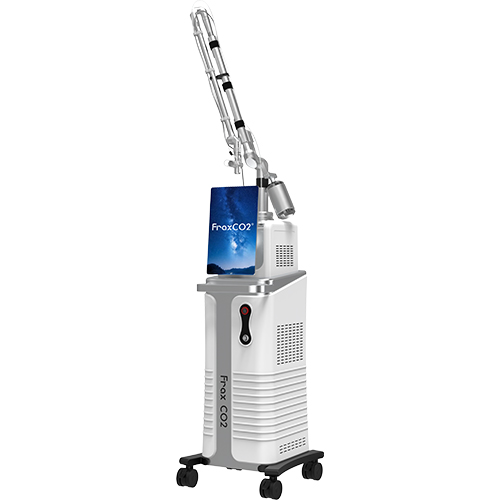
FC300 — Professional 3-in-1 Fractional CO2 Laser with USA RF Tube
- USA RF-excited metal-ceramic tube — 3–5 year lifespan, stable output, cleaner MTZs
- 70W / 100W power options — sufficient for aggressive single-pass deep scar treatment
- 3 modes: Fractional (resurfacing) + CW (lesion excision) + Super Pulse (high peak, low spread)
- Adjustable density 5–40% + multiple scan patterns (square, circle, line)
- FDA, CE, ISO 13485
- Best for: Dermatology clinics, medical aesthetic centers, scar revision specialists
CO2 Fractional vs RF Microneedling — Complete Technology Comparison (downtime, scar improvement rates, Fitzpatrick safety) →
7. FAQ
Yes — if you plan to use the laser for more than 2 years. DC tube machine: $4,000 purchase + $300 tube replacement at month 14 + $300 replacement at month 28 + 2 weeks downtime each replacement = $4,600+ and 4 weeks of lost revenue over 3 years. RF tube machine: $8,000 purchase + zero replacements over 3 years (tube rated 3–5 years) = $8,000 and zero downtime. The RF tube machine costs $3,400 more upfront but saves $600+ in replacement costs and 4 weeks of clinic downtime. At $1,500/session and 4 sessions/week, 4 weeks of downtime costs you $24,000 in lost revenue — making the RF tube the overwhelmingly better financial choice.
1 session for significant improvement (53–69% scar reduction). This is CO2's key advantage over non-ablative technologies — one well-executed treatment produces dramatic results. A second session (3–6 months later) adds 10–20% additional improvement. For deep acne scars: 1–2 sessions. For perioral wrinkles: 1 session. For full-face rejuvenation: 1 session annually. Patient counseling: "One treatment will give you significant improvement. A second treatment 6 months later can refine the result. Most patients are satisfied after one."
Minimum: (1) Manufacturer device training (1–2 days). (2) Post-ablative wound care protocol training. (3) Fitzpatrick assessment and patient selection training. (4) Infection recognition and management. (5) Laser safety officer certification (required by law in most jurisdictions for Class II/IV lasers). (6) 5–10 supervised treatments before independent operation. CO2 is not a "learn on YouTube" device. The gap between a well-trained operator and an under-trained one is the gap between dramatic before/after photos and a complication that damages your clinic's reputation.
Yes — CO2 is often combined with PRP (platelet-rich plasma) applied immediately post-laser to accelerate healing, or with growth factor serums during the recovery phase. Do NOT combine CO2 with other ablative or thermal procedures in the same session. If combining with injectables (fillers, Botox), do injectables first, wait 2 weeks, then do CO2 — not the reverse. Combining CO2 with RF Microneedling: do RFMN first (3–4 sessions), then CO2 4–6 weeks after the last RFMN session for the final resurfacing result.
US market benchmarks (2026): Full face CO2 fractional: $1,500–$2,500. Face + neck: $2,000–$3,500. Perioral only: $600–$1,000. Periorbital only: $500–$800. Full face + PRP add-on: +$400–600. Acne scar package (2 sessions): $2,500–$4,000. Pricing strategy: position CO2 as your premium resurfacing procedure. It should be priced above RF Microneedling ($400–800) and chemical peels ($200–500). The higher price is justified by the dramatic single-session results and the medical-grade nature of the procedure.