Picosecond vs Nd:YAG Q-Switched Laser: Which Tattoo Removal Technology Should Your Clinic Invest In? (2026)
Tattoo RemovalThe transition from nanosecond Q-switched Nd:YAG to picosecond laser represents the single largest technological leap in tattoo removal in the past 20 years. The difference comes down to pulse duration — and a 1,000× shorter pulse changes how ink is destroyed, not just how fast. Picosecond lasers shatter ink via photoacoustic (mechanical) stress; nanosecond lasers rely on photothermal (heat) destruction. This distinction affects every clinical outcome: number of sessions, pain, scarring risk, and which ink colors can be effectively treated.
This comparison analyzes both technologies across 12 dimensions, including pulse physics, ink color efficacy, clinical session counts, safety profiles, and Winkonlaser product specifications.
| Dimension | Picosecond Laser | Nd:YAG Q-Switched Laser |
|---|---|---|
| Pulse Duration | 300–900 picoseconds (ps = 10⁻¹² seconds) | 5–20 nanoseconds (ns = 10⁻⁹ seconds) |
| Speed Comparison | ~1,000× shorter pulse than Nd:YAG | 1,000× longer pulse than picosecond |
| Primary Mechanism | Photoacoustic (mechanical) — laser-induced stress waves shatter ink particles into sub-micron fragments | Photothermal (heat) — rapid heating vaporizes ink particles; surrounding thermal damage contributes to clearance |
| Wavelengths | 532nm, 755nm, 1064nm (triple-wavelength common); 785nm (some models) | 532nm (KTP frequency-doubled) + 1064nm (fundamental) |
| Ink Particle Size After Treatment | Sub-micron fragments — small enough for rapid lymphatic clearance; less ink residual | Micron-sized fragments — slower macrophage clearance; more residual ink per session |
| Sessions Required | 3–5 sessions for >90% clearance (professional black ink); 5–8 for multi-color | 5–10 sessions for >90% clearance (professional black ink); 8–15 for multi-color |
| Ink Colors Treatable | Black, dark blue, red, yellow, green, purple, orange — 755nm specifically targets green/blue ink | Black, dark blue (1064nm); red, orange, yellow (532nm). Green ink — poor response |
| Pain Level | Low–moderate — shorter pulse = less heat = less pain; fewer sessions tolerated better | Moderate–high — longer pulse = more heat buildup = more discomfort; cumulative over more sessions |
| Thermal Damage Risk | Minimal — photoacoustic effect is mechanically selective to ink; surrounding dermis largely preserved | Moderate — photothermal effect heats surrounding tissue; higher risk of hypopigmentation, fibrosis with repeated treatments |
| Downtime | 3–7 days (erythema, mild crusting); lower PIH risk | 5–10 days (erythema, crusting, possible blistering); higher PIH risk especially on darker skin |
| Machine Price Range | $10,000–$25,000 (triple-wavelength); $6,000–$12,000 (single-wavelength portable) | $4,000–$10,000 (dual-wavelength 532nm+1064nm); $2,000–$5,000 (portable) |
| Per-Session Revenue | $200–$500 (small tattoo); $400–$1,000 (large/multi-color) | $100–$300 (small); $200–$600 (large) |
| ROI Timeline | 8–14 months — higher machine cost offset by premium pricing, faster results attracting more patients | 4–8 months — lower upfront cost; volume-based revenue model requiring more patients/month to match pico profitability |
1. The Physics: Why Pulse Duration Changes Everything
Picosecond — Shattering Ink with Sound Waves
A picosecond laser delivers energy in pulses lasting 300–900 trillionths of a second. At this timescale, the dominant effect is not heat — it's photoacoustic stress. The ultra-short pulse generates a shockwave that mechanically fractures ink particles into sub-micron fragments. Because the pulse is shorter than the thermal relaxation time of the ink particle (the time it takes heat to dissipate from the particle to surrounding tissue), very little heat leaks into the surrounding dermis.
- Particle fragmentation: The shockwave shatters ink into fragments 10–100× smaller than those produced by nanosecond pulses. Smaller fragments = faster lymphatic clearance = fewer sessions.
- Thermal confinement: The pulse is so short that heat doesn't have time to diffuse beyond the ink particle. Result: ink is destroyed with virtually no thermal damage to surrounding collagen and fibroblasts. This is why picosecond treatments have lower scarring risk and faster healing.
- 755nm advantage: Picosecond platforms add a 755nm (alexandrite) wavelength specifically for green and blue inks — colors that 1064nm and 532nm Nd:YAG cannot effectively target. This makes picosecond the only technology capable of treating all tattoo ink colors.
Nd:YAG Q-Switched — Heating Ink to Vaporization
A Q-switched Nd:YAG laser delivers pulses in the 5–20 nanosecond range — still very short by most standards, but 1,000× longer than picosecond. At this pulse duration, the ink particle has time to absorb energy and convert it to heat, which vaporizes the particle and causes some thermal damage to the surrounding dermal matrix.
- Photothermal mechanism: The ink particle is heated to thousands of degrees in nanoseconds, causing micro-explosions within the dermis. This vaporizes ink but also denatures some surrounding collagen — which is why multiple Nd:YAG sessions can lead to textural changes and hypopigmentation.
- Established technology: Nd:YAG has been the tattoo removal standard since the 1990s. Tens of thousands of machines are in clinical use worldwide. Treatment protocols are well-established and most practitioners are trained on this platform.
- 532nm + 1064nm dual-wavelength: 1064nm targets black and dark blue ink with deep penetration (4–6mm). 532nm (achieved by passing 1064nm through a KTP crystal) targets red, orange, and yellow pigments. Green ink is poorly absorbed at both wavelengths — a significant limitation.
2. Ink Color Efficacy: Which Laser Treats Which Colors
| Tattoo Ink Color | Picosecond (532/755/1064nm) | Nd:YAG Q-Switched (532/1064nm) | Best Choice |
|---|---|---|---|
| Black | ★★★ Excellent (1064nm) | ★★★ Excellent (1064nm) | Either — both clear black ink effectively; pico clears faster (3–5 vs 5–8 sessions) |
| Dark Blue | ★★★ Excellent (1064nm + 755nm) | ★★ Good (1064nm) | Picosecond — 755nm adds blue absorption peak |
| Red | ★★★ Excellent (532nm) | ★★★ Excellent (532nm) | Either — both handle red well at 532nm |
| Green | ★★★ Excellent (755nm) | ★ Poor | Picosecond only — 755nm is required for green ink absorption |
| Yellow | ★★ Good (532nm) | ★★ Good (532nm) | Either — yellow is inherently difficult; results are modest for both technologies |
| Purple | ★★★ Excellent (755nm + 1064nm) | ★ Poor | Picosecond only — purple requires 755nm for the blue component |
| Orange | ★★★ Excellent (532nm) | ★★★ Excellent (532nm) | Either |
| White / Flesh-Tone | ★★ Moderate | ✕ Contraindicated | Picosecond only — Nd:YAG can darken white/flesh-tone inks irreversibly |
3. Clinical Session Comparison
| Clinical Parameter | Picosecond | Nd:YAG Q-Switched |
|---|---|---|
| Session interval | 4–8 weeks | 6–8 weeks |
| Black professional tattoo to >90% clearance | 3–5 sessions | 5–10 sessions |
| Amateur black tattoo to >90% clearance | 2–4 sessions | 4–7 sessions |
| Multi-color tattoo to >75% clearance | 5–8 sessions | 8–15 sessions (green/purple may never fully clear) |
| Treatment time (palm-sized tattoo) | 3–5 minutes | 5–10 minutes |
| Immediate post-treatment appearance | Erythema + mild frosting (resolves in 20–30 min) | Erythema + frosting + pinpoint bleeding (resolves in 30–60 min) |
| Post-treatment care | Avoid sun, keep moisturized, no picking; normal activity next day | Avoid sun, antibiotic ointment, keep covered 24h; activity restriction 2–3 days |
4. Winkonlaser Products for Each Technology
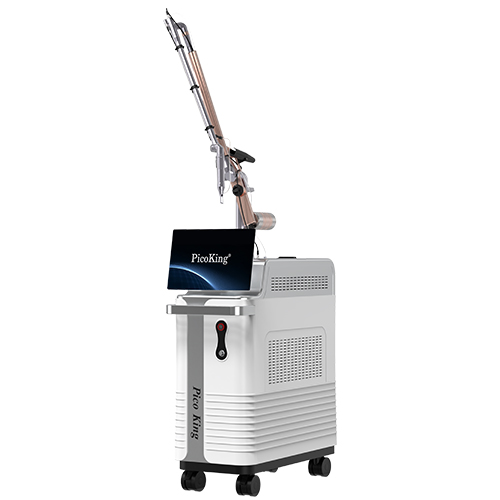
EL950 — Professional-Grade Picosecond Laser Tattoo Removal Machine
- Technology: Triple-wavelength picosecond laser — 532nm, 755nm, 1064nm — covers the full tattoo color spectrum including green, blue, and purple
- Pulse duration: 350 picoseconds — optimal for photoacoustic fragmentation without thermal collateral damage
- Energy: 1064nm: 100–1,200mJ; 532nm: 50–600mJ; 1064nm multi-pulse: 100–3,000mJ — covers the full range from superficial cosmetic tattoos to deep professional ink
- Spot size: 2–10mm adjustable; smaller spots for dense professional ink, larger spots for faster coverage
- Work modes: 4 modes — Standard Pulse, Long Pulse, Multi Pulse, Dual Pulse — selectable for different ink types, depths, and skin tones
- Frequency: 1–10Hz — rapid pulse rate for efficient large-area treatment
- Best for: Clinics building a premium tattoo removal practice; treating multi-colored and professional tattoos; expanding into pigmentation and skin rejuvenation
- Certification: FDA, CE, ISO 13485
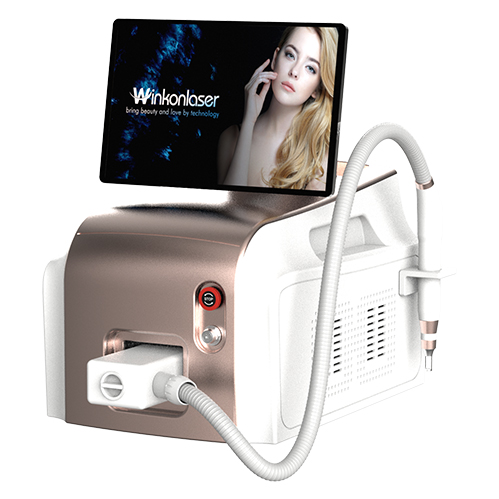
EL400 — Q-Switched Nd:YAG Laser Tattoo Removal Machine
- Technology: Q-switched Nd:YAG with KTP frequency doubling — 1064nm + 532nm dual-wavelength
- Pulse duration: Nanosecond Q-switched — proven photothermal mechanism for black and red/orange ink
- Energy: Up to 1000mJ at 1064nm, 400mJ at 532nm — high energy for deep, dense professional ink
- Spot size: 2–8mm variable — precision targeting of individual tattoo elements
- Frequency: 1–10Hz — rapid pulse rate for efficient treatment
- Best for: Clinics entering tattoo removal at an accessible price point; predominantly black-ink amateur tattoo clientele; as a second-room device alongside a picosecond platform
- Certification: FDA, CE, ISO 13485
5. Final Verdict: Picosecond, Nd:YAG, or Both?
Decision Matrix by Clinic Profile
| Your Clinic Profile | Best Technology | Recommended Machine | Rationale |
|---|---|---|---|
| Dedicated tattoo removal clinic, premium positioning | Picosecond | EL950 Picosecond | Triple-wavelength treats all ink colors; "pico" is the consumer-recognized premium technology; fewer sessions = higher patient satisfaction and referral rate; 755nm is essential for the growing cosmetic tattoo removal market (microblading, permanent makeup) |
| Startup clinic, limited capital, black-ink focus | Nd:YAG Q-Switched | EL400 Nd:YAG | Lower machine cost; clinically adequate for 80%+ of tattoo removal patients (black/red inks only); proven reliability; good entry point to build a patient base before upgrading to picosecond |
| Full-service dermatology / laser clinic | Both | EL950 + EL400 | Pico for multi-color, cosmetic tattoos, and premium-paying patients; Nd:YAG for straightforward black-ink cases at a lower cost structure. Both platforms combined cover 100% of tattoo removal demand + pigmentation + skin rejuvenation |
| Cosmetic tattoo / PMU removal specialist | Picosecond Only | EL950 | PMU inks (microblading, lip blush, eyeliner) often contain iron oxides and titanium dioxide that can darken irreversibly with Nd:YAG. Picosecond's photoacoustic mechanism is safer for these pigments. 755nm treats flesh-tone inks that Nd:YAG cannot address |
| High-volume chain, price-competitive | Nd:YAG Primary | EL400 | Lower cost per treatment room; deploy multiple units across locations; refer multi-color cases to a central picosecond-equipped hub; volume-based model works with Nd:YAG's per-session pricing |
6. Frequently Asked Questions
Yes — with an important nuance. Picosecond is objectively superior in three ways: (1) Fewer sessions — 3–5 vs 5–10 for the same endpoint because picosecond shatters ink into smaller, more easily cleared particles. (2) More colors — the 755nm wavelength treats green, blue, and purple inks that 1064nm/532nm Nd:YAG cannot effectively target. (3) Less thermal damage — the photoacoustic mechanism preserves surrounding dermis better than photothermal Nd:YAG, resulting in faster healing and lower scarring risk. However, Nd:YAG remains a clinically effective and cost-efficient choice for black-ink-only amateur tattoos. For multi-colored professional tattoos, cosmetic tattoos (PMU/microblading), or patients who want the fewest possible sessions, picosecond is the clear winner.
For a professional black-ink tattoo to >90% clearance: picosecond = 3–5 sessions; Nd:YAG = 5–10 sessions. For an amateur black-ink tattoo: picosecond = 2–4 sessions; Nd:YAG = 4–7 sessions. The session count difference exists because picosecond produces sub-micron ink fragments that the lymphatic system clears rapidly, while nanosecond Nd:YAG produces larger micron-sized fragments that require more sessions and longer intervals between treatments for complete clearance. Practical implication: a picosecond patient completes treatment in 4–10 months (3–5 sessions at 8-week intervals); an Nd:YAG patient takes 10–20 months (5–10 sessions at 6–8-week intervals).
Green ink absorbs poorly at both 1064nm and 532nm — the two wavelengths available on Nd:YAG lasers. The physics is straightforward: for a laser to destroy ink, the ink must absorb the laser's wavelength. Green ink reflects green light (~530–560nm) and does not absorb near-infrared (1064nm). The 532nm KTP wavelength is close to green, but the absorption overlap is weak. Picosecond solves this with a 755nm (alexandrite) wavelength, which sits in the red portion of the spectrum — the complementary color to green — and is strongly absorbed by green and blue pigments. This is why multi-wavelength picosecond platforms (532nm + 755nm + 1064nm) can treat the full color spectrum while dual-wavelength Nd:YAG cannot.
Yes — most patients report picosecond as significantly less painful than Nd:YAG. The physics explains why: Nd:YAG's nanosecond pulse generates substantial heat that activates dermal pain receptors (nociceptors), creating the characteristic "hot rubber band snap" sensation. Picosecond's pulse is 1,000× shorter — the energy is delivered and dissipated before heat builds up enough to trigger the same pain response. The sensation is described as a "sharp flick" rather than a "hot snap." Additionally, because picosecond requires fewer sessions, the cumulative pain experience across the full treatment course is dramatically lower: 3–5 sessions of moderate discomfort vs 5–10 sessions of more intense pain for Nd:YAG.
Yes — this is a significant secondary revenue stream that Nd:YAG cannot match. Picosecond lasers with a fractionated handpiece (holographic lens array) can deliver Laser-Induced Optical Breakdown (LIOB) at the dermal-epidermal junction without ablating the skin surface. This triggers a wound-healing cascade that stimulates collagen and elastin production, improving skin texture, pore size, fine lines, and pigmentation. Treatments include: pico toning for melasma and solar lentigines (using low-fluence 1064nm), pico genesis for overall skin rejuvenation (using 532nm/1064nm fractionated), and acne scar revision (using focused 1064nm). These treatments command $200–$500 per session with 3–5 sessions per course — essentially turning the pico machine into a skin rejuvenation platform that generates revenue between tattoo removal patients. Nd:YAG Q-switched lasers have limited to no skin rejuvenation capability beyond basic "laser toning" at 1064nm, which is less effective and carries higher PIH risk.