


What a Fractional CO2 Laser Quote Should Itemize
Schema-ready summary: The best fractional CO2 quote is not the lowest price. It is the quote that itemizes the tube type, handpiece-measured output, scanning range, cooling, smoke evacuation, model-specific CE MDD and ISO 13485 evidence, training, spare parts, and total landed cost, because those fields decide safety and the real cost after the first year.
Most fractional CO2 quotes look different because suppliers describe different machines with the same words. One quote may list a 100W system with a real RF metal-ceramic tube, a balanced delivery arm, and cooling that can survive a full clinic day. Another may offer the same wattage on paper while hiding a DC glass tube, a poor arm, and a cooling loop that fades after a few cases. I have handled enough of these comparisons to know that the bottom-line price is the weakest line in the document.
This guide treats a CO2 laser quote as a specification audit. It covers the line items that decide safety, treatment quality, repair time, and the real cost after three years.
What should a fractional CO2 laser quote itemize?
Short answer: a usable quote lists the exact model, 10,600nm wavelength, tube type and manufacturer, output at the handpiece, operating modes, spot size and pitch, scan shapes, cooling, certification, warranty, training, and total landed cost. A price with a photo is not a quote.
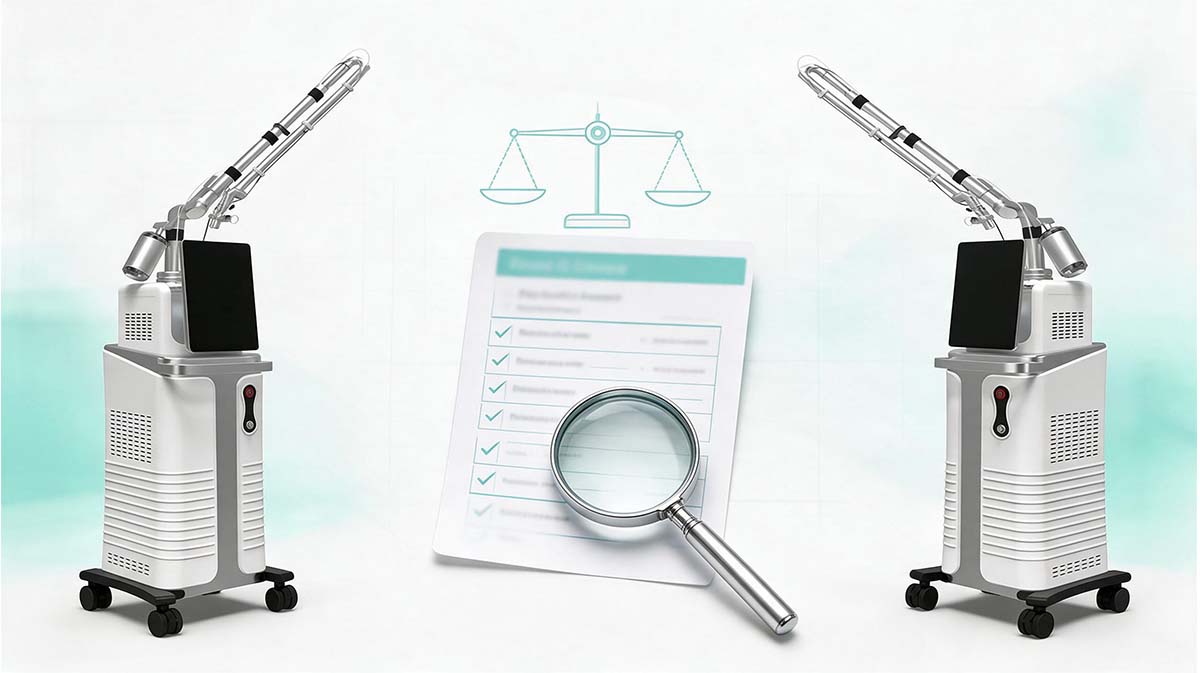
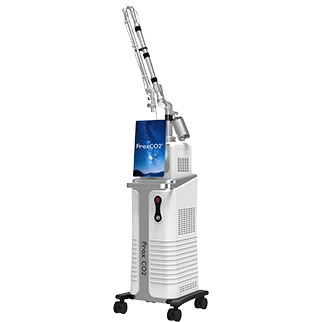
I line up the same fields for every supplier so a lower price cannot simply mean a missing scanner, a weaker cooling system, or no training. The FC300 is a useful reference because Winkonlaser states its 70W and 100W configurations on the product page instead of hiding the details in a later email.
| Line item | What to require in writing |
|---|---|
| Wavelength | 10,600nm |
| Tube | RF-excited metal-ceramic or DC glass, with manufacturer and rated life |
| Output | Power verified at the handpiece, not only at the tube |
| Modes | Fractional, continuous wave, and super pulse where needed |
| Scanning | Spot size, pitch, density, and scan shapes |
| Cooling | Cooling type, water volume, and duty-cycle limits |
| Certification | Model-specific CE MDD and ISO 13485 evidence |
| Support | Warranty, training, spare-part lead time, and smoke evacuation |
Why does tube type change the three-year cost?
Short answer: a DC glass tube commonly lasts 1 to 2 years, while a quality RF metal-ceramic tube is usually rated for 3 to 5 years. The tube is the largest future repair line in a fractional CO2 machine.
The tube is not a permanent part. A DC-excited glass tube is cheaper and can lose output as the gas ages. A quality RF-excited metal-ceramic tube costs more up front, holds output more steadily, and usually stays in service longer. When a clinic runs acne scar and resurfacing sessions every day, the longer-rated tube usually wins on three-year cost, even though its invoice line is higher.
Ask for the tube manufacturer and a photo of the actual tube label before you pay. A supplier who will not name the tube is hiding the largest future expense. You can see the FC300 configuration on the product page and check the maintenance profile in the three-year operating-cost guide.
How should you verify output and beam delivery?
Short answer: ask for output measured at the handpiece aperture with an external power meter. A label that says 70W at the tube can deliver much less after the mirrors and arm joints.
A CO2 beam travels from the tube through mirrors and an articulated arm before it reaches the skin. Energy is lost at every joint, so tube output is not the same as tissue output. A 70W machine can deliver a useful 40W at the handpiece, but a supplier should be able to state that number rather than repeat the label.
Also check the arm itself. A balanced 7-joint articulated arm protects alignment and treatment consistency. A cheap arm can lose 20 to 30 percent of the beam after shipping, which turns a strong machine into a slow, uneven one.
Which scanning and cooling fields matter?
Short answer: spot size, spot pitch, fractional density, scan shapes, pulse duration, cooling design, and smoke evacuation all change what the machine can treat safely.
Scanning is where flexibility lives. A useful fractional platform adjusts the density from about 5 to 40 percent, offers spot pitch in the range of 0.1mm to 1.5mm, and supports square, rectangular, circular, and linear patterns. Those settings let an operator protect thin periorbital skin and still treat a body scar with a denser pattern. Pulse duration from 0.1ms to 10ms matters too: shorter pulses reduce thermal spread, while longer pulses coagulate more tissue.
Cooling is the other survival system. A 100W tube turns most of its input energy into heat, so the quote should state the cooling method, water volume, and any duty-cycle limit. Smoke evacuation is not an accessory. Ablative CO2 work creates laser plume, and a filter system protects staff while keeping residue off the optics.
What certification wording is safe to accept?
Short answer: require model-specific CE MDD and ISO 13485 documentation for fractional CO2. Do not accept a blanket FDA clearance claim for this category.
Certification is the easiest place for a quote to drift. In the Winkonlaser line, FDA 510(k) K241860 belongs only to the DM60 and DM40P diode machines. Fractional CO2 should be verified under CE MDD and ISO 13485, not described as FDA cleared because another product from the same factory holds a clearance. ISO 13485 is a quality-management certification, not a device clearance, so keep those terms separate.
Ask for the exact model number, certificate number, issuing body, and expiry date. Compare all four fields against the certification record instead of accepting a general badge. This import and certification guide explains the paperwork before the machine reaches your market.
What hidden costs should you add back?
Short answer: add freight, duty, voltage conversion, smoke-evacuator filters, spare lenses, tube replacement, installation alignment, training, and realistic service response to the machine price.
The first invoice is only the opening layer. International freight and duty vary by destination, so request Incoterms and the port. A 110V or 220V build should be confirmed before shipment. Spare handpiece lenses and smoke-evacuator filters are recurring items. The tube will eventually need replacement, so ask for its price and shipping lead time in the same quote.
Training and response time belong in writing too. A supplier who sends only a manual leaves the clinic to learn wound care and alignment on its own. Ask how long a tube, lens, power supply, and motherboard take to reach your market.
What should you ask before sending a deposit?
Short answer: request the datasheet, handpiece output measurement, tube evidence, certificate matched to the model, warranty text, training schedule, spare-part list, and landed cost before any payment.
I keep the final review to eight checks:
-
Confirm the exact model and wavelength in the invoice.
-
Confirm the tube type, manufacturer, and rated life.
-
Ask for measured output at the handpiece.
-
Confirm spot pitch, density, scan shapes, and pulse duration.
-
Confirm cooling, smoke evacuation, and voltage.
-
Match the CE MDD and ISO 13485 documents to the model.
-
Ask for the warranty on the main unit and handpiece, plus spare-part lead times.
-
Add freight, duty, installation, and training to make the final landed total.
Winkonlaser was founded in Beijing in 2012, exports to 120-plus countries, and has 15-plus engineers on the product and support side. The stated support structure includes a two-year warranty on the main unit and handpiece with lifetime technical support, but the warranty and certificate still need to be confirmed against the exact model and destination.
The honest limits
A complete quote does not make fractional CO2 suitable for every patient. The treatment is contraindicated for active skin infections, keloid-prone patients, pregnancy, and patients on isotretinoin. Fitzpatrick V and VI skin is generally not a CO2 resurfacing candidate because of the post-inflammatory hyperpigmentation risk. The machine resurfaces skin and improves scars and texture; it does not remove deep fat or make a poor candidate safe.
FAQ
Q: How much does a fractional CO2 laser machine cost?
A: Contact for pricing. A meaningful quote depends on the tube type, output at the handpiece, scanning range, cooling, certification, training, spare parts, and import terms, so a single price without those fields is not useful.
Q: Which CO2 laser tube is better for a busy clinic?
A: A quality RF-excited metal-ceramic tube is usually rated for 3 to 5 years and holds output more steadily. A DC glass tube is cheaper and commonly rated for 1 to 2 years, so the longer-rated tube often wins on three-year cost for daily resurfacing work.
Q: Does a fractional CO2 laser have FDA 510(k) clearance?
A: Not as a blanket category claim in the Winkonlaser line. Fractional CO2 is verified under CE MDD and ISO 13485. FDA 510(k) K241860 belongs only to the DM60 and DM40P diode machines, so certification must be matched to the exact model.
Q: What should the quote say about laser output?
A: Ask for output measured at the handpiece aperture with an external power meter. Tube power is not the same as tissue power because mirrors and arm joints absorb part of the beam.
Q: Why does smoke evacuation belong in a CO2 laser quote?
A: Ablative treatment creates laser plume. Smoke evacuation protects staff and keeps acidic residue off the articulated arm and optics, while filters become a recurring operating cost.
Q: What warranty and support should a clinic expect?
A: Ask for two-year coverage on the main unit and handpiece with lifetime technical support, plus written lead times for the tube, lens, power supply, motherboard, and training schedule.
Get a CO2 quote that itemizes the real machine
Before you compare another fractional CO2 machine, send the same eight-line checklist to every supplier and ask for the datasheet in writing. For a configured FC300 quote with your wattage, voltage, training, and destination terms, contact Winkonlaser and request the model-specific documentation with the pricing.