Diode vs IPL vs Alexandrite: Which Hair Removal Machine Should You Actually Buy?
Hair RemovalIf you're reading this, you've probably already seen the spec sheets. Diode = 808nm. IPL = broad spectrum. Alexandrite = 755nm. But specifications don't determine your clinic's profitability — total cost of ownership (TCO) does. A $3,000 IPL machine that costs $1,500/year in lamp replacements and loses clients because of mediocre results is far more expensive than a $7,000 diode laser with zero consumables and a growing referral base. Let's look at the purchase decision from the P&L side, not the spec sheet side.
For the clinical technology comparison (wavelengths, skin type efficacy, treatment depths), see our Diode vs IPL vs Alexandrite Technology Comparison in the Comparison Center. This guide is about the buying decision.
The Real Cost: 3-Year Total Cost of Ownership
Machine price is misleading. Here's what you actually spend over 3 years when you factor in everything:
| Cost Factor | IPL ($3K machine) | Diode DM40P ($7K) | Alexandrite ($25K) |
|---|---|---|---|
| Machine purchase | $3,000 | $7,000 | $25,000 |
| Lamp / cartridge replacements (3yr) | $4,500–$7,500 | $0–$500 | $2,400–$3,600 |
| Annual maintenance | $800/yr | $300/yr | $800/yr |
| Consumables (gel, tips, etc.) | $500/yr | $0 | $400/yr |
| Downtime cost (repair days × lost revenue) | $3,000–$8,000 | $1,000–$2,000 | $2,000–$5,000 |
| 3-Year Total Cost | $10,500–$17,900 | $7,900–$10,400 | $28,600–$36,800 |
Key insight: The $3,000 IPL machine costs more over 3 years than the $7,000 diode laser — once you add the xenon lamp replacements (every 6–12 months at $500–$1,500 each), consumables, and the revenue lost when the machine is down for maintenance. The diode's upfront premium disappears within the first year.
3-Year ROI: Profit-to-Cost Comparison
| Metric | IPL | Diode (DM40P) | Alexandrite |
|---|---|---|---|
| Max clients/day (comfort limited) | 5 (treatments are slower & more painful) | 8 (fast, sapphire-cooled, comfortable) | 10 (fastest on fair skin only) |
| Avg session price (market tolerance) | $80 | $180 | $220 |
| Annual revenue (22 days/mo) | $105,600 | $380,160 | $580,800 |
| 3-year revenue | $316,800 | $1,140,480 | $1,742,400 |
| 3-year total cost | $10,500 | $7,900 | $28,600 |
| 3-Year Net Profit | $306,300 | $1,132,580 | $1,713,800 |
| Profit-to-Cost Ratio | 29× | 143× | 60× |
The diode delivers 143× return on investment — 5× better than IPL and 2.4× better than Alexandrite. This is the metric that should drive your purchase decision.
Client Demographics: What You're Really Buying
Your machine determines which clients you can treat. In most urban markets worldwide, the population is diverse. A technology that excludes darker skin types excludes a significant revenue stream.
| Your Market | Clients You'd Lose With IPL | Clients You'd Lose With Alexandrite | Clients You'd Lose With Multi-λ Diode |
|---|---|---|---|
| Northern Europe (95%+ Fitz I–III) | <5% | <5% | 0% |
| Southern Europe / Mediterranean | 10–15% | 15–25% | 0% |
| United States (urban areas) | 20–35% | 30–50% | 0% |
| Middle East / South America | 30–50% | 40–65% | 0% |
| South Asia / Africa / Caribbean | 60–90% | 70–95% | 0% |
Unless your market is exclusively fair-skinned, a diode laser is the only machine that doesn't systematically turn away paying clients. Each turned-away client is not just lost revenue — they're a referral you'll never get.
Procurement Traps by Technology
⚠ IPL Trap: "Xenon Lamp Lifetime" Fraud
IPL manufacturers claim lamp lifetimes of 50,000–100,000 shots. Reality: lamp energy degrades 15–30% after just 10,000 shots, meaning treatment efficacy drops long before the lamp "dies." You'll either replace lamps every 6–8 months or deliver degrading results to your clients. Detection: Ask for the guaranteed energy stability curve, not just shot count.
⚠ Diode Trap: "Fake 4-Wavelength" Scam
Some manufacturers claim "multi-wavelength" but only use a single 808nm diode bar with a tinted filter — not actual separate wavelength sources. Result: you get the 808nm performance with none of the multi-wavelength benefits. Detection: Ask to see the actual diode bars. A genuine 4-wavelength system has physically separate emitters; a fake one has one bar with colored glass.
⚠ Alexandrite Trap: The "Low Price" Alexandrite Bait
Genuine Alexandrite lasers use expensive solid-state crystal rods. If an "Alexandrite" is priced under $10,000, it's almost certainly a diode laser with 755nm branding. A real Alexandrite rod alone costs $4,000–$8,000 at wholesale. Detection: Real Alexandrite machines are never below $15,000 new.
What About At-Home IPL? The Competitive Threat Question
Many new clinic owners worry about competition from consumer IPL devices (Philips Lumea, Braun, etc.). This concern is misplaced. Consumer devices operate at 10–25 J/cm² vs professional 40–120 J/cm² — a fraction of the energy. They take 2–3× more sessions for 30–40% weaker results. Consumer devices create your best clients — people who tried at-home, got frustrated, and now want professional results they can see. A clinic using a professional-grade machine has no competition from the drugstore.
Which Winkonlaser Machine Matches Your Budget?
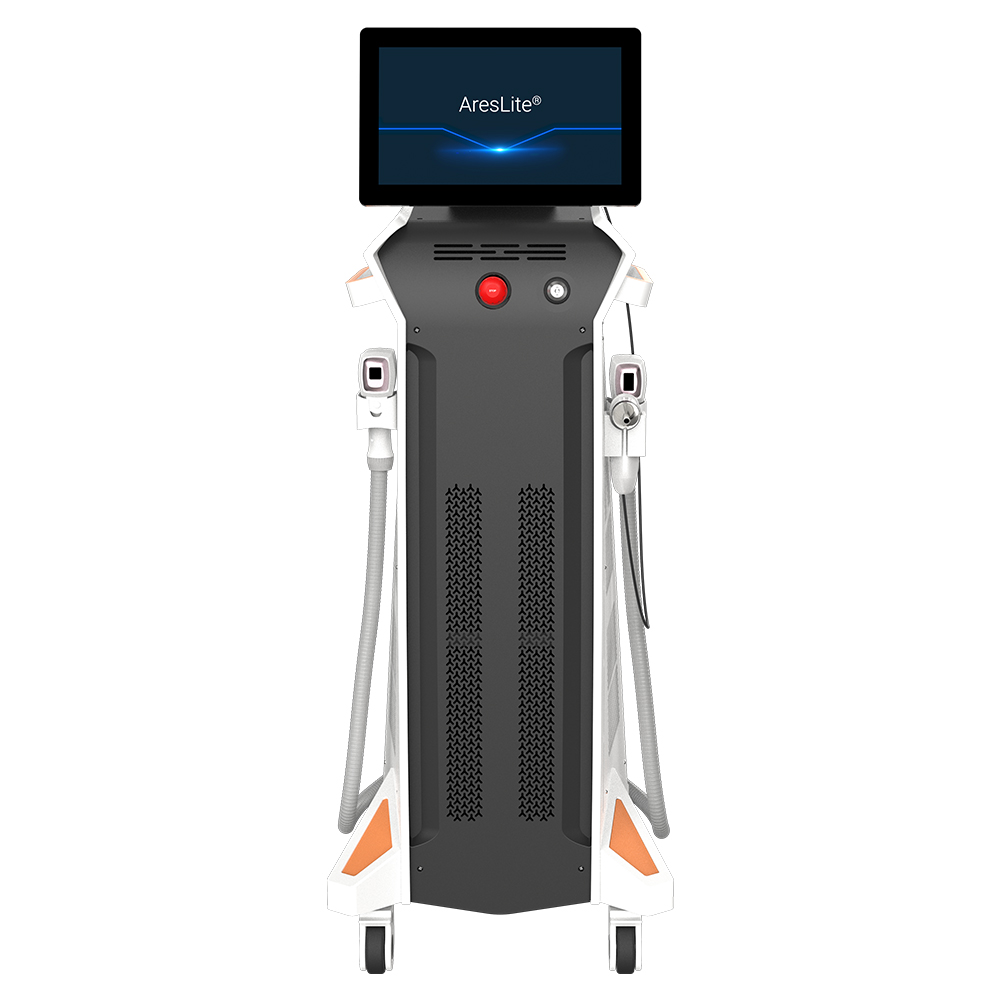
AresLite DM40P — Quad-Wavelength Diode Laser
- 4 wavelengths (755/808/940/1064nm) — treats all Fitzpatrick types I–VI
- 350g ultra-light handle, 200 million shot lifespan
- 3-year TCO: ~$7,900 | 3-year profit: ~$1,132,000 | Profit ratio: 143×
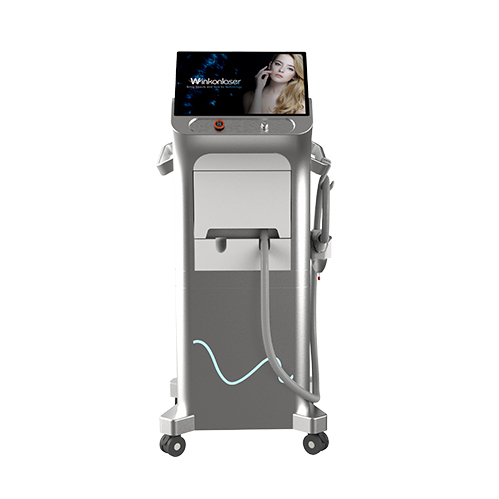
AresLite DM60 — High-Throughput Diode Laser
- 4 interchangeable spots (6mm circle to 12×36mm) — 30–50% faster treatments
- 4 wavelengths, DCS 5-in-1 cooling, 100 million shots
- Best for: clinics treating 8+ clients/day, full-body sessions, multi-practitioner setups
The Only Metric That Matters
Ignore the spec sheets. Look at one number: profit-to-cost ratio over 3 years. The math is definitive:
IPL: 29× | Alexandrite: 60× | Diode: 143×
The diode laser returns $143 in net profit for every $1 spent — 5× better than IPL. It treats every client who walks through your door, operates for years with near-zero consumable cost, and commands premium pricing because clients can feel the difference. If you're starting a clinic or upgrading from IPL, a multi-wavelength diode is not the cheapest option — it's the most profitable one.
Contact info@winkonlaser.com or +86 13313061061 for a personalized TCO analysis based on your clinic's expected volume.
Frequently Asked Questions
Wait. Here's why: a $3,000 IPL machine costs $5,000–$8,000 over 3 years in lamps and consumables alone — more than a diode laser's total TCO. Meanwhile, it produces weaker results that hurt your reputation. Save for 2–3 more months, or explore financing — the diode's extra $4,000 upfront is recovered within 2–3 weeks of operation through faster treatments and higher pricing. Starting with a compromised machine creates a compromised brand.
Low barrier to entry. You can buy an IPL machine for $2,000–$4,000, watch a YouTube video, and start treating clients. But clients increasingly know the difference between IPL and real laser — and they ask. Poor results from IPL create a growing market of disappointed clients seeking better treatment. That's your opportunity.
Use this analogy: "IPL is like a floodlight — it lights up the whole room. Diode laser is like a spotlight — it targets exactly what needs treating. Fewer sessions, less discomfort, better results. That's why we invested in it." Clients understand this immediately and are willing to pay more for a clearly superior technology.
Only with a multi-wavelength diode that includes 1064nm. Single-wavelength 808nm diode treats types I–IV but is marginal for V–VI. Alexandrite is unsafe beyond type III. IPL is unsafe beyond type III. If your market includes any diversity, a 4-wavelength diode (755/808/940/1064nm) is the only single-machine solution that treats everyone.