


Which Is Right for Your Clinic: Fractional CO2 Laser or RF Microneedling?
Table of Contents
Quick answer: for a clinic treating acne scars with a busy, downtime-sensitive patient mix, RF microneedling is usually the safer first machine. A fractional CO2 laser becomes the right upgrade when you already have a patient list that accepts several days of healing and you want deeper remodeling in fewer sessions.
Clinics usually keep two scar-treatment lists: patients who can take a week of downtime and patients who cannot. The machine decision follows those lists, not the other way around. A fractional CO2 laser and an RF microneedling machine both remodel scarred skin, but they sit on opposite sides of that downtime line, and they earn money on different schedules.
How do fractional CO2 and RF microneedling actually work?
Short answer: fractional CO2 uses a 10,600 nm laser to create microscopic columns of vaporized skin, while RF microneedling sends radiofrequency current through insulated needles that reach 0.2 mm to 7.0 mm below the surface.
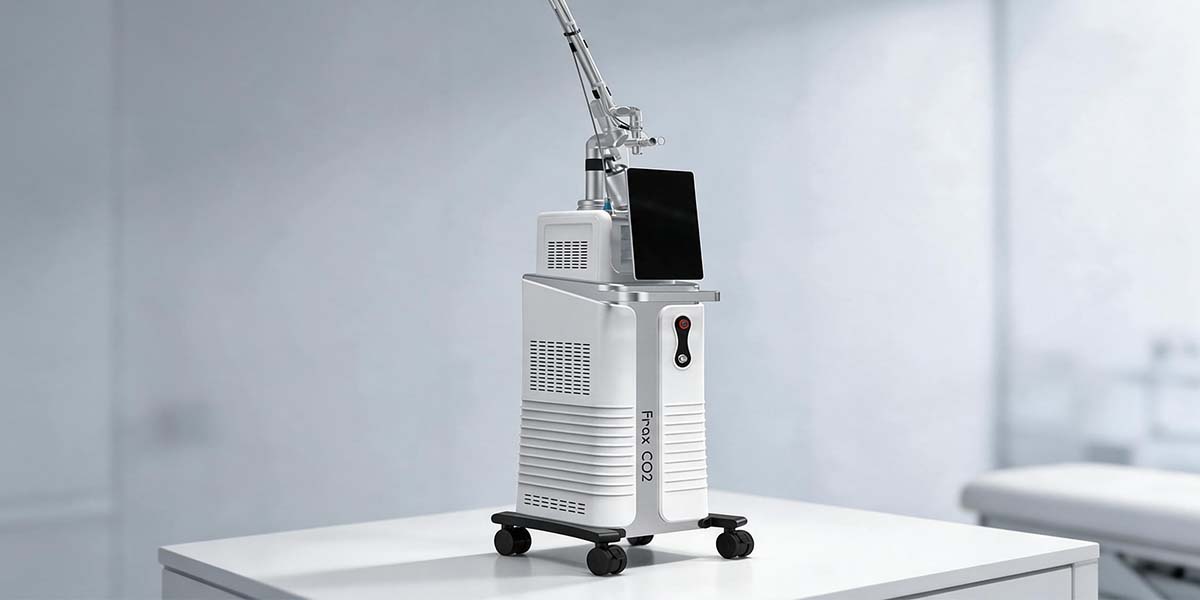
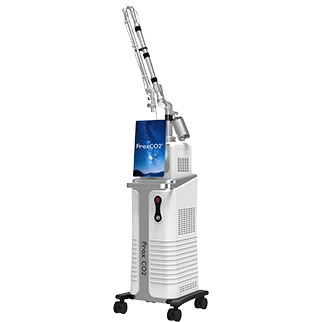
A fractional CO2 laser does not remove the whole surface at once. It fires a grid of tiny columns, and each column ablates skin while leaving surrounding tissue intact to speed repair. That is why the method is called fractional. The 10,600 nm wavelength is absorbed strongly by water, so it removes tissue precisely and adds heat that helps the dermis remodel as it heals.
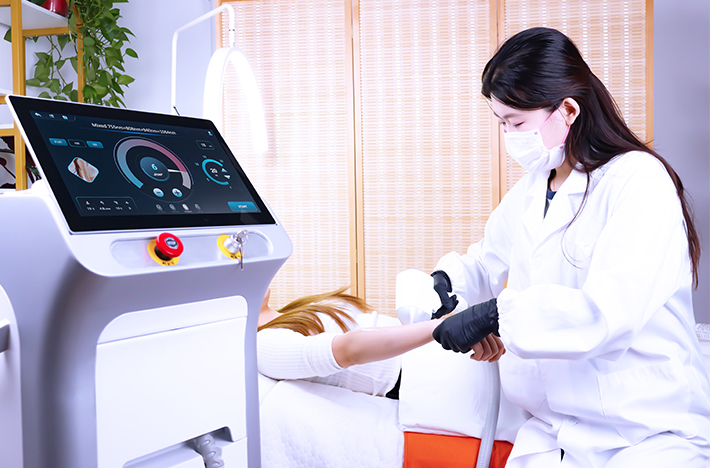
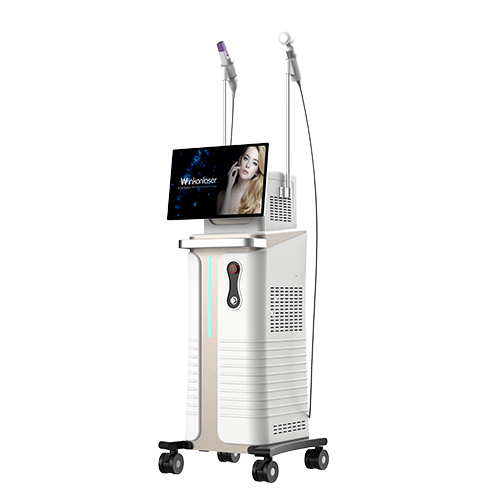
RF microneedling works from a different direction. The needles make the channels, and the radiofrequency energy heats the dermis below the tip. Because the needles can be insulated, the energy lands at a chosen depth without burning the whole surface. The TM80 is a dual-frequency design with 2.2 MHz insulated needles plus a 700 kHz conductive mode, and its needle depth adjusts from 0.2 mm to 7.0 mm. You can check the full configuration on the TM80 RF microneedling product page.
The practical difference is where the main injury happens. Fractional CO2 injures and resurfaces from the top down. RF microneedling injures mostly under the surface and leaves the epidermis mostly intact. That one difference drives downtime, pigment risk, and which patients can be treated safely.
Which one treats atrophic acne scars better?
Short answer: fractional CO2 usually shows faster visible change per session on boxcar and rolling scars, while RF microneedling is the safer first choice for darker skin and busy patients because it disturbs the surface less.
For rolling and boxcar scars, most clinicians plan 3 to 5 fractional CO2 sessions. The surface is removed and rebuilt, so the scar edge is smoothed more aggressively in each treatment. Icepick scars respond less to any surface treatment and often need a targeted technique such as TCA cross before the resurfacing work starts.
RF microneedling is commonly planned as 3 to 6 sessions. The change per session is usually more gradual, but downtime is much shorter, so patients are more likely to finish the series. In my experience, a clinic that fills daily RF microneedling slots often recovers the machine faster than a clinic that sells fewer, higher-priced CO2 sessions with long gaps between them.
The table below compares the two machines on the points that show up in a clinic budget, not just on the marketing sheet.
| Factor | Fractional CO2 laser | RF microneedling |
|---|---|---|
| Energy source | 10,600 nm ablative laser | Radiofrequency through insulated needles |
| Main injury | Surface columns from the top down | Dermal heating below the surface |
| Typical downtime | Three to seven days of redness, crusting, and peeling | About one to two days of pinkness |
| Typical sessions for atrophic scars | 3 to 5 | 3 to 6 |
| Darker skin fit | Higher pigment risk, needs careful settings | Generally safer with insulated needles |
| Main repeat cost | Laser tube, optics, and consumable parts | A sterile needle cartridge per patient |
| First-line role | Upgrade for deeper remodeling | Workhorse for downtime-sensitive patients |
How much downtime does each machine create?
Short answer: fractional CO2 commonly means three to seven days of visible healing, while RF microneedling usually means one to two days of pinkness, with makeup often allowed the next day.
Fractional CO2 patients typically leave red or bronze, then crust and peel over the following days. Most clinics tell patients to avoid sun and heavy activity for about a week while the skin re-epithelializes. The downtime is part of the product: the visible healing is how the surface gets replaced, and a patient who books that treatment has already accepted a recovery period.
RF microneedling patients usually have pinpoint bleeding and redness right after the session, then settle into mild pinkness. Many can return to work the next day. That short recovery is why the machine fits working clients and lunchtime-style schedules, and why it can hold more slots per room per week.
What do the running costs and consumables look like?
Short answer: fractional CO2 carries longer-term tube and optical costs, while RF microneedling has a sterile cartridge as its main per-patient cost, which makes the session cost easier to predict.
A fractional CO2 laser has a laser tube with a finite service life, plus optics, a smoke evacuation filter, and cooling water that must be maintained. The costs arrive less often than a per-patient consumable, but each one is larger, and a failed tube can take the room out of service while the part ships. For the full operating-cost picture, see the fractional CO2 maintenance and operating cost guide.
RF microneedling uses disposable sterile cartridges. The TM80 ships with 13 sterile cartridges, and the standard workflow uses one cartridge per patient to prevent cross-contamination. Because the cartridge count moves with patient volume, the direct cost per session is easy to forecast and hard to understate.
What does the buy-in and payback look like?
Short answer: machine prices are quoted case by case, so use Contact for pricing, but payback depends more on price per session, weekly utilization, and consumables than on the sticker price alone.
Do not compare sticker prices across suppliers. Compare the landed cost: the machine, shipping, import duties, installation, training, and the first consumable set. Then model the room. A higher-priced CO2 machine can lose to a lower-priced RF microneedling machine if the CO2 room runs fewer sessions per week because of longer treatment time and downtime. For CO2 market context, see the fractional CO2 cost guide.
The payback math is sessions per week times price per session, minus the direct cost per session, measured against the landed cost and any financing. Utilization moves the break-even date more than a small difference in machine price in most cases, which is why the patient list matters more than the brochure.
What are the safety and certification boundaries?
Short answer: Winkonlaser fractional CO2 machines are CE MDD plus ISO13485, not FDA cleared, and the RF microneedling certificate must be confirmed for the exact model before import. Screening and contraindications apply either way.
Certification language matters when a clinic imports equipment. Only the DM60 and DM40P diode lasers carry FDA 510(k) clearance under K241860, and the FE60 EMS unit carries K253790 for its cleared use. Fractional CO2 machines such as the FC300 and FC100 are CE MDD plus ISO13485, not FDA cleared, so do not accept a supplier who attaches an FDA claim to a CO2 machine. For the RF microneedling machine, confirm the current certificate and model list in writing before ordering.
Neither treatment is suitable for every patient. Both are not suitable during pregnancy, over an active infection, or for people with a history of keloid scarring. Photosensitizing medication, recent sun exposure, and darker skin types also change the settings and risk, especially for an ablative CO2 treatment. A qualified operator has to assess each patient, and no machine removes that step.
How should a clinic choose in seven steps?
Short answer: choose by patient mix and utilization first, then model downtime capacity and consumables, then verify certification and warranty, and only then compare landed cost.
-
Split your patient list into people who can heal for a week and people who cannot, and count how many of each you actually see in a month.
-
Estimate how many sessions per week each machine could realistically fill, not how many the best week could fill.
-
Model price per session, direct cost per session, and monthly consumables for each machine.
-
Confirm the certification boundary for the exact models, and get the certificate list in writing.
-
Compare landed cost through Contact for pricing, including shipping, duties, installation, training, and the first consumables.
-
Check the warranty terms. Winkonlaser was founded in Beijing in 2012, exports to 120+ countries, and has 15+ engineers, with a two-year warranty on the main unit and handpiece plus lifetime technical support.
-
Pick the machine that still breaks even in the conservative utilization case, not the best-case case.
For more on the RF microneedling decision, see the how-to-choose-an-RF-microneedling-machine guide.
FAQ
Q: Which is better for acne scars, fractional CO2 or RF microneedling?
A: Fractional CO2 usually changes atrophic scars faster per session, but RF microneedling has far less downtime and is safer for darker skin. Many clinics start with RF microneedling as the daily workhorse and add fractional CO2 for patients who accept a longer recovery.
Q: How much downtime does each machine cause?
A: Fractional CO2 commonly means three to seven days of visible healing, while RF microneedling usually means one to two days of pinkness and a faster return to normal activity.
Q: Is a fractional CO2 laser FDA cleared?
A: No. Winkonlaser fractional CO2 machines such as the FC300 and FC100 are CE MDD plus ISO13485, not FDA cleared. Only the DM60 and DM40P diode lasers carry FDA 510(k) under K241860.
Q: What does the TM80 RF microneedling machine include?
A: The TM80 is a dual-frequency design with 2.2 MHz insulated and 700 kHz conductive modes, 0.2 mm to 7.0 mm needle depth, 13 sterile cartridges, and intelligent vacuum sensing. Confirm the current configuration and certificate on the product page.
Q: Which machine has lower running costs?
A: RF microneedling usually has a more predictable per-session cost because the main consumable is a sterile cartridge. A fractional CO2 laser has larger but less frequent tube, optics, and cooling costs.
Q: Should a new clinic buy both machines at once?
A: Not at first. Start with the machine that matches most of your patient list, reach steady utilization, then add the second. Buying both before demand is proven ties up cash in two payment and consumable schedules.
Match the machine to your booking sheet
The safer purchase is the one your booking sheet can fill every week. If most patients cannot take a week of downtime, RF microneedling earns faster. If you already have a scar-heavy list that accepts recovery, fractional CO2 can justify a higher price per session. For a written landed-cost quote on the TM80 RF microneedling system or the FC300 and FC100 fractional CO2 range, send your expected weekly sessions through the Winkonlaser contact page.