


Which Alexandrite Laser Machine Should Your Clinic Buy? We Ranked 10 on Speed, Skin Types and the 10x Price Gap
1. INTRODUCTION
The alexandrite laser is the quiet gold standard of laser hair removal. Search for “best laser hair removal machine” and you’ll drown in diode rankings. But ask a dermatologist which wavelength removes hair fastest on light skin, and they’ll usually point at 755nm. It sits at the peak of melanin absorption, which means it clears fine, light hair faster than almost anything else.
Here’s the strange part. The same 755nm technology costs about $8,000 from a factory in China and about $150,000 from a US brand. Same wavelength. Same basic physics. Twenty times the price.
I have been in this industry since 2012, and I have seen this exact confusion cost buyers more money than any spec sheet ever did. A clinic owner gets three quotes, sees the spread, and assumes the expensive machine must be twenty times better. It isn’t. But it also isn’t twenty times worse value. The truth is messier, and it’s worth five minutes to understand before you spend.
This ranking puts ten machines side by side and tells you what actually separates them: wavelength coverage, pulse width, spot size, build quality, service, and clinical track record. And it answers the one question every buyer asks: what does the price gap actually buy?
2. HOW WE RANKED THESE MACHINES
No ranking is worth much unless you know the method, so here it is in the open.
We scored each machine on six things, weighted like this:
Wavelength coverage, 25%. A 755nm-only machine is excellent on light skin and dangerous on dark skin. A dual 755+1064nm machine covers Fitzpatrick I through VI. Coverage matters more than raw power.
Pulse width and energy range, 20%. Hair removal is heat delivered to the follicle over time. A machine that offers only one pulse width limits what you can safely treat.
Speed and spot size, 15%. Bigger spot means faster sessions and more patients per day.
Build quality and lifespan, 15%. Handpiece life, cooling reliability, how long it runs before parts fail.
Clinical track record and safety, 15%. Real studies, real clearance, years in the field.
Price and ROI, 10%. We score value, not cheapness. A $100,000 machine that pays for itself in a year beats a $50,000 machine that sits idle.
Most rankings rank the brand, not the machine. A famous name scores high because it is famous. We scored machines instead, which is why you’ll see an $8,000 machine sitting at number six. If that surprises you, read the price gap section before you argue with us.
3. THE 10 ALEXANDRITE LASER MACHINES, RANKED
Number 1. Candela GentleMax Pro, the benchmark. Dual 755nm alexandrite plus 1064nm Nd:YAG. Large spot sizes up to 18mm and 24mm. This is the machine every other alexandrite gets compared to. It’s fast, it’s reliable, and it holds resale value better than anything else. List price runs roughly $100,000 to $150,000 depending on configuration. If you’re a high-volume med spa in a wealthy market and you can keep it booked, it earns its keep. If you’re a new clinic doing fifteen sessions a week, it’s a very expensive way to remove hair.
Number 2. Candela GentleLase Pro, the classic single-wavelength. 755nm alexandrite only, no 1064nm. For light skin it’s still excellent, and it’s cheaper than the GentleMax at roughly $60,000 to $90,000. The catch is the single wavelength: treat a Fitzpatrick V or VI patient with it and you’re asking for trouble. It’s the machine that made 755nm famous, and it shows its age in coverage.
Number 3. Cynosure Elite iQ, the strong dual. 755nm alexandrite plus 1064nm Nd:YAG, like the GentleMax. Solid build, good service network in the US, typically $80,000 to $120,000. Clinically it does most of what the GentleMax does. The difference comes down to brand loyalty, local service, and what your rep will negotiate.
Number 4. Quanta Duetto MT EVO, the European dual. Italian-built, 755nm plus 1064nm, and one of the more affordable western dual-wavelength options at roughly $60,000 to $90,000. Good reputation for build quality. Less name recognition than Candela or Cynosure in North America, which matters less than you’d think, and more than it should when patients recognize brand names.
Number 5. Deka Motus AY, the moving-technology wildcard. 755nm alexandrite plus 1064nm Nd:YAG with a moveo handpiece that keeps the laser moving across the skin, which Deka claims makes it gentler. Around $70,000 to $100,000. It feels genuinely different in the hand, and patients often report it hurts less. The trade-off: moving-pulse protocols can be slower on large areas than a fixed big spot.
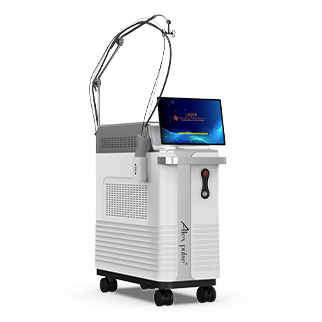
Number 6. Winkonlaser CL300 AlexPulse, the value pick. I’ll be upfront that we build this machine, so take the placement with that in mind. The specs are real and they’re on the page: dual 755nm alexandrite plus 1064nm Nd:YAG, 60J at 755nm and 110J at 1064nm, pulse width from 0.25 to 100ms, frequency up to 10Hz, 5000W. It carries CE MDD and ISO 13485 clearance, and it ships factory-direct for roughly $7,800 to $11,000. That’s the number that makes western buyers suspicious, and I understand why. See the price gap section for what you give up at that number.
Number 7. Winkonlaser EL200B, the GentleLase alternative. Same dual 755nm plus 1064nm core as the CL300, positioned as a long-pulse machine. Spot sizes 3, 12, 16 and 18mm standard, with 6, 10 and 24mm available. Air and water cooling, two-year warranty with a spare handpiece. If your clinic wants a true 755nm machine but doesn’t need the CL300’s higher output, this is the entry point.
Numbers 8 through 10. The OEM budget tier. The last three slots aren’t specific brands, and that’s deliberate. Below the CL300 there’s a whole shelf of generic 755nm alexandrite machines coming out of Shenzhen and Beijing factories, priced from about $3,000 to $8,000. Some are perfectly fine. Some carry exaggerated specs, keep no spare parts in your country, and offer a warranty that only works if you ship the machine back to China at your own cost. The honest advice if you go budget OEM: buy from a factory that’s been around more than a few years, ask for a video call of the machine running, and confirm parts and service before you pay. Never buy the cheapest listing on the page.
4. WHAT THE PRICE GAP ACTUALLY BUYS
Twenty times the price. What are you paying for?
First, service. Candela and Cynosure keep technicians in most countries who will show up, fix the machine, and keep you running. When a $100,000 machine goes down, someone comes. When an $8,000 machine goes down, you’re emailing a factory and hoping the video they send is enough to fix it yourself. For a clinic doing forty sessions a week, downtime costs more than the machine.
Second, clinical data and training. The western brands carry decades of published studies and training programs. The physics of 755nm doesn’t change across brands, but the protocols, the safety data, and the handholding do.
Third, parts and lifespan. This is the one I’d point at as a buyer. A Candela handpiece is built to run daily for years. A budget handpiece may need replacing sooner. That said, a new budget handpiece often costs less than a single Candela service call.
What you are not paying for is twenty times better hair removal. A 755nm photon removes hair the same way whether it comes from a $150,000 machine or an $8,000 one. The laws of physics don’t care about the logo. Treat the same skin type with the same energy and the same pulse width, and you get comparable results.
So the decision is about volume and market. High volume, wealthy market, brand-conscious patients, can’t afford downtime: buy the western benchmark. New clinic, price-sensitive market, willing to manage service yourself and train your own operators: the value tier makes real sense.
5. ALEXANDRITE VS DIODE: A QUICK HONEST COMPARISON
You’ll be offered both, so here’s the short version. 755nm alexandrite has the highest melanin absorption, so it’s faster and more effective on fine, light hair and light skin. That’s why dermatologists call it the gold standard for Fitzpatrick I to III. 808nm diode is more forgiving on darker skin and usually cheaper. It’s the workhorse, not the specialist. A dual 755 plus 1064nm machine splits the difference: 755nm for light skin, 1064nm for dark skin.
If your patients are mostly light-skinned with fine hair, alexandrite is the better tool. If the mix is broad and you want one machine that treats everyone safely, a good diode with 1064nm or a dual alexandrite both work. We wrote a longer breakdown of diode versus IPL and a full alexandrite-versus-everything guide if you want the details.
6. WHO SHOULD NOT USE AN ALEXANDRITE LASER
This is the safety section, and it matters. Laser hair removal is contraindicated for pregnant or breastfeeding patients, anyone with an active skin infection or open wound in the treatment area, people on photosensitizing medications like some antibiotics and isotretinoin, anyone with a recent tan or fake tan, patients with a history of keloid scarring or photosensitivity disorders, and anyone with a pacemaker or implanted device without a doctor’s clearance.
The 755nm wavelength is also specifically not for dark skin used alone. On Fitzpatrick V and VI skin, 755nm’s high melanin absorption becomes a hazard and can burn the skin. That’s exactly why dual 755 plus 1064nm machines exist, and why you should never run a 755nm-only machine on dark skin.
7. HONEST LIMITATIONS OF 755NM
A buyer who knows the limits makes fewer expensive mistakes, so here they are.
First limitation: skin type. 755nm is the best wavelength for light skin and the worst choice for dark skin used alone. If your patient base is mostly Fitzpatrick IV to VI, buy a 1064nm Nd:YAG or a dual machine, not a 755nm-only unit.
Second limitation: hair color. No laser removes white, grey, or red hair. Alexandrite is excellent on dark hair and fine light hair, but it cannot treat hair with no pigment. If a salesperson says their laser removes blonde or grey hair, walk away.
Third limitation: it’s not one-and-done. Alexandrite reduces hair permanently, but permanent reduction isn’t never a hair again. Patients need a full course of sessions and later top-ups. Anyone who quotes a single-session cure is overselling.
Fourth limitation: operator skill. A 755nm machine in untrained hands burns skin. The machine matters less than the person running it. Budget for training, not just the box.
8. FAQ
Q: Is alexandrite better than diode for laser hair removal?
A: For fine, light hair on light skin, yes. Alexandrite’s 755nm wavelength has the highest melanin absorption, so it’s faster and more effective on Fitzpatrick I to III. Diode is more forgiving on darker skin and usually cheaper.
Q: Why is there such a huge price gap between alexandrite machines?
A: Brand, service network, clinical data, parts availability, and manufacturing location. The physics of 755nm is the same at every price point. What changes is what happens when the machine breaks and how much training you get.
Q: Can a 755nm alexandrite laser treat dark skin?
A: Not alone. On Fitzpatrick V and VI skin, 755nm risks burning because it targets melanin so aggressively. You need the 1064nm Nd:YAG wavelength for dark skin, which is why dual machines exist.
Q: How many sessions does alexandrite hair removal take?
A: Typically six to eight sessions spaced four to six weeks apart for most areas, then occasional top-ups. Fine hair may need more, coarse dark hair fewer.
Q: What does an alexandrite laser machine cost in 2026?
A: Roughly $3,000 to $8,000 for generic OEM units, $7,800 to $11,000 for a factory-direct dual-wavelength machine like the CL300, and $60,000 to $150,000 for western brands like Candela and Cynosure.
Q: Does an alexandrite laser hurt?
A: Patients describe it as a rubber-band snap. Alexandrite can feel sharper than diode because the wavelength is absorbed more strongly. Built-in contact cooling and correct settings reduce it a lot.
Q: What’s the difference between the CL300 and the EL200B?
A: Both are dual 755nm plus 1064nm machines. The CL300 is the higher-output flagship. The EL200B is the long-pulse entry point with standard 3, 12, 16 and 18mm spot sizes. Both carry CE MDD and ISO 13485.
Q: Is an alexandrite laser worth it for a new clinic?
A: It depends on your patient mix. If you treat mostly light-skinned patients with fine hair and you can’t afford downtime, a reliable dual-wavelength alexandrite pays off. If your market is price-sensitive with mixed skin types, a good diode or a value-priced dual machine is the safer first buy.
9. SOURCES
This ranking draws on the following reference points. Wavelength and melanin absorption data follow the standard clinical understanding that 755nm alexandrite sits near the peak of melanin absorption and that 1064nm Nd:YAG penetrates to treat darker skin types. Clearance details: the CL300 and EL200B carry CE MDD and ISO 13485 clearance. Western machine pricing reflects published list prices and should be confirmed with your local distributor, since street prices vary by region and negotiation. For background on the 755nm wavelength, see what a 755nm alexandrite laser is.
10. GET A QUOTE
If you’ve read this far, you probably know which side of the price gap you’re on. If the value tier fits your clinic, start with the two machines we actually build. The CL300 AlexPulse is the flagship dual-wavelength alexandrite. The EL200B is the long-pulse alternative with standard spot sizes and a spare handpiece.
We have shipped to 120 countries since 2012, and we’ll tell you the machine’s limits before we tell you the price. Contact us and we’ll quote you within a business day.