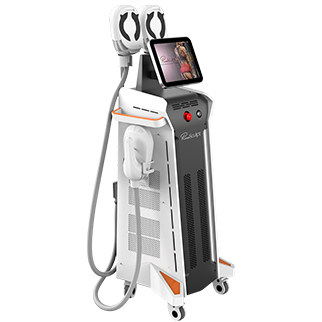



Which Body Slimming Machines Actually Earn Their Price in 2026? A Clinic Owner’s Ranking
Table of Contents
Body slimming is one of the most confusing categories in aesthetics to buy into. A machine that costs $4,000 and one that costs $200,000 can both be sold to you as “fat reduction” — and a clinic owner has no easy way to tell which one will actually book clients and pay for itself. I have been building body-sculpting and hair-removal equipment since 2012, and our machines run in clinics across 120 countries. The question I get asked more than any other is this: which slimming machine is actually worth the money.
This ranking is not a list of the most famous brand names. It ranks machines on what decides whether your clinic makes money: clinical evidence, the results clients can see, what a session costs you to run, and how fast the machine earns back its price. I’ll tell you the strengths and the honest weaknesses of every machine on the list — including the ones we make.
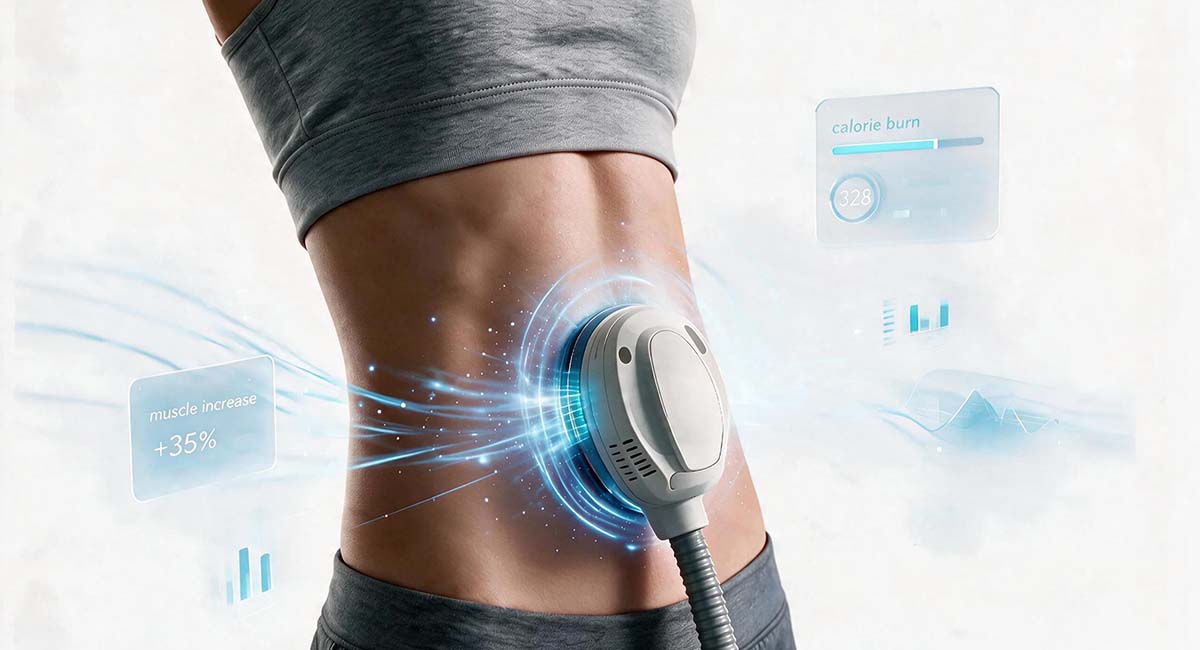
How We Ranked These Machines: Six Criteria
Every machine is scored on six dimensions, each weighted by how much it matters to a clinic’s bottom line:
1. Clinical evidence (20%) — Is the technology backed by FDA clearance and published studies, or by marketing?
2. Measurable results (20%) — Does the client see a real change (fat loss %, muscle gain %), and how fast?
3. Treatment versatility (15%) — How many body areas and client types can one machine treat?
4. Session comfort (15%) — Is it painless and downtime-free? Uncomfortable treatments stop clients from coming back.
5. Operating cost (20%) — What does each session cost you in consumables, applicators and maintenance?
6. Purchase ROI (10%) — Can the machine price be recovered in a realistic number of sessions?
A machine that scores 9.0 out of 10 is not “the best for everyone” — it is the best for a specific kind of clinic. I’ll say which kind under each entry.
The Ranking
#1 — BTL Emsculpt Neo (HIFEM+ Synchronized RF) — 9.2/10
Emsculpt Neo combines high-intensity electromagnetic muscle stimulation with synchronized radiofrequency, so it builds muscle and reduces fat in the same 30-minute session. This is the machine most clinic owners name first when I ask what they are saving up for, and for good reason: it does two jobs at once, and BTL’s published data is the reference point every competitor is measured against.
What it does well: supramaximal muscle contractions (roughly 20,000 in a session) plus RF heating that raises subcutaneous fat temperature enough to trigger apoptosis. Clients feel the muscle work immediately, which makes the treatment easy to sell and easy to upsell as a course.
The honest downside: the machine is a six-figure investment, applicators wear out and are a recurring cost, and staff need real training to place the pads correctly. If your clinic books fewer than 10 body sessions a week, the payment will sit heavy. Best for established clinics and chains that already have body-contouring demand.
#2 — Allergan CoolSculpting Elite (Cryolipolysis) — 9.0/10
CoolSculpting is the name that created the non-invasive fat-freezing category, and Elite is the current version with two applicators that let you treat two areas at once. Cryolipolysis cools fat cells to a temperature that kills them while leaving skin and surrounding tissue intact; the dead cells are cleared by the body over the following weeks.
What it does well: a mountain of published evidence, FDA clearance, and brand recognition that does part of your marketing for you. Clients ask for it by name. Results are permanent for the treated fat cells.
The honest downside: it only reduces fat — it does nothing for muscle or skin laxity, so clinics often pair it with a second machine. It is a high-ticket purchase, applicators are consumable, and a rare side effect (paradoxical adipose hyperplasia) is real even if uncommon. Best for clinics that want the most recognized fat-freezing brand and can absorb the consumable cost.
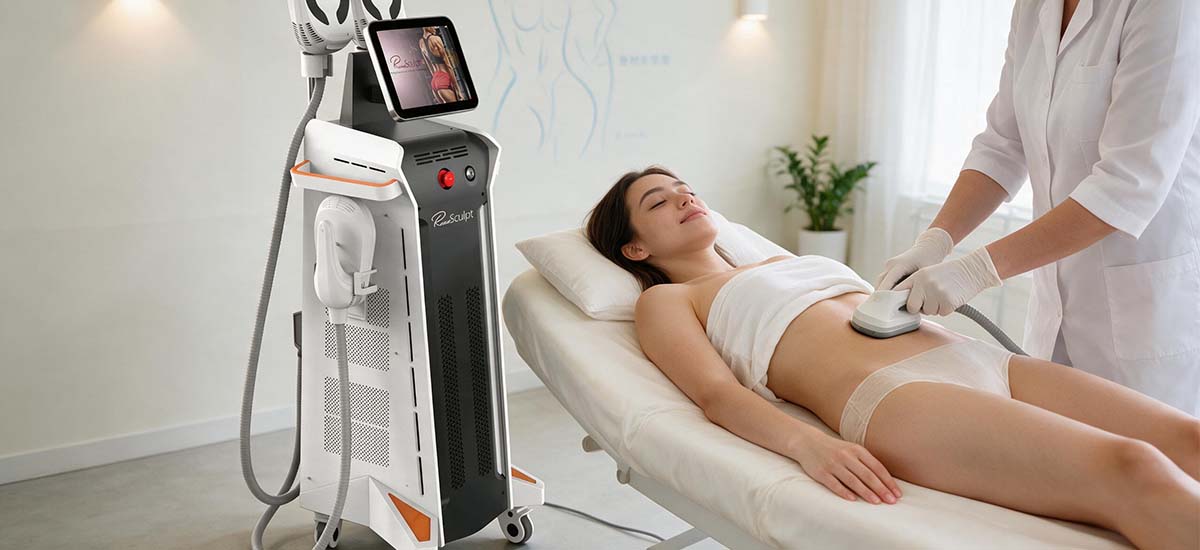
#3 — Winkonlaser Renasculpt FE60 (HIEMT + EMS + RF) — 8.7/10
This is our flagship, and I’ll be direct about both what it gets right and where it gives ground. The Renasculpt FE60 is a 3-in-1 system: HIEMT electromagnetic muscle stimulation, EMS, and microcurrent RF in one unit. It delivers 15 Tesla, 5000W, and a 1–135Hz frequency range, with five applicators — four body pads plus a pelvic-floor therapy pad. Clinical data cited for the platform shows roughly 35% muscle volume increase and 50% subcutaneous fat reduction over a treatment course.
What it does well: it is engineered to do what Emsculpt Neo does — build muscle and reduce fat in one 30-minute session — at factory-direct pricing around $4,500–$5,000 instead of a six-figure price tag. That changes the ROI math completely: a clinic can recover the machine cost in a few body-sculpting courses rather than a year of full books. It is FDA approved, and because it is sold factory-direct, you are not paying distributor markup.
The honest downside: the Renasculpt name does not yet carry BTL’s brand pull, so you sell on results and pricing rather than on a name your clients already know. If your clients specifically demand “Emsculpt” by name, this is not that brand. Best for clinics and salons that want muscle-plus-fat treatment with a fast payback and can live without a household brand name.
#4 — BTL Emsculpt (HIFEM) — 8.4/10
The original Emsculpt is the muscle-building-only predecessor of the Neo. It uses HIFEM to force supramaximal contractions and build muscle, with no RF component, so it does not reduce fat on its own.
What it does well: proven muscle-building, strong brand recognition, and a slightly lower price than the Neo. For a clinic that only wants to add muscle toning (buttocks, abdomen, arms) it is a focused tool.
The honest downside: without RF, it is a one-trick machine. Clients who want fat reduction too will need a second device, which means a second purchase. It is still a high-ticket item. Best for clinics pairing it with an existing fat-reduction machine, or gyms and physio practices that only need muscle work.
#5 — Cynosure SculpSure (1060nm Laser Lipolysis) — 8.2/10
SculpSure uses a 1060nm diode laser to heat subcutaneous fat to around 42–47°C, the range that triggers fat-cell apoptosis without damaging skin. Four flat applicators strap onto the body, and a 25-minute session treats multiple areas.
What it does well: FDA-cleared, non-invasive, and the flat applicators are hands-free — a technician can run several clients in sequence. It is a genuine fat-reduction device with published data.
The honest downside: like CoolSculpting, it reduces fat only — no muscle building, no skin tightening. Some clients describe the heating as an intense warm pulse. Best for clinics that want a hands-free laser fat-reduction option alongside another body treatment.
#6 — Winkonlaser MixSlim HS1000C (360° Cryolipolysis) — 8.0/10
The MixSlim HS1000C is our 360° cryolipolysis machine, built to deliver the same fat-freezing mechanism as the category leaders with dual applicators so two areas can be treated simultaneously.
What it does well: it is a direct, far more affordable alternative to a CoolSculpting-style investment — the same fat-freezing principle at factory-direct pricing. The 360° design lets the applicator wrap around a contour (flanks, abdomen, thighs), and running costs are low because there are no single-use pads to keep buying.
The honest downside: same category limits as any cryolipolysis device — fat reduction only, results appear over weeks rather than immediately, and it carries the same rare-side-effect profile inherent to the mechanism. Best for clinics that want to add fat-freezing without the six-figure entry cost.
#7 — Cutera truSculpt iD (Monopolar RF) — 7.8/10
truSculpt iD uses monopolar radiofrequency with real-time temperature feedback to heat tissue for fat reduction and some skin tightening, and it can treat the full body.
What it does well: versatile (face and body), comfortable, and the real-time temperature control makes treatments consistent. It adds a mild skin-tightening benefit that pure fat-freezing lacks.
The honest downside: RF results are generally more gradual than laser or cryolipolysis, and it does not build muscle. It is a “results over several sessions” machine rather than a dramatic single-course treatment. Best for clinics that want a single RF platform for both body and face.
#8 — BTL Vanquish ME (Non-Contact RF) — 7.5/10
Vanquish ME uses a large non-contact RF panel that hangs over the body and heats a wide area without touching the skin.
What it does well: completely contactless, so it treats large areas (abdomen, flanks) with zero operator fatigue and no applicator to place. Comfortable for clients.
The honest downside: non-contact RF delivers a broad, gentle heating rather than a targeted treatment, so results are modest and take multiple sessions. It is fat-oriented only — no muscle, minimal skin tightening. Best as a hands-free add-on for large-area treatments.
#9 — Syneron UltraShape Power (Focused Ultrasound) — 7.3/10
UltraShape Power uses pulsed, focused ultrasound to mechanically destroy fat cells without heat, then the body clears them naturally.
What it does well: truly non-thermal (no heating, minimal discomfort), FDA-cleared for fat reduction, and selective — it targets fat cells while sparing surrounding tissue.
The honest downside: fat reduction only, and mechanical ultrasound results are gradual and require multiple sessions. The device is a meaningful investment for a single-mechanism machine. Best for clinics that specifically want a non-thermal, no-downtime fat option.
#10 — Winkonlaser 10D Body Sculpt (Lipolaser LLLT) — 7.0/10
The 10D is our laser-lipo system: low-level laser therapy at 532nm and 635nm, delivered through ten pads, at 800W. It is a cold-light, non-surgical approach to body sculpting and pain therapy.
What it does well: completely painless, zero consumables, and low entry cost. Ten laser pads treat a wide area at once, and the Mitsubishi laser sources are rated for over 10,000 hours. It is easy to train staff on and has no downtime.
The honest downside: low-level laser is a gentler mechanism than heat-based fat reduction, so visible results require a longer course and are more modest per session. I would position it as a maintenance, wellness, or entry-level treatment rather than a headline fat-removal device. Best for salons adding a low-cost, zero-risk body treatment.
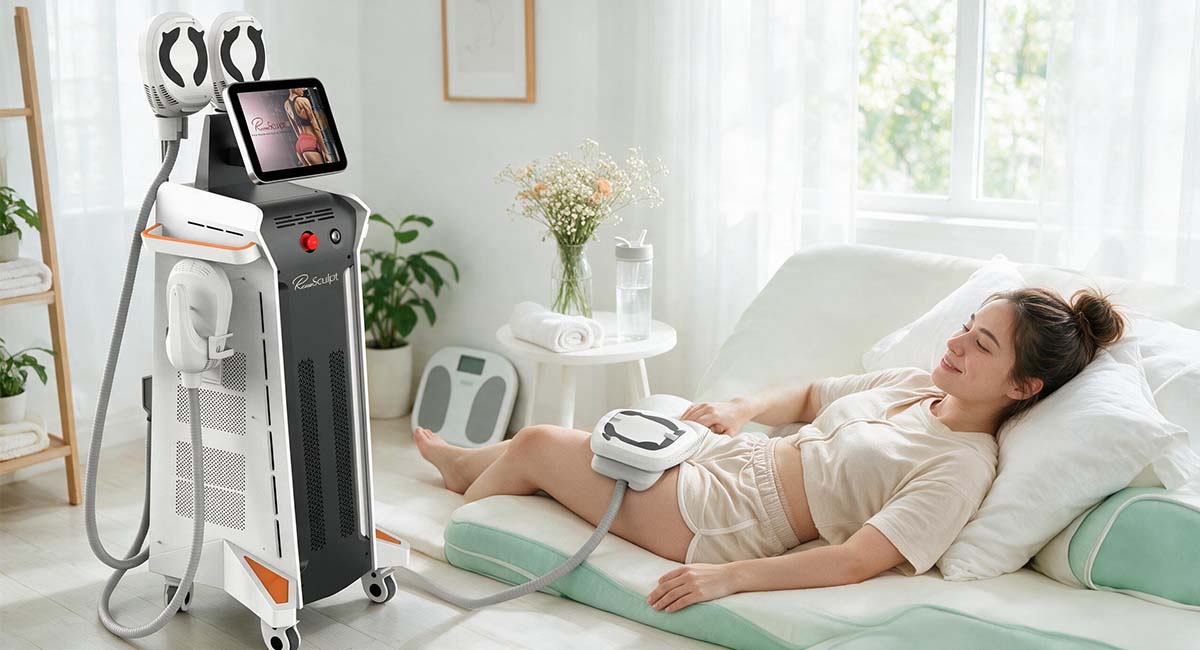
All 10 at a Glance
| Rank | Machine | Technology | Builds muscle? | Reduces fat? | Consumables | Best for |
|---|---|---|---|---|---|---|
| 1 | BTL Emsculpt Neo | HIFEM+ + RF | Yes | Yes | Yes (applicators) | Established clinics, chains |
| 2 | CoolSculpting Elite | Cryolipolysis | No | Yes | Yes (applicators) | Brand-led fat freezing |
| 3 | Renasculpt FE60 | HIEMT + EMS + RF | Yes | Yes | No | Fast-ROI muscle + fat |
| 4 | BTL Emsculpt | HIFEM | Yes | No | Yes | Gyms, muscle-only |
| 5 | Cynosure SculpSure | 1060nm laser | No | Yes | No | Hands-free laser lipo |
| 6 | MixSlim HS1000C | 360° cryolipolysis | No | Yes | No | Affordable fat freezing |
| 7 | Cutera truSculpt iD | Monopolar RF | No | Yes (mild) | No | Face + body RF |
| 8 | BTL Vanquish ME | Non-contact RF | No | Yes (mild) | No | Hands-free large area |
| 9 | Syneron UltraShape Power | Focused ultrasound | No | Yes | No | Non-thermal fat only |
| 10 | Winkonlaser 10D | Lipolaser LLLT | No | Yes (mild) | No | Low-cost entry / wellness |
How the Technologies Actually Differ
If you take one thing from this ranking, take this: “body slimming” is not one technology. It is five different mechanisms, and they do not substitute for each other.
Muscle stimulation (HIEMT / EMS). These machines build muscle and, with synchronized RF, reduce fat at the same time. This is the only category that gives a client more than fat loss — it gives tone and definition. For most clinics, a muscle-plus-fat machine has the strongest upsell story because clients see and feel the muscle working during the first session.
Cryolipolysis (fat freezing). This is the most recognized fat-only mechanism. It kills fat cells permanently in the treated area, but it does nothing for muscle or skin, and results show over weeks as the body clears the dead cells. Choose it when clients specifically ask for “fat freezing.”
Laser lipolysis (1060nm or LLLT). Two very different things share the “laser lipo” label. A 1060nm device like SculpSure heats fat to the apoptosis range — a real fat-reduction treatment. Low-level laser therapy (LLLT), like our 10D, uses cold light and is a gentler, no-downtime option. When a supplier quotes you a “laser lipo machine,” ask which mechanism and which wavelength before you compare prices.
Cavitation and RF. Ultrasound cavitation breaks fat cells with sound waves; RF heats tissue for fat reduction and mild skin tightening. Both are usually more gradual than cryolipolysis or 1060nm laser and are often bundled into multi-function machines.
Three Buying Mistakes I See Repeatedly
Mistake 1: buying on wattage or “Tesla” numbers alone. A spec sheet can say anything. What matters is whether the energy is delivered deep enough and consistently enough to produce a result — and whether there is clinical evidence behind the platform. I have watched clinics buy the highest-numbered machine on a supplier’s comparison chart and get a device that under-delivers. Ask for the mechanism, the studies, and a demo before you trust the brochure.
Mistake 2: ignoring consumables and session cost. The sticker price is only half the picture. A machine with consumable applicators that cost you tens of dollars per session quietly eats your margin for years. Before you buy, calculate the true cost per session — not just the purchase price.
Mistake 3: treating “FDA cleared” and “FDA approved” as the same thing. They are not the same regulatory bar, and a device can be marketed with a claim its clearance does not actually cover. Verify the specific indication on the clearance before you repeat a supplier’s claim to your clients.
Which Machine Should You Buy?
Your answer depends on one number: how many body sessions you can realistically book each week.
-
Fewer than 5 body sessions a week — do not buy a six-figure machine. A factory-direct muscle-plus-fat system like the Renasculpt FE60, or a lower-cost cryolipolysis unit like the MixSlim HS1000C, keeps your payback short while you build demand.
-
5 to 15 sessions a week — a muscle-plus-fat machine with a strong brand or a dual-applicator fat-freezing system makes sense. Consumable cost now matters, so model it.
-
15+ sessions a week, established body practice — the premium names (Emsculpt Neo, CoolSculpting Elite) justify their price because your volume covers the consumables and the brand pulls clients.
The machines we build are for the first two tiers: clinics that want the treatment capability of the premium brands at factory-direct pricing, without the six-figure commitment and without ongoing applicator costs.
One limitation I want to be upfront about: no body slimming machine produces the overnight transformation some brochures imply, and every technology on this list works best as a treatment course with realistic client expectations — not as a single session.
Frequently Asked Questions
Q: What is the best body slimming machine for a new clinic?
A: A muscle-plus-fat machine with no consumables, so you can run unlimited sessions while you build a client base. The Renasculpt FE60 fits this: it builds muscle and reduces fat in one session, and there are no applicators to keep buying.
Q: How much does a body slimming machine cost?
A: The range is extreme — from roughly $4,000 for entry-level factory-direct machines to over $200,000 for premium brands. The price you pay should track the volume you can book, not the brand’s marketing budget.
Q: Do slimming machines really work?
A: The right machine, used correctly, produces real and measurable results — muscle gain, fat reduction, or both. The honest caveat is that no machine replaces diet and exercise, and the best results come from a treatment course plus realistic client expectations.
Q: Which is better, Emsculpt or CoolSculpting?
A: They do different jobs. Emsculpt builds muscle (and the Neo also reduces fat); CoolSculpting only freezes fat. If you want one machine that does both, a muscle-plus-fat system is the better use of your budget.
Q: What is the difference between laser lipo and cryolipolysis?
A: Laser lipo (1060nm) heats fat cells to trigger their removal; low-level laser (LLLT) uses cold light for a gentler effect. Cryolipolysis freezes fat cells. Heat, cold and light are three different mechanisms with three different result speeds.
Q: Are body slimming machines safe?
A: FDA-cleared or approved machines are safe for most people when used by trained staff and within protocol. The machines are contraindicated for pregnancy, active cancer, pacemakers or metal implants near the treatment area, and certain skin conditions — a proper consultation screens for these before any session.
Q: How many sessions do clients need?
A: Muscle-plus-fat treatments typically deliver visible change in a 4–6 session course. Fat-freezing and laser lipo results build over weeks as the body clears treated cells, and multiple sessions are usually needed per area.
Q: What is the ROI of a body slimming machine?
A: A factory-direct machine in the $4,500–$5,000 range can be paid back in a handful of treatment courses, because session cost is near zero with no consumables. A six-figure premium machine needs consistent high volume to cover applicator costs and the upfront price.
Sources
-
BTL Industries — Emsculpt Neo and Emsculpt clinical documentation.
-
Allergan Aesthetics — CoolSculpting and CoolSculpting Elite product information.
-
Cynosure — SculpSure 1060nm laser lipolysis technical literature.
-
Cutera — truSculpt iD product information.
-
Syneron Candela — UltraShape Power focused ultrasound literature.
-
Winkonlaser — Renasculpt FE60, MixSlim HS1000C and 10D product specifications (verified on winkonlaser.com).
Related Reading
If you are comparing machines and want straight answers on specifications or pricing, contact us — I would rather you buy the right machine for your clinic than the wrong one quickly.