


Picosecond vs Nanosecond Laser: Which Actually Removes Tattoos Faster?
Table of Contents
You are sitting on two quotes from two suppliers. One is pushing a picosecond laser. The other swears by nanosecond. Both toss around words like “gold standard” and both cost more than you want to spend. And you are supposed to figure out, from spec sheets that read like a physics exam, which one will actually get ink off your clients’ skin faster.
I have watched this exact conversation play out in clinics more times than I can count. So let me cut through it.
The Short Answer
Here is the thing nobody spells out. Picosecond and nanosecond are not two different machines doing two different jobs. They are two different ways of delivering the same kind of energy. The difference comes down to how long each pulse lasts, and that single number changes everything about how the laser treats skin.
Let me start with the plain version. A nanosecond is one billionth of a second. A picosecond is one trillionth of a second. That sounds like hair-splitting until you understand what the laser does with that time.
A nanosecond laser works mainly through heat. The pulse stays on long enough to warm the tattoo ink, and the ink particle breaks apart because it overheats. It works. But that heat also leaks into the skin around the ink, which is why nanosecond treatments tend to sting more and need more downtime.
A picosecond laser works through pressure, not heat. The pulse is so short that it does not have time to cook the surrounding skin. Instead it delivers a shockwave that shatters the ink into much smaller fragments. Smaller fragments are easier for your body to clear out. That is the whole game in one sentence: picosecond shatters finer, so the body finishes the job faster.
I should be careful here, because a lot of salespeople say “picosecond is better, period.” That is not quite true either. Nanosecond is not broken. For plenty of cases it still does solid work, and it costs a lot less. The honest answer is that picosecond is usually faster and gentler, while nanosecond is cheaper and still effective for simple black ink.

Picosecond vs Nanosecond: The Comparison Table
| Dimension | Picosecond | Nanosecond |
|---|---|---|
| Pulse duration | 10⁻¹² seconds | 10⁻⁹ seconds |
| How it breaks ink | Photomechanical (shockwave) | Photothermal (heat) |
| Ink fragmentation | Very fine fragments | Medium fragments |
| Pain level | Milder | More painful |
| Thermal damage risk | Lower | Higher |
| Sessions needed | 3–6 | 8–12 |
| Downtime | Faster healing | Redness/scabbing, several days |
| Color coverage | Black + stubborn blue/green | Black + some dark ink |
| Skin rejuvenation | Yes (1320nm black doll facial) | Limited |
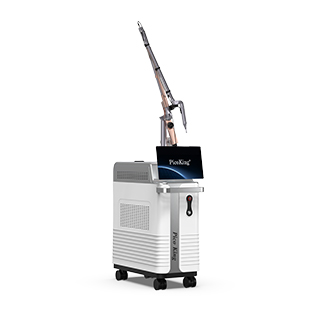
| Entry price | ~$6,900 (PicoKing EL950) | ~$1,500 (portable ND:YAG) |
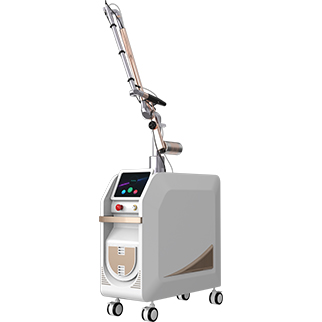
| Representative machine | PicoKing EL950 | LG002B portable ND:YAG |
What This Means in Practice
So which one do you buy? It depends on what your clinic actually does, not on which salesperson talked louder.
If you mostly remove simple black tattoos and your budget is tight, a nanosecond Q-switched machine still makes sense. You will do more sessions per client, but you can also price those sessions lower and still come out ahead.
If you want to clear multi-color tattoos, pigmentation, and offer skin rejuvenation too, a picosecond machine earns its price. One machine covers tattoo removal, pigment treatment, and a facial treatment. That is three revenue streams instead of one.
I should mention the thing most spec sheets skip: color matters more than people think. Red, blue, and green ink are stubborn. Nanosecond heat often cannot shift them without scarring risk. Picosecond shockwaves break those colors without cooking the skin. If your market has a lot of clients with colored tattoos, this alone tilts the decision.
The Honest Limits
Now the part where I am honest about limits. The main limitation of both technologies is that neither works on every skin type or every ink color, and pretending otherwise just sets a client up for disappointment.
Neither technology removes a tattoo in one session. Anyone who tells you otherwise is selling hope, not a machine. Both take multiple visits and both depend heavily on the ink type, the skin tone, and how deep the artist put the ink.
Wavelength matters as much as pulse duration. A 1064nm beam penetrates deeper and is safer for darker skin, which is why both picosecond and nanosecond machines lean on it for tattoo work. The 532nm and 755nm wavelengths target red, orange, and brown pigment better, so a machine that only offers one wavelength limits what you can treat. A four-wavelength platform is the difference between a machine that removes tattoos and one that also clears pigment and brightens skin.
Skin tone changes the calculation too. Fitzpatrick skin types V and VI, meaning darker skin, hold more melanin, and melanin absorbs laser energy the same way tattoo ink does. A laser that fires too long, or at the wrong wavelength, can damage the surrounding skin instead of the ink. This is where picosecond’s short pulse earns its reputation, because it does the work before the heat spreads.
Which One Should You Buy?
For clinics, my honest recommendation breaks into three groups.
If you are a new tattoo studio adding removal as a side service, start with nanosecond. The entry cost is low, around $1,500 to $3,000 for a portable unit, and it handles the basic black-ink jobs that walk in the door.
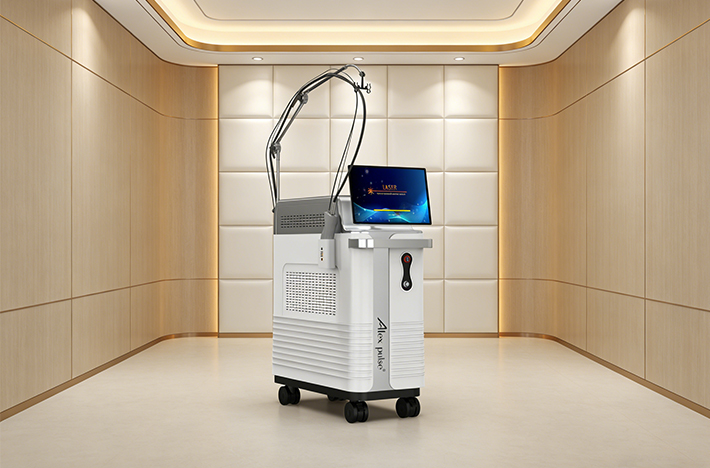
If you are an established clinic or med spa doing serious volume, the picosecond flagship is the better call. Winkonlaser’s PicoKing EL950 runs four wavelengths, 532nm, 755nm, 1064nm, and 1320nm, which covers tattoo removal, pigmentation, and skin rejuvenation in one platform. The 1320nm setting is specifically for the “black doll” facial, not for hair removal, so do not confuse the two.
If you are somewhere in between, you can run a nanosecond portable as the entry tool and add picosecond once volume justifies it. There is nothing wrong with that ladder.
The last thing I would say is this. We have been building and exporting these machines for over 12 years, shipping to more than 90 countries, and the question I hear most is not “which technology” but “will my clients actually see a difference.” The answer is yes, and the difference shows up in fewer sessions. Fewer sessions means happier clients, and happier clients mean more referrals. That is the real ROI, and it beats any spec-sheet bullet point.

Frequently Asked Questions
Q: Is picosecond faster than nanosecond for tattoo removal?
A: Yes, in most cases. Picosecond shatters ink into finer fragments, so the body clears it in fewer sessions, often 3 to 6 versus 8 to 12 for nanosecond.
Q: Does picosecond hurt less than nanosecond?
A: Usually, yes. Because picosecond works through shockwave rather than heat, there is less thermal damage to surrounding skin and most people find it milder.
Q: How many sessions does a picosecond laser need?
A: Most tattoos need 3 to 6 sessions with picosecond. Simple black ink can clear faster, while stubborn colors and amateur deep tattoos can take more.
Q: Is a nanosecond laser still worth buying?
A: For simple black tattoos on a budget, yes. A Q-switched nanosecond machine from around $1,500 still does the job, just with more sessions and more downtime.
Q: Can picosecond remove all tattoo colors?
A: It covers more colors than nanosecond, including difficult blue and green. But some colors, like certain whites and yellows, resist all lasers. No machine removes every ink.
If you are comparing machines right now, the practical next step is to look at what your clients actually ask for. If it is mostly black ink, nanosecond will pay for itself. If it is color and pigmentation and skin work, picosecond is the machine that grows with you. Our PicoKing EL950 is the picosecond platform we built for exactly that, and you can see the full specs at the EL950 product page. If you want to talk through which one fits your clinic, contact us and we will walk through it with you, no pressure.
You can learn more about what to look for in a picosecond machine in our picosecond buying guide, and if you want the technical background on how these wavelengths behave, our Nd:YAG technology explainer covers it.