


HIFU vs Thermage: Which One Actually Lifts? – Winkonlaser
Table of Contents
The Question Clients Keep Asking
Every week, someone walks into a clinic and says the same thing: “I want to lift my face, but I don’t want surgery. Should I do HIFU or Thermage?”
They have usually done their homework. They have read the forums, watched the before-and-after videos, and now they are standing in front of you expecting a clear answer. There is not one universal answer, but there is a clear way to choose.
The short version: HIFU fires focused ultrasound energy deep into the SMAS layer, the same layer a surgeon pulls during a facelift. Thermage uses monopolar radiofrequency to heat the dermis and tighten the whole skin. Both tighten. Neither is a facelift. But they tighten different layers, and that is why the right choice depends on what your client’s face actually needs.
How HIFU Actually Works
HIFU is ultrasound, not light and not radiofrequency. The machine focuses ultrasound waves at precise depths under the skin, typically 1.5mm, 3.0mm, and 4.5mm, and creates tiny thermal coagulation points at each depth. The tissue around each point heats to roughly 60 to 70 degrees Celsius for a fraction of a second.
The 4.5mm depth is the one that matters. That is the SMAS, the superficial musculoaponeurotic system, the layer a surgeon physically lifts and repositions in a surgical facelift. HIFU cannot replace that surgery, but it can tighten the same layer without cutting.
The result shows up gradually. The heat creates controlled micro-injuries, and the body answers by building new collagen over the next two to three months. Skin looks firmer, the jawline gets a little sharper, and the lower face stops sagging as much.
I have watched clinics run HIFU for a few years now. The results are real but modest. A client with mild to moderate laxity gets a nice lift. A client with heavy jowls and deep folds will not get the same outcome, and you should say that up front. Promising a facelift from any non surgical device is how you lose a client’s trust forever.
How Thermage Actually Works
Thermage is monopolar radiofrequency. A single electrode pushes RF energy through the skin, heating the dermis and the deeper layers while the surface stays cooled. The target is the collagen layer, heated into the same 60 to 65 degree range.
The mechanism is different from HIFU. HIFU punches focused points of heat at fixed depths. Thermage delivers a broader field of heat through the tissue, which contracts the collagen that is already there and triggers new collagen over the months that follow. It is less about lifting one specific layer and more about tightening the whole fabric of the skin.
Thermage is best known as a single session treatment. You come in once, and the tightening keeps improving for up to six months. That is the main selling point: one visit, then done.
The brand name matters here. Thermage is a registered product line, and a lot of what people think they know about RF skin tightening comes from its marketing. Generic RF tightening devices exist, but when a client says “Thermage,” they usually mean that branded single session monopolar RF experience.
The Core Difference: Depth and Energy
If I had to reduce the whole comparison to one sentence: HIFU targets deeper layers with focused ultrasound, and Thermage tightens a broader area with radiofrequency heat.
That one sentence drives most of the real world differences. HIFU reaches the SMAS at 4.5mm, which is why it gets marketed as a non surgical facelift. Thermage heats the dermis and the subdermal layer, which is why it is better known for overall skin smoothing and tightening, especially around the eyes and across the full face.
One more thing worth saying plainly: HIFU has a mechanical precision that Thermage does not. Ultrasound can create exact thermal zones without heating everything along the way. RF heats everything in its path, which is why cooling matters so much in RF devices. You are protecting the surface while you heat the deeper layer. A laser works differently again, using a specific light wavelength measured in nanometers, like 755nm or 1064nm, to hit a target. HIFU and Thermage are not lasers, and the distinction matters when a client asks what they are actually paying for.
HIFU vs Thermage: Full Comparison Table
| Dimension | HIFU | Thermage |
|---|---|---|
| Energy type | Focused ultrasound | Monopolar radiofrequency |
| Target depth | 1.5mm to 4.5mm (SMAS) | Dermis and subdermal layer |
| Core action | Lifts the SMAS layer | Tightens and smooths the full skin |
| Best for | Mild to moderate sagging, jawline, lower face | Overall skin laxity, fine lines, eye area |
| Sessions needed | Often 1, sometimes a touch up | Usually 1 |
| Results appear | 2 to 3 months | Over 3 to 6 months |
| Results last | Roughly 12 to 18 months | Roughly 12 to 24 months |
| Pain level | Moderate, brief zaps | Moderate, with a heated sensation |
| Downtime | None to a day | None to a day |
| Suitable skin types | All | All |
| Typical market cost per session | Lower than Thermage | Higher than HIFU |
The market cost line is deliberately vague. Prices vary so much by country and clinic that a fixed number would be misleading. What holds true almost everywhere: a Thermage session tends to run higher than a HIFU session, partly because of the branded consumable tips and partly because it is positioned as a premium single session treatment.
Results and How Long They Last
HIFU results build over two to three months as the new collagen forms, and they usually hold for 12 to 18 months. Thermage results build over three to six months and often hold for 12 to 24 months. Neither is permanent, and both need maintenance to keep the effect.
The honest math most clinics skip: a client who gets HIFU once a year spends less per year than a client who gets Thermage, but the Thermage client may walk away feeling they got more “tightening” because the improvement keeps compounding for longer.
I have seen clients walk out of a HIFU session and look the same for six weeks, then suddenly look firmer at the eight week mark. That delay surprises people. If you do not set the expectation up front, the client thinks it failed. Say the words “this takes two to three months to show” before you start, not after.
Pain and Downtime: What Clients Will Ask
Both are tolerable but not painless. HIFU feels like a series of quick, sharp zaps, strongest over bony areas like the jaw and forehead. Thermage feels like a spreading heat with a cold spray or cooled tip to keep the surface comfortable.
Downtime is basically zero for both. Mild redness for a few hours, maybe slight tenderness for a day. Clients can go back to work the same afternoon, which is a big part of why both sell well to people who cannot afford a surgical recovery.
Who Should Get Which
Break it into three groups.
Group one, mild to moderate sagging with a soft jawline: HIFU is the better fit. It hits the SMAS directly, which is the layer doing the sagging.
Group two, overall laxity with fine lines, especially around the eyes: Thermage tends to win, because it tightens the full skin rather than one deep layer.
Group three, heavier jowls, deep nasolabial folds, or significant loose skin: neither one is going to satisfy them. This client is a surgical consult, and recommending HIFU or Thermage instead is setting them up to be disappointed.
Where Both Fall Short (Honest Limitations)
No piece of technology is perfect, and honesty about limits builds trust. Neither HIFU nor Thermage is a substitute for a surgical facelift. Neither removes significant excess skin. Neither is permanent, and results vary a lot from person to person. Someone with thin skin or poor collagen response will get less than the before and after photos suggest.
There is one more limitation that rarely gets said out loud: both depend on the operator and the protocol. A weak machine, a rushed session, or an undertrained operator produces a warm face and no result. The device matters, but the person running it matters just as much. That is why I would not recommend buying a HIFU machine on price alone.
A Clinic Owner’s View: One Machine or Both
If you already run a clinic and you are deciding what to add, the question is not “which treatment is better” but “which client am I missing.”
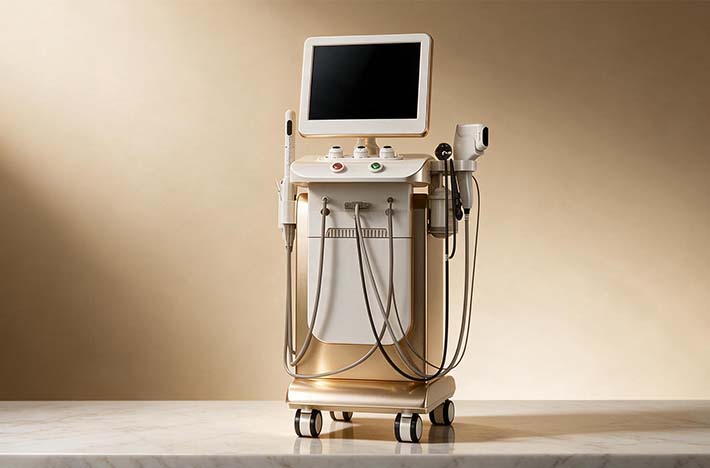
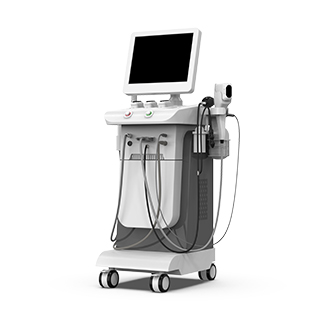
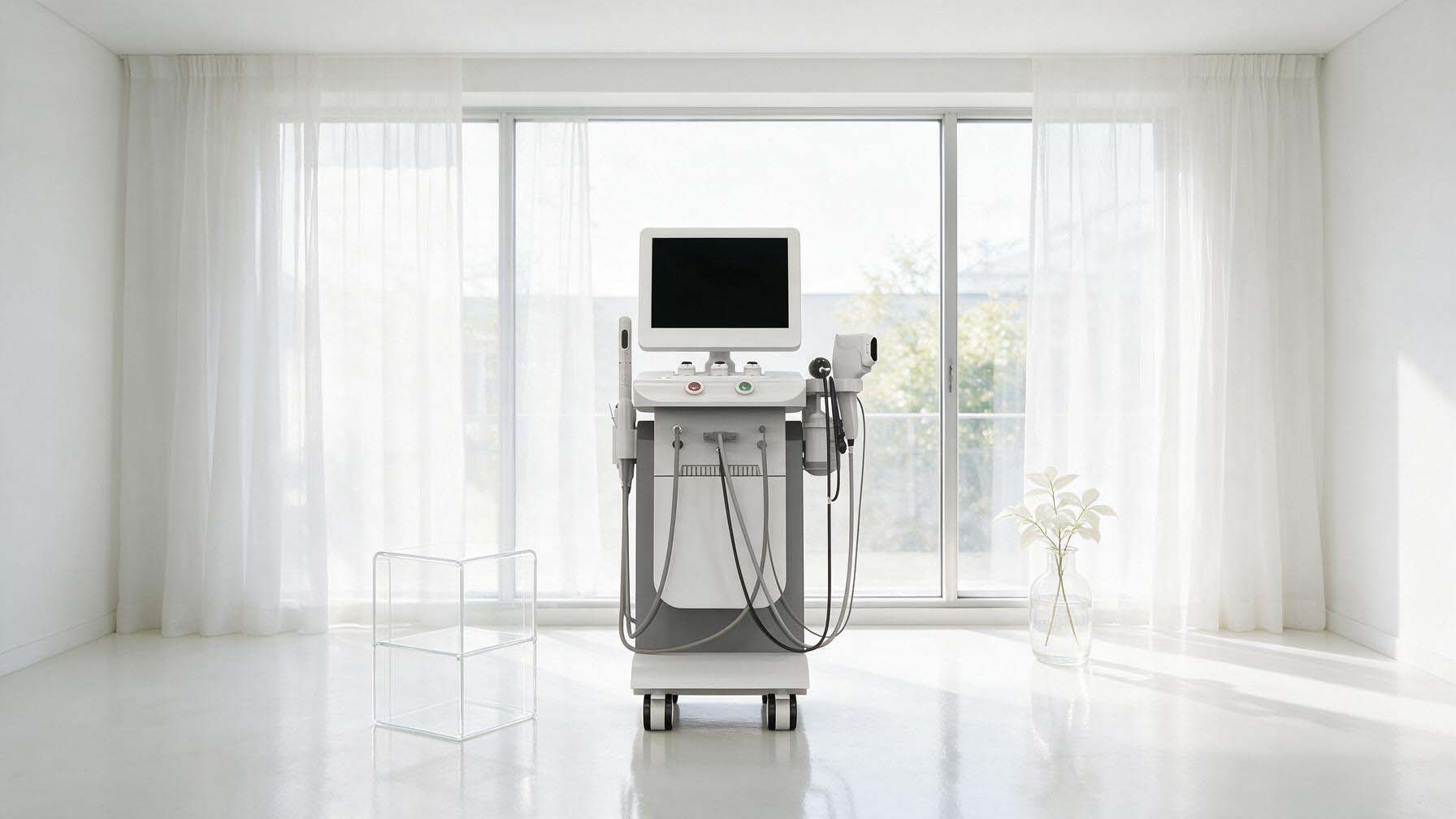
A HIFU machine covers the client who wants a lift and a sharper jawline. It also opens the door to body applications, since the same HIFU platform can treat the abdomen, arms, and thighs at deeper cartridge depths. The Winkonlaser 7D HIFU (HU400), for example, is a 4-in-1 system that pairs 3D/4D/7D HIFU with microneedle RF. One machine delivers both the deep SMAS lift and the surface tightening we just compared, across eight cartridge depths from 1.5mm to 16mm, so it moves from a 4.5mm facial SMAS treatment to deeper body contouring without a second device. That is the practical payoff of the HIFU-versus-RF question we started with: you can stop choosing and carry both in one unit. Winkonlaser has been manufacturing aesthetic machines for over 12 years, and the HU400 carries that experience. It is a workhorse, not a first generation prototype.
Thermage style RF, on the other hand, covers the client who wants full face smoothing and eye area tightening. It is a great second modality, but as a standalone it does not offer the depth range that HIFU does, and the branded consumables make the per session cost harder to control.
Most clinics that offer both end up using HIFU for the lift and RF for the surface. They are complementary, not competing. If you can only add one, and you want the broadest range of treatable clients from a single device, a multi depth HIFU platform like the 7D HIFU (HU400) is the more practical first step. You can read more about how the depth system works in our guide to HIFU for face treatment, and see how HIFU compares to RF microneedling in our dedicated comparison.
Contraindications and Safety
Both HIFU and Thermage are contraindicated for pregnancy, active skin infections or open wounds in the treatment area, and for anyone with a pacemaker or implanted electronic device, since the energy can interfere. People with metal implants in the treatment zone should be cleared by a physician first. Neither treatment is recommended for anyone with active autoimmune disease affecting the skin or a history of poor wound healing without a medical sign off. This is not an exhaustive list, and a proper consultation should always come before a first session.
FAQ
Q: Is HIFU better than Thermage?
A: It depends on the goal. HIFU reaches deeper into the SMAS layer for lifting and jawline definition. Thermage tightens and smooths the full skin surface. For sagging, HIFU. For overall laxity and fine lines, Thermage.
Q: Which is more painful, HIFU or Thermage?
A: Both are tolerable. HIFU feels like quick sharp zaps, stronger over bone. Thermage feels like spreading heat with a cooled tip. Neither needs numbing for most clients.
Q: How long do results last?
A: HIFU typically 12 to 18 months, Thermage 12 to 24 months, with maintenance sessions to keep the effect.
Q: Which costs more?
A: Thermage sessions tend to run higher than HIFU, largely because of branded consumable tips and its premium positioning. Actual prices vary widely by clinic and country.
Q: How many sessions will I need?
A: Usually one for either treatment. Some clients add a HIFU touch up after a year. Neither is a one and done forever, maintenance keeps the result.
Q: Can HIFU and Thermage be combined?
A: Yes, they are complementary. HIFU lifts the deep layer while RF tightens the surface, which is why many clinics offer both.
Final Verdict
Here is the way I would put it to a client: if you want to lift and define, choose HIFU. If you want to smooth and tighten everywhere, choose Thermage. If you want both, do both, because they work at different depths and do not fight each other.
For a clinic owner, the smarter first purchase is usually a multi depth HIFU machine, because it covers the lift clients today and the body contouring clients tomorrow. Whatever you add, buy it for the clients you actually see, and be honest with them about what the machine can and cannot do. That honesty is the thing that keeps them coming back, long after the tightening fades.
For factory direct pricing on the 7D HIFU (HU400) or to talk through which machine fits your client base, get in touch with Winkonlaser and we will walk you through the options without the sales pressure.