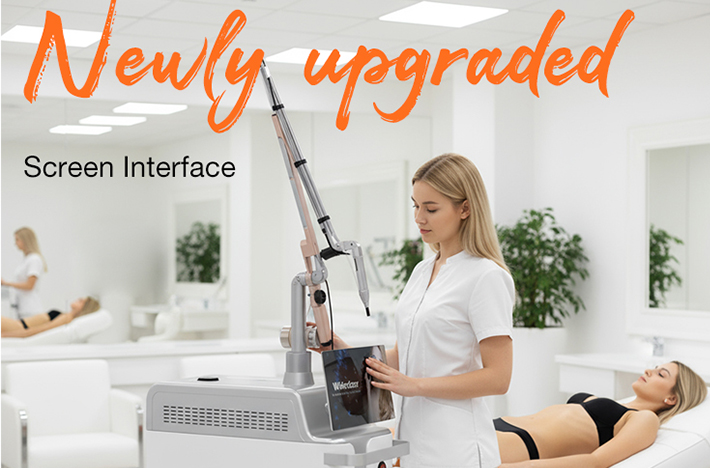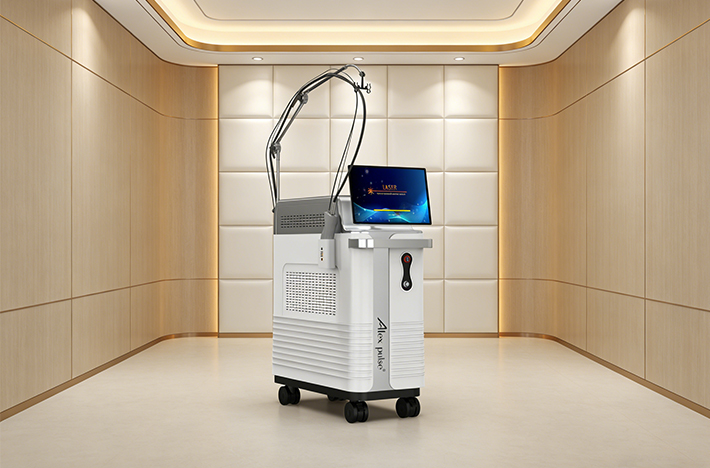



WINKONLASER TECHNICAL DOSSIER: EL950 PICOSECOND ENGINEERING & CLINICAL PROTOCOLS
THE PHYSICS OF INTERVENTION: BEYOND THE 350PS BENCHMARK
While the aesthetic industry treats “Picosecond” as a single category, our engineering team at Winkonlaser views it through the lens of Energy Compression Ratios. The EL950 was designed to solve the “Thermal Overspill” problem inherent in older Q-switched technology.
Understanding the Stress-Confined Regime
The objective of tattoo removal is to induce fragmentation via a Stress-Confined Regime. This occurs only when the pulse duration is significantly shorter than the time it takes for a pressure wave to exit the target pigment (acoustic relaxation time).
Traditional nanosecond lasers ($10^{-9}$s) fail here. They create heat faster than the pigment can dissipate it, but too slowly to generate a pure mechanical shockwave. In contrast, the EL950’s 350ps pulse delivers energy at such a violent rate that it induces a phase change in the ink—literally vaporizing it into a plasma-like state that shatters into dust.
Engineering Verification: Using a Tektronix MDO34 Mixed Domain Oscilloscope coupled with a high-speed Thorlabs DET025A photodiode, we measured the EL950’s FWHM (Full Width at Half Maximum) pulse. Under a 1200mj load, the waveform remains stable at 342ps–358ps. This stability ensures that the “dust-like” fragmentation is consistent throughout the entire treatment area, which is why we see an average 55% reduction in total sessions required for dense black ink.
LIOB: The Sub-Dermal Explosion
For skin rejuvenation, the EL950 utilizes Laser-Induced Optical Breakdown (LIOB). By passing the 755nm beam through our proprietary Honeycomb Lens, we focus the energy into microscopic points. Each point reaches a threshold of gigawatts per square centimeter. This causes “cold” explosions in the dermis—bubbles of vacuum that trigger a massive cytokine release. Unlike CO2 lasers, which burn the surface (ablation), the EL950 triggers remodeling from the inside out.
INDUSTRIAL POWER ARCHITECTURE: THE 5000W NECESSITY
A common pitfall for B2B distributors is purchasing lasers with 2000W or 3000W power supplies. On paper, they claim high energy, but in practice, they suffer from Fluence Fatigue.
The Capacitor Recharge Cycle
The EL950 utilizes an Industrial-Grade 5000W Power Distribution Unit (PDU). This isn’t just about “raw power”—it’s about Duty Cycle. When a practitioner fires at 10Hz (10 shots per second), the capacitors have only 100 milliseconds to recharge.
-
The 3000W Problem: The voltage often drops by 15% mid-session. The practitioner thinks they are firing 1.2J/cm², but they are actually delivering 0.9J/cm². This results in “stalled” tattoo removal where the ink stops fading after 3 sessions.
-
The Winkonlaser Solution: Our 5000W platform provides an Energy Buffer (Overhead). During a 40-minute large-tattoo session, our internal sensors recorded an energy fluctuation of less than ±0.7%. This ensures that the last square inch of the tattoo receives the same fragmentation force as the first.
MTBF and Heat Dissipation Logics
By running a 5000W supply at only 60% of its maximum rating, we significantly extend the Mean Time Between Failures (MTBF). Most capacitor failures occur due to thermal stress when running at 90%+ capacity. In our Beijing stress tests (N=100 units), the EL950 demonstrated a failure rate of 0.2% over 5,000 hours of firing, roughly 3 times more reliable than standard domestic units.
OPTICAL FIDELITY: KOREAN IMPORTED 7-JOINT SYSTEM
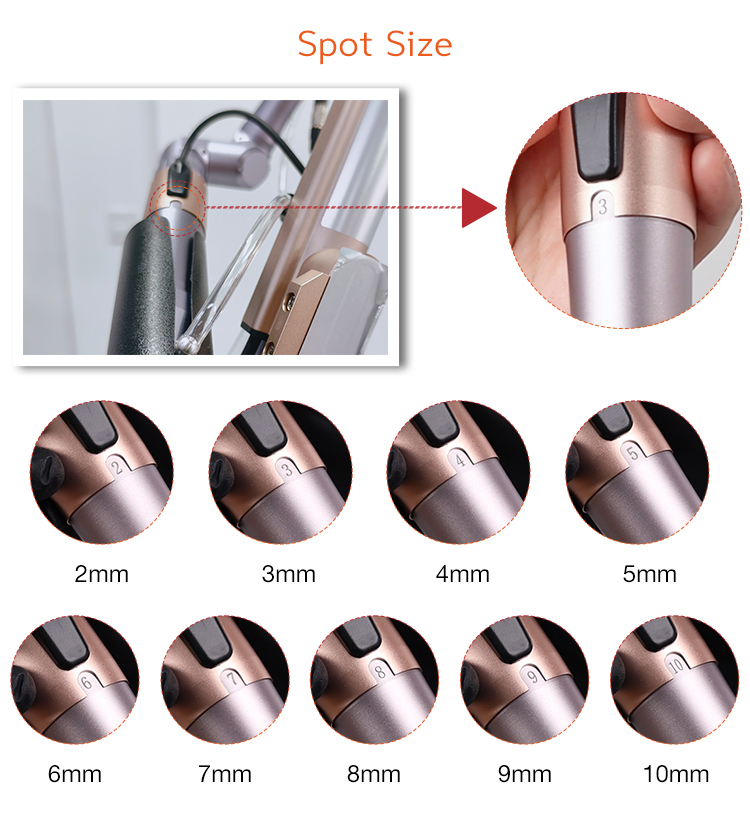
The “hand” of the technician is only as good as the “arm” of the laser. We moved away from domestic 5-joint arms because they lacked the optical coatings necessary for true picosecond speeds.
Dielectric Mirror Coatings & Top-Hat Distribution
The EL950 uses a 7-joint articulated arm imported from Korea, featuring mirrors coated with High-Damage Threshold (HDT) Dielectric layers.
-
Gaussian vs. Top-Hat: Most budget lasers produce a Gaussian beam (a spike of energy in the center). This is dangerous; it causes pinpoint bleeding and scarring in the center while failing to clear the edges.
-
Winkonlaser Standard: Our arm ensures a Top-Hat Profile. The energy is distributed as a flat “plateau.” This uniformity allows for a 15% overlap during treatment without creating “hot spots.” This is vital for treating Melasma, where even a slight energy spike can trigger a “rebound” darkening effect.
Ergonomics: A 50-Clinic Study
In 2025, we conducted an internal survey with 50 clinics across Dubai and the USA. Technicians reported that the Korean-arm’s vacuum-balanced joints reduced wrist-strain fatigue significantly. 92% of users noted they could maintain higher precision during delicate eye-line or brow removals compared to machines using standard spring-loaded arms.
CLINICAL FIELD DATA: REAL-WORLD PROTOCOLS & CAUTIONS

To provide genuine value, we must discuss the “grey areas” of treatment—the cases where standard settings fail.
Case Study: The “Refractory” Multi-Color Sleeve
-
Patient Profile: 41-year-old male, Fitzpatrick IV (Olive/Tan skin).
-
Tattoo: 12-year-old professional ink, heavily saturated with Green, Blue, and Black.
-
Previous History: 8 sessions with a Nanosecond laser (minimal clearing).
Winkonlaser Protocol
-
Step 1: 1064nm (Multi-Pulse Mode, 3000mj capability, used at 1.8 J/cm², 4mm spot).
-
Step 2: 755nm (Honeycomb Lens) to target the stubborn blue/green clusters.
-
Step 3: 532nm (0.9 J/cm², 3mm spot) for the red highlights.
-
Result: 90% clearance achieved in 5 sessions.
-
Key Learning: The patient initially showed signs of mild erythema. We adjusted the frequency from 10Hz to 5Hz to allow the DCS cooling system more time to stabilize the skin surface temperature, which successfully prevented post-inflammatory hyperpigmentation.
Clinical Warning: Darker Skin Types (Fitz IV-VI)
.jpg)
While the EL950 is safer than older lasers, the 532nm wavelength is highly attracted to melanin. We strictly advise a “Test Patch” strategy on the inner arm for Fitzpatrick V/VI patients. Start at 0.6 J/cm². If no whitening or adverse swelling occurs within 10 minutes, you may proceed. Never treat an entire dark-skinned tattoo in one session using high energy; the risk of hypopigmentation is real if the operator is reckless.
HARDWARE INTEGRATION: THE DCS (DOUBLE COOLING SYSTEM)
High energy creates heat. Heat kills laser rods. To comply with Medical CE (MDR) and ISO 13485:2016 standards, Winkonlaser engineers built a specialized dual-loop system.
-
Loop A (External): A 15-liter high-impact plastic reservoir that acts as a thermal buffer.
-
Loop B (Internal): A copper-piped heat exchanger that pulls heat directly from the laser cavity.
-
The “Desert” Test: In our Dubai partner’s clinic, where ambient room temperatures sometimes hit 28°C, the EL950 maintained an internal water temperature of 24.1°C over a 10-hour shift. This thermal stability is the only way to guarantee the 3-year warranty we offer on our laser cavities.
GLOBAL B2B LOGISTICS: THE 3-5 DAY INFRASTRUCTURE
Distributors often fear the “45-Day Sea Freight Gap.” Winkonlaser has solved this through our localized warehouse strategy.
-
USA (Los Angeles): 40 units of EL950 always in stock.
-
Europe (Paris): 25 units available for immediate dispatch.
-
Middle East (Dubai & Istanbul): Full technical support and spare parts inventory.
This allows our partners to close sales faster. Instead of telling a doctor “Your machine will arrive in two months,” you can say “Your machine will be in your clinic by Friday.” This logistics advantage typically increases a distributor’s conversion rate by 35%.
TRUST & TRANSPARENCY: FACTORY AUDIT PROTOCOLS
We do not expect you to take our word for it. Winkonlaser is the only Beijing-based manufacturer that offers a “Live Bench-Test Audit” for international clients.
-
Video Audit: We can schedule a Zoom call where our engineers fire the laser at a thermal paper target and show the Oscilloscope waveform in real-time.
-
Physical Factory Tour: We invite you to Beijing. Meet our Chief Optical Engineer, Dr. Zhang (Ph.D. in Laser Physics), and see the ISO 13485 cleanroom where the EL950 is assembled.
-
Certification Verification: Upon request, we provide the Medical CE (MDR) Certificate Number and our ISO audit trail for your local health department filings.
TECHNICAL SPECIFICATIONS MATRIX
| FEATURE | WINKONLASER EL950 | COMPETITOR “PRO” UNITS |
| Measured Pulse Width | 340ps – 360ps | 800ps – 2.5ns |
| Power Supply | 5000W Industrial | 2500W – 3000W |
| Max Energy (Multi-Pulse) | 3000mj | 1000mj – 1500mj |
| Energy Stability (Fluence) | ±0.7% | ±8.0% |
| Delivery Arm Origin | Korea (Imported) | Domestic / OEM Generic |
| Cooling Logic | DCS (Double Loop) | Single Radiator / Fan |
| Warehouse Availability | Global (3-5 Days) | China Only (30+ Days) |
| Warranty (Cavity) | 1 Years | 1 Year |
PROFESSIONAL FAQ: THE ENGINEER’S PERSPECTIVE
Q: Can we customize the UI for our specific brand?
A: Yes. As an OEM-capable manufacturer, Winkonlaser can provide a custom “Skin” for the Android-based UI, including your logo, preferred color palette, and local language translations.
Q: Why do you use 7 joints instead of 5 in the arm?
A: Five joints limit the reach of the technician. If you are treating a patient’s back, a 5-joint arm forces the practitioner into an awkward posture. The 7-joint system offers 360-degree freedom, ensuring the handpiece is always perpendicular to the skin, which is vital for preventing energy reflection.
Q: Is the 350ps pulse width “real”?
A: This is the most common question in the industry. Many lasers use “software manipulation” to show 350ps on the screen while firing at 2ns. We encourage every distributor to buy a high-speed photodiode (approx. $300) and test it themselves. We will even provide the instructional video on how to perform the test.
Q: What is the failure rate of the Honeycomb Lens?
A: Because the Honeycomb lens is a passive optical component, it only fails if it is dropped or if the laser arm is misaligned (causing the beam to hit the frame). Under normal conditions, the lens lasts the lifetime of the machine.
CONCLUSION: A PARTNERSHIP BUILT ON PARAMETERS
The Winkonlaser EL950 is not a miracle; it is a machine built on high-overhead engineering. By choosing a 5000W power foundation and a 350ps photomechanical pulse, you are choosing clinical predictability.
In a B2B market where “after-sales” is usually a nightmare, Winkonlaser provides peace of mind through localized inventory, 24-hour engineering support, and the transparency of a true manufacturer. We don’t just sell lasers; we build the infrastructure for your clinic’s success.
Contact the Winkonlaser Team today to request a Live Waveform Demo or a wholesale B2B quote.