
How Does Laser Hair Removal Work? Science Explained for Clinic Owners
Table of Contents
If you’re a clinic owner considering adding laser hair removal to your services, you’ve probably read the marketing. “Permanent results.” “Painless.” “Works on all skin types.”
But what actually happens inside the skin when you press the handpiece to someone’s leg?
I’ve worked with hundreds of clinics over the past decade. The ones who understand the science make better equipment decisions, train their staff faster, and get better results. The ones who skip this part end up buying the wrong machine and spending months figuring out why their treatments aren’t working.
This guide covers the actual mechanism — selective photothermolysis, why wavelength matters, what happens during the hair growth cycle, and why the latest generation of diode lasers is changing the game for professional clinics.
1. The Core Principle: Selective Photothermolysis
Here’s the short version.
A laser emits a single wavelength of light. That light passes through the skin. A specific target inside the skin absorbs that light and converts it into heat. The heat destroys the target without damaging everything around it.
That’s selective photothermolysis — selective (it picks the target), photo (light), thermolysis (heat destruction). The concept was first described by Dr. Rox Anderson and Dr. John Parrish at Harvard in 1983. It’s still the foundation of every medical laser treatment today.
For laser hair removal specifically:
The target is melanin — the pigment in the hair shaft and follicle. When the laser pulse hits the skin, melanin absorbs the light energy. That energy converts to heat. The heat travels down the hair shaft into the follicle and damages the cells responsible for hair growth.
The key word is selective. The laser wavelength has to be chosen so that melanin absorbs it strongly, but the surrounding skin tissue (water, hemoglobin) does not. If the wavelength hits water or blood instead of melanin, you get general tissue heating — burns, blisters, no hair reduction.
That’s why wavelength selection matters more than power output. A high-power laser at the wrong wavelength will damage skin. A properly tuned laser at moderate power will selectively destroy follicles with minimal side effects.
A 2012 review in the Journal of Cutaneous and Aesthetic Surgery found that diode lasers (800-810nm) produce 75-90% hair reduction after 6-8 sessions. Alexandrite (755nm) shows similar results but with faster treatment speeds on lighter skin. Nd:YAG (1064nm) has lower absorption by melanin but penetrates deeper, making it the safest choice for dark skin (Fitzpatrick IV-VI).
2. The Hair Growth Cycle — Why Multiple Sessions Are Necessary
This is the part most patients don’t understand, and honestly, a lot of clinic owners don’t fully appreciate it either.
Hair grows in three phases:
Anagen (active growth phase): The follicle is producing hair and directly connected to the blood supply. Melanin is concentrated in the hair bulb. This is the only phase where laser treatment is effective — the melanin target is present, and the follicle is metabolically active enough to be destroyed by heat.
Catagen (transition phase): Hair growth stops. The follicle shrinks and detaches from the blood supply. Melanin production drops. Laser treatment during this phase has poor results.
Telogen (resting phase): The old hair is shed. The follicle is dormant. No melanin target. No effect from laser.
Why this matters for your clinic:
At any given time, only 30-50% of hairs in a treated area are in anagen. That means a single laser session only catches about a third of the active follicles.
The rest are in catagen or telogen — they survive the session and will produce hair again weeks or months later. That’s why standard protocols recommend 6-10 sessions spaced 4-8 weeks apart. Each session catches the hairs that have cycled into anagen since the last treatment.
Body area also matters. Scalp hair has a long anagen phase (years), which is why it’s harder to remove permanently. Leg hair has shorter anagen cycles, so it responds faster. Armpit and bikini hair fall somewhere in between.
I’ve seen clinic owners promise “permanent results after 6 sessions” based on marketing material. It’s not that simple. You need to manage patient expectations honestly: significant hair reduction (70-90%) after a full course, but maintenance sessions once or twice a year are still common.
3. How Different Wavelengths Target Different Tissues
This is where the physics gets interesting, and where most marketing glosses over the details.
Melanin absorbs light across a broad spectrum, but the absorption curve isn’t flat. Different wavelengths penetrate to different depths and target different structures.
755nm (Alexandrite)
Highest melanin absorption of all hair removal wavelengths. The 755nm light is absorbed strongly by melanin in the hair shaft, which means it works fast — treatment times can be 20-30% shorter than 808nm on light skin. But because it’s absorbed so strongly, it carries a higher risk of epidermal damage on darker skin types. Best for Fitzpatrick I-IV. This is the go-to for treating fine, light-colored hair that other wavelengths miss.
808nm (Diode)
The sweet spot. High enough melanin absorption to be effective, deep enough penetration to reach the follicle base in most skin types. This is the workhorse wavelength in professional laser hair removal. Most clinical studies on diode laser efficacy use the 800-810nm band. It’s the most versatile option for clinics treating a diverse clientele.
940nm
This wavelength targets hemoglobin as well as melanin. The addition of hemoglobin targeting means it can coagulate the small blood vessels that supply the follicle. Cut off the blood supply, and the follicle cannot sustain growth. Not every system includes 940nm, but the ones that do add an extra mechanism of action on top of thermal destruction.
1064nm (Nd:YAG)
The deepest penetration of all four wavelengths. Melanin absorption at 1064nm is much lower than at 755nm or 808nm, which means less competition from epidermal melanin. This makes it the safest option for dark skin (Fitzpatrick V-VI) and tanned skin. The trade-off is lower absorption efficiency — you need higher fluence (energy per area) to achieve the same thermal effect.
Why a multi-wavelength system matters for your clinic:
A single-wavelength laser is optimized for one type of patient. If your clientele includes both fair-skinned patients with fine hair and dark-skinned patients with coarse hair, you need different wavelengths to treat them safely and effectively.
The BeauteMed AresLite non-crystal diode lasers (DM40P and DM60) integrate all four wavelengths — 755nm, 808nm, 940nm, and 1064nm — in a single handpiece. The operator selects the appropriate wavelength for each patient’s skin type and hair characteristics. This means one machine covers Fitzpatrick I-VI. No second system needed.
I’ve seen clinics spend $40,000 on a single-wavelength Alexandrite system, then another $60,000 on an Nd:YAG because they wanted to treat dark skin. A multi-wavelength diode laser at a fraction of that cost covers both use cases and produces comparable clinical outcomes.
4. Why Multi-Wavelength Systems Outperform Single-Beam Lasers
This isn’t just about covering more skin types. There’s a practical efficiency angle.
Treating a full leg on a single-wavelength system means swapping patients between machines for different skin areas — or worse, using one wavelength on a patient it’s not optimized for.
With a multi-wavelength system, you can treat a patient with mixed skin characteristics in one session. Switch between 755nm for fine, light hair and 1064nm for coarse, dark hair in the same treatment. No moving the patient. No machine swap. No extra treatment time.
The BeauteMed AresLite systems use FAC (Fast-Axis Collimator) lenses that achieve 99% energy transfer efficiency. Traditional diode lasers lose 15-30% of their energy through the crystal delivery system. Non-crystal technology eliminates that loss, so the energy you set on the screen is the energy that reaches the patient’s skin.
A 2021 study in the Journal of Cosmetic and Laser Therapy compared multi-wavelength diode lasers to single-wavelength systems and found faster treatment times, higher patient satisfaction, and fewer adverse events with the multi-wavelength approach.
5. What Happens During a Laser Hair Removal Session
For the clinic owner who hasn’t operated a laser yet, here’s the step-by-step:
Preparation: The treatment area is shaved 12-24 hours before the session. Shaving leaves the hair shaft below the surface, which is exactly where the laser energy should be absorbed. Waxing or plucking removes the target — do not let patients wax before laser treatment.
Coupling: A cooling gel or the laser handpiece’s built-in cooling system makes contact with the skin. The DCS™ 5-in-1 system on BeauteMed lasers cools the sapphire window to -5°C to +5°C. This pulls heat away from the epidermis during the pulse, preventing burns.
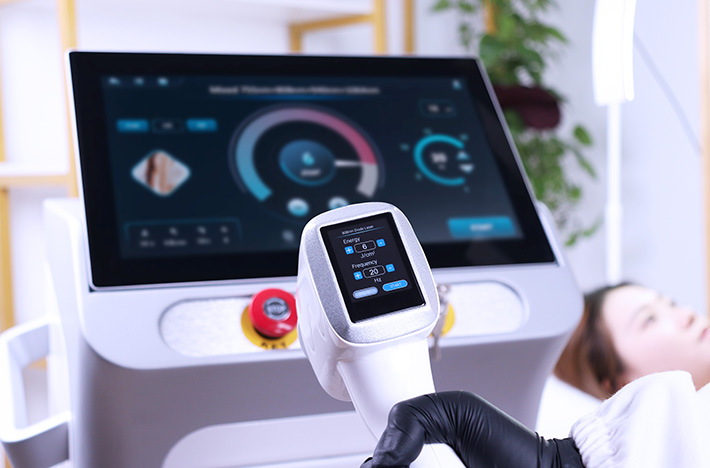
Treatment: The operator selects wavelength, fluence, and pulse width based on the patient’s Fitzpatrick skin type and hair characteristics. On AresLite systems, the SIFHR® technology delivers up to 20Hz pulses in a sliding motion. A full leg can be treated in 15-20 minutes.
Post-treatment: Mild redness and perifollicular edema (small bumps around hair follicles) are normal for 1-24 hours. These are signs that the follicle received thermal damage. No bumps means the energy was too low. The patient must avoid sun exposure for at least two weeks after each session.
What you feel during the session: A warm snap, like a rubber band flicking the skin. The DCS cooling system minimizes this sensation. Most patients describe it as “uncomfortable but tolerable” — not painful. Pain during treatment usually means the fluence is too high or the wavelength is wrong for the patient’s skin type.
6. What Professional-Grade Systems Add That Consumer Devices Cannot
There’s a reason at-home IPL devices cost $300 and professional laser systems cost $5,000-$18,000. They are not the same technology.
AresLite Non-Crystal Technology:
Traditional diode lasers use crystal bars to deliver the laser beam. These crystals degrade over time, require periodic replacement, and lose 15-30% of energy through the delivery system. AresLite non-crystal technology eliminates the crystal entirely. The laser diode emits coherent light directly, with FAC collimation achieving 99% energy transfer. Zero energy decay over 200 million shots. No crystal replacement. No performance degradation.
DCS™ Dynamic Cooling System:
The cooling system on a professional laser isn’t a luxury — it’s a safety requirement. The DCS 5-in-1 system combines semiconductor cooling, compressor cooling, forced air, water circulation, and sapphire crystal contact cooling. It reaches -45°C and maintains the handpiece tip at -5°C to +5°C continuously, even during 20Hz continuous operation. Consumer devices have passive cooling that is ineffective at therapeutic energy levels.
200 Million Shots:
A professional diode laser is rated for 200 million shots. At 20 treatments per week, that’s over 15 years of clinical use. Consumer devices are typically rated for 50,000-100,000 shots — enough for one person, not for a clinic.
FDA Clearance (K241860):
The clinical difference comes down to this: professional systems are FDA-cleared medical devices. Consumer devices are not. The FDA requires clinical data on safety and efficacy. The testing, the documentation, the traceability — these add cost but ensure the device actually works and does not injure patients.
7. Factors That Affect Treatment Outcomes
Not every patient responds the same way. Here’s what I’ve seen in practice:
Hair color and thickness: Dark, coarse hair responds best. The more melanin in the hair, the more laser energy is absorbed. Blonde, red, gray, and white hair have minimal melanin — laser hair removal will not work on these hair colors regardless of the machine. Be upfront with patients about this before they book.
Skin type: Fitzpatrick I-III respond well to most wavelengths. Fitzpatrick IV-VI require longer wavelengths (808nm or 1064nm) to avoid epidermal damage.
Hormonal factors: PCOS, pregnancy, menopause, and certain medications can stimulate hair growth that resists laser treatment. These patients may need more sessions and more frequent maintenance.
Operator skill: The machine is only as good as the person operating it. Proper training on wavelength selection, fluence settings, pulse width, and skin type assessment makes a measurable difference. I’ve seen the same machine deliver 60% reduction with one operator and 90% with another.
8. Common Misconceptions About Laser Hair Removal
“Laser hair removal is permanent.”
The FDA allows the term “permanent hair reduction,” not “permanent hair removal.” The distinction matters. A treated follicle will not produce hair again, but some follicles in telogen during treatment may recover and produce hair later. Most patients achieve 70-90% reduction, not 100%.
“One session is enough.”
Not possible. Because only 30-50% of hairs are in anagen at any time, each session only catches a fraction of the follicles. Standard protocols require 6-10 sessions for optimal results.
“IPL and laser are the same thing.”
IPL is broadband light — a range of wavelengths emitted at once. Laser is a single, coherent wavelength. IPL is less effective, less selective, and carries a higher risk of side effects than laser.
“Laser hair removal is painful.”
Modern cooling systems have reduced discomfort significantly. The BeauteMed DCS™ cooling system keeps the sapphire window at -5°C to +5°C, numbing the skin before each pulse. Most patients describe it as a warm snap, not sharp pain.
9. Contraindications and Safety
⚠️ Laser hair removal is contraindicated in:
-
Pregnancy (no clinical data on safety)
-
Active skin infections or open wounds in the treatment area
-
Photosensitivity disorders or taking photosensitizing medications
-
History of keloid scarring
-
Recent tanning (within 2 weeks) — increases burn risk
-
Active cancer treatment in the area to be treated
-
Tattoos in the treatment area — laser will absorb into tattoo ink
Pre-treatment patch testing is recommended for all patients, especially those with darker skin types or a history of adverse skin reactions.
10. Frequently Asked Questions
Q: How does selective photothermolysis differ from general tissue heating?
A: Selective photothermolysis targets a specific chromophore (melanin in the hair) using a wavelength that is strongly absorbed by that chromophore but not by surrounding tissues. General tissue heating affects everything in the beam path — useful for skin tightening, not for hair removal.
Q: Why do diode lasers use four wavelengths instead of one?
A: Different wavelengths penetrate to different depths and target different tissue structures. 755nm targets melanin in the upper follicle. 808nm penetrates deeper to the follicle base. 940nm targets blood supply. 1064nm is safe for dark skin. A single wavelength cannot do all four jobs effectively.
Q: How does the AresLite non-crystal diode laser differ from traditional diode lasers?
A: Traditional diode lasers use crystal bars that scatter 15-30% of the laser energy and degrade over time. AresLite technology uses direct-emission coherent light with FAC collimation, achieving 99% energy transfer efficiency. No energy decay. No crystal replacement. The result is more consistent clinical outcomes and lower long-term operating costs. See the BeauteMed DM40P and DM60 for specifications.
Q: Can laser hair removal treat ingrown hairs?
A: Yes — this is one of the most effective applications. By destroying the follicle, laser treatment eliminates the source of the ingrown hair. Many clinics report that patients seeking treatment for ingrown hairs are among their most satisfied.
Q: What is SIFHR® technology and how does it improve treatment?
A: SIFHR (Smart Ice Fast Hair Removal) delivers up to 20Hz pulses in a sliding treatment motion. Standard diode lasers operate at 1-5Hz. The higher frequency means you cover more surface area per second. A full leg in 15-20 minutes instead of 45-60 minutes.
11. Final Verdict
Laser hair removal works because of a well-understood physical principle: selective photothermolysis. The laser targets melanin in the hair follicle, converts light to heat, and destroys the follicle without damaging surrounding skin.
The technology has evolved significantly since 1983. Modern multi-wavelength systems like the BeauteMed AresLite DM40P and DM60 integrate four wavelengths in a single handpiece, cover Fitzpatrick skin types I-VI, deliver 200 million shots over a clinical lifetime, and achieve 99% energy transfer efficiency through non-crystal technology.
For clinic owners evaluating equipment, the question isn’t “does laser hair removal work?” — it does, and the evidence is overwhelming. The question is which system delivers the best outcomes for your patient population and practice model.
BeauteMed offers FDA-cleared laser hair removal systems with US warehouse delivery (24-48 hours). We work with clinics and distributors worldwide.
Browse our laser hair removal systems — or contact us to discuss which system fits your practice.

.jpg)