FDA 510(k) for Laser Machines: Verify Before You Buy
Regulatory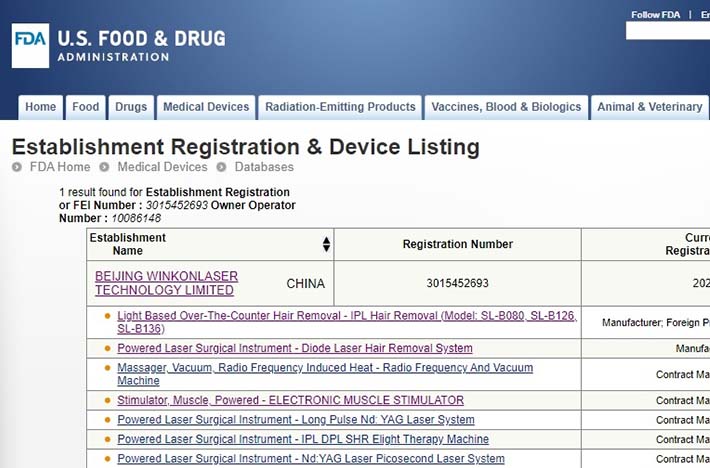
You're on a call with a salesperson. They say their laser machine is "FDA certified." Is it? The phrase "FDA certified" doesn't exist in US regulations — it's not a legal term. What you actually need to verify is FDA 510(k) clearance, and it has a specific format (K followed by 6 digits, e.g. K241860) that you can look up in 30 seconds on a government database. This guide shows you how — and how to spot the 5 most common FDA claims that don't mean what they sound like.
The 4 FDA Terms Salespeople Use — And What They Actually Mean
| What They Say | What It Actually Means | Is It Enough? |
|---|---|---|
| "FDA 510(k) Cleared" | Device reviewed and found substantially equivalent to a predicate device. Has a verifiable K-number. | YES — this is what you need |
| "FDA Registered" | The manufacturing facility paid an annual registration fee and is listed in the FDA database. The device itself has NOT been reviewed. | NO — facility registration ≠ device clearance |
| "FDA Approved" | Applies to Class III high-risk devices (implants, pacemakers) via the PMA pathway. Laser hair removal devices are Class II — they go through 510(k) clearance, not PMA approval. If someone says their laser is "FDA Approved," they don't understand the regulatory system they're operating in. | NO — wrong pathway, wrong terminology |
| "FDA Certified" / "FDA Listed" | These are not FDA terms. They have no legal meaning. Anyone using them is either ignorant or deliberately misleading buyers. | NO — meaningless words |
How to Verify a 510(k) Number in 30 Seconds
Step 1: Ask for the K-Number
A legitimate 510(k) number looks like K241860 — the letter K followed by 6 digits. If the salesperson hesitates, can't produce it, or gives you something in a different format, the clearance likely doesn't exist.
Step 2: Go to the FDA Database
Open accessdata.fda.gov/scripts/cdrh/cfdocs/cfpmn/pmn.cfm — this is the official FDA 510(k) Premarket Notification database. It's public, free, and takes one search.
Step 3: Enter the K-Number and Search
Type the K-number (e.g., K241860) into the "510(k) Number" field. Hit search. If the device exists, you'll see the applicant name, device name, and clearance date. If nothing comes up, the number is either fake or belongs to a different device.
Step 4: Check the Device Name Matches
Verify that the device name on the FDA record matches what you're buying. A common fraud: the seller shows a real 510(k) from one device while selling you a completely different machine. Cross-check the device name and manufacturer name on the FDA record with what's on your invoice.
5 Claims to Walk Away From
What Happens If You Buy a Machine Without 510(k)
Beyond the obvious (customs seizure at port), operating a non-cleared laser device exposes you to:
- Liability insurance voiding — most malpractice and general liability policies explicitly exclude non-FDA-cleared devices. One claim, and you're personally liable.
- State board disciplinary action — medical and cosmetology boards in many states can revoke your license for using uncleared devices.
- Client lawsuits — if a complication occurs, the plaintiff's attorney will ask one question: "Was this machine FDA cleared?" If the answer is no, the case is nearly indefensible.
- Resale value: zero — you can't legally sell a non-cleared device to another US clinic.
Frequently Asked Questions
Yes. FDA 510(k) is federal — it applies nationwide. Individual states may layer additional requirements (e.g., Texas requires facility registration; California requires specific laser operator training), but these are on top of FDA clearance, never in place of it. No state exempts you from federal medical device regulations.
No. Once a device receives 510(k) clearance, the clearance does not expire as long as the device remains substantially unchanged. If the manufacturer modifies the device in a way that affects safety or effectiveness, a new 510(k) is required.
Yes. FDA 510(k) is available to manufacturers in any country. The application process is the same regardless of where the factory is located. Many Chinese manufacturers (including Winkonlaser) hold valid FDA 510(k) clearances. Country of origin does not determine FDA eligibility.
If you put your own brand name on a device, you typically become the "legal manufacturer" and need your own 510(k) — the original manufacturer's 510(k) doesn't automatically cover your branded version. Winkonlaser offers OEM/ODM services with regulatory support to navigate this correctly.