


Is EMS Good for Losing Weight? Real Results, Science & What to Expect
Table of Contents
- What EMS Actually Does to Your Body
- “Losing Weight” vs “Losing Fat” — Why the Difference Matters
- What the Studies Actually Say About EMS for Fat Loss
- Who Gets Results from EMS — and Who Doesn’t
- Can EMS Replace Exercise? Let’s Talk Calories
- What a Real EMS Fat Loss Protocol Looks Like
- Why RF Matters: EMS Alone Isn’t Enough
- 4 Common Misconceptions About EMS and Weight Loss
- Who Shouldn’t Use EMS
- Final Verdict
- Frequently Asked Questions
Every week, someone walks into a clinic and asks the same question: “Can this machine help me lose weight?” They’ve seen the before-and-after photos. They’ve heard the claims — “30 minutes equals 20,000 sit-ups.” They’ve maybe even watched a video of someone’s abs contracting uncontrollably and thought, that looks like it has to do something.
But here’s the thing most people don’t tell you: the answer is not a straight yes or no. It depends entirely on what you mean by “losing weight,” what kind of EMS you’re talking about, and what else you’re doing alongside it.
I’ve been working with EMS technology for years — both as a manufacturer and directly with clinics that use these machines daily. I’ve seen what works, what doesn’t, and where the industry oversells. Let me walk you through it honestly.
1. What EMS Actually Does to Your Body
EMS — Electrical Muscle Stimulation — has been around since the 1960s. Physical therapists use it to prevent muscle atrophy in patients who can’t move. You stick electrodes on the muscle, send electrical pulses through, and the muscle contracts. It’s not new. It’s not magic. It’s a well-understood physiological mechanism.
What changed in the last five years is that equipment manufacturers got better at delivering that stimulation at much higher intensities, over larger surface areas, and with deeper penetration. The older EMS devices you’d find in a physio clinic use relatively low-frequency current that mainly hits superficial muscle fibers. The newer generation — specifically HIEMT (High-Intensity Focused Electromagnetic Technology) — uses magnetic fields instead of direct electrical current. Magnetic fields pass straight through skin and fat without resistance and induce current directly inside the muscle tissue. They can recruit motor neurons at depths and densities old-school EMS never could.
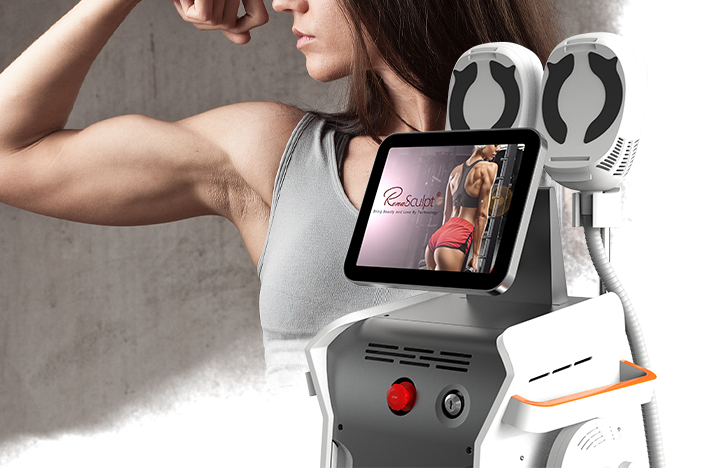
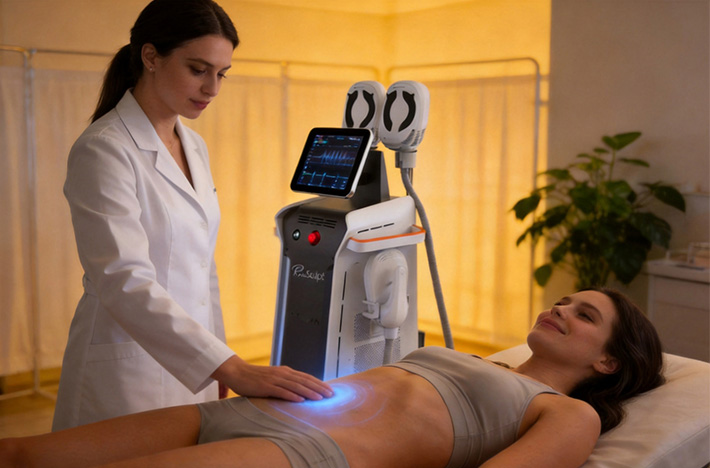
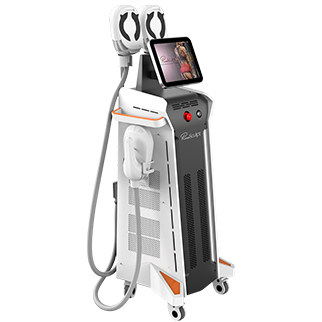
The Renasculpt FE60 is a good example of this newer generation. It combines HIEMT with radiofrequency — so while the magnetic pulses force supramaximal muscle contractions, the RF energy simultaneously heats the dermis to stimulate collagen production. It’s a combined approach, not just “zap the muscle and hope for the best.”
But does any of this actually make you lose weight? That depends entirely on how you define weight loss.
2. “Losing Weight” vs “Losing Fat” — Why the Difference Matters
Here’s where most of the confusion starts. When people say “I want to lose weight,” what they usually mean is “I want to look different in the mirror.” They want less fat, more definition, a smaller waist, a firmer appearance. They don’t actually care about the number on the scale.
EMS is very good at changing what you see. It’s mediocre at changing what the scale says. And that distinction matters.
Muscle tissue is denser than fat tissue. One kilogram of muscle takes up significantly less space than one kilogram of fat. If you gain muscle while losing fat — which is exactly what a properly done EMS protocol can help with — your waist circumference shrinks, your clothes fit better, and you look leaner, all while your scale weight stays roughly the same or even goes up slightly.
I’ve seen this pattern play out countless times. A client does a course of six to eight sessions on the FE60. They come back for their follow-up measurement. Their waist is down 3 to 5 centimeters. Their abdomen looks firmer. They can see the outline of muscles that weren’t visible before. But their weight? Maybe down 1 kilogram. Maybe unchanged. A few clients even gained a kilogram because their muscle mass increased faster than their fat mass decreased.
So the honest answer: If you want the number on the scale to drop, EMS alone might disappoint you. If you want to look leaner and more toned, it can deliver noticeable results. This is the single most important thing to understand before you spend money on EMS for weight loss.

3. What the Studies Actually Say About EMS for Fat Loss
There’s a handful of peer-reviewed research on HIEMT for body contouring. The results are reasonably consistent — and they’re not the kind of dramatic numbers you see in a social media ad.
A 2019 study published in the Journal of Drugs in Dermatology followed subjects who received four HIEMT sessions over two weeks targeting the abdomen. The results:
- Average waist circumference reduction: ~4 cm
- Fat thickness decrease (measured by ultrasound): ~19%
- Muscle thickness increase: ~16%
A separate study on combined HIEMT + RF treatment — the same approach the FE60 uses — reported both fat reduction and skin tightening effects. The RF component addresses something that pure muscle stimulation can’t: skin laxity. When you reduce fat volume in an area, the skin above doesn’t always snap back, especially in clients over 35 or people who’ve lost significant weight. RF heating helps with that contraction.
I’m not going to pretend these numbers are life-changing on their own. A 4-centimeter waist reduction is real and visible — but it’s not dramatic. The people who see the best results from EMS are those who combine it with decent nutrition and regular movement. The machine amplifies what’s already happening. It doesn’t replace the basics.
4. Who Gets Results from EMS — and Who Doesn’t
Based on what I’ve seen across the clinics we work with, the results spectrum breaks into three groups:
Group 1: Active people with stubborn fat deposits
You go to the gym three or four times a week. You eat reasonably well. But you have that stubborn lower belly fat or love handles that won’t budge no matter how many crunches you do. EMS is at its best here. The supramaximal contractions target areas that regular exercise can’t seem to touch. These clients typically see the most dramatic before-and-after results.
Group 2: Sedentary people just starting to make changes
EMS can kickstart things — the forced muscle contractions do burn energy, and building a bit of muscle raises your resting metabolic rate. But if you’re not changing your diet at all, the effect will be modest. I’ve seen clients in this group who were disappointed, and I don’t blame them. The marketing creates the impression that EMS alone can transform a body without any effort. It can’t.
Group 3: Already lean people seeking definition
If you’re at around 12% body fat and want visible muscle definition, EMS can help bring it out. The muscle growth from supramaximal contractions thickens the muscle belly, making it more visible under the skin. This group tends to be the happiest with their results, though they’re usually the least in need of “weight loss.”
Takeaway: EMS works best when you treat it as a tool in a toolbox. It amplifies effort. It doesn’t replace it.
5. Can EMS Replace Exercise? Let’s Talk Calories
This is the claim that makes me the most skeptical. Some providers advertise EMS sessions as equivalent to hours of gym time. Let’s be direct: the energy expenditure during a 30-minute EMS session is real but modest. Researchers have measured the metabolic cost at roughly 150 to 250 calories per session — about the same as a brisk 30-minute walk, not a CrossFit workout.
The real metabolic benefit isn’t what you burn during the treatment. It’s the muscle tissue you build or preserve, which raises your resting metabolic rate. One kilogram of muscle burns about 13 calories per day at rest. It’s not huge, but it adds up. And when combined with the mechanical fat disruption that some researchers believe HIEMT causes — intense contractions may stress fat cells enough to trigger apoptosis — you get a compound effect.
But if someone tells you EMS will help you lose 10 kilograms without changing anything else? They’re selling you hope, not a solution.
6. What a Real EMS Fat Loss Protocol Looks Like
Most clinical protocols recommend:
- 4 to 6 sessions total, spaced 2-3 days apart
- 30 minutes per session
- 2 to 3 weeks to complete the initial course
- Maintenance: 1 session every 4-6 weeks after
Areas that respond best:
- Abdomen (most common)
- Buttocks (lifting and firming)
- Thighs
- Arms (definition)
What you should feel: Intense muscle contractions you cannot control. Intensity should increase gradually as you adapt. By session three or four, you should tolerate near-maximum intensity. If you’re not challenged, either the machine isn’t powerful enough or the operator isn’t increasing the output enough.
What you should NOT feel: Pain, burning on the skin, or discomfort at the pad edges. Surface burning means the RF is too hot or the contact is poor. A good operator adjusts immediately.
When results appear: Typically 2 to 4 weeks after the last session. The lag matters — muscle growth and fat cell changes take time. Clients who judge the treatment immediately after their final session are often disappointed. The real change shows up later.
7. Why RF Matters: EMS Alone Isn’t Enough
A lot of older EMS-only devices on the market don’t include radiofrequency. They’re cheaper. They do produce muscle contractions. But for the visible fat loss people actually care about, RF makes a meaningful difference.
Here’s why: when you reduce fat volume without addressing skin laxity, you can end up with loose skin that looks worse than the original problem. This is especially true for clients over 35. The RF component in combination machines heats the dermis to 41-43°C, which immediately contracts existing collagen and, over weeks, stimulates new collagen production. The result is firmer skin that conforms better to the newly defined muscle underneath.
Without RF? You get stronger muscles under looser skin. That’s a less aesthetic outcome.
8. Four Common Misconceptions About EMS and Weight Loss
“EMS is the same as a TENS unit.” No. A TENS unit pushes low-voltage current through surface electrodes. It penetrates skin poorly. HIEMT uses magnetic fields that pass through everything until they hit motor neurons, then induce current at depth. They’re fundamentally different technologies that happen to share the word “stimulation.”
“An $80 ab belt from Amazon does the same thing.” It doesn’t. Consumer-grade EMS operates at a fraction of the intensity and penetration depth. That belt makes your skin tingle and superficial muscles twitch. It will not produce supramaximal contractions or recruit deep fibers. Clinical machines operate at field strengths measured in Tesla — a completely different category.
“EMS melts fat.” This is misleading. EMS doesn’t “melt” fat like laser lipolysis. The mechanism is indirect — intense mechanical contractions stress fat cells, and some studies suggest this can trigger apoptosis. But EMS is primarily a muscle stimulator. Fat reduction is a secondary effect, most pronounced when combined with RF.
“One session is enough.” No reputable clinician would say this. Four to six sessions minimum. Anyone promising visible results after one session is overpromising.
9. Who Shouldn’t Use EMS
EMS is safe when used correctly, but it’s not for everyone. Contraindications include:
- Pregnancy
- Implanted electrical devices (pacemakers, defibrillators)
- Metallic implants in the treatment area
- Epilepsy
- Active cancer
- Recent surgical scars or areas with compromised skin sensation
A responsible provider always does a health screening before the first session. If your technician doesn’t ask about medical history, that’s a red flag.
Final Verdict: Is EMS Good for Losing Weight?
Yes, but with important qualifications.
EMS — particularly the newer HIEMT + RF combination — produces measurable reductions in fat thickness and waist circumference. It builds muscle, improves resting metabolic rate, and targets stubborn areas that resist exercise. When combined with reasonable nutrition and activity, it accelerates results.
But EMS is not a weight loss shortcut. It doesn’t replace diet or exercise. It doesn’t “melt” fat. The scale change is often modest even when the visual change is noticeable.
If you’re a clinic owner: set realistic expectations with your clients. Overpromising leads to refunds and bad reviews. Underpromising and overdelivering builds a loyal base.
If you’re considering EMS for yourself: go in with your eyes open. Take before photos. Measure your waist, not just your weight. Commit to the full protocol. And combine it with good nutrition and movement — that combination is where the real results come from.
If you’d like to learn more about adding an EMS body sculpting machine to your clinic, contact us. We manufacture the Renasculpt series and can walk you through the specs, pricing, and expected results for your specific use case.