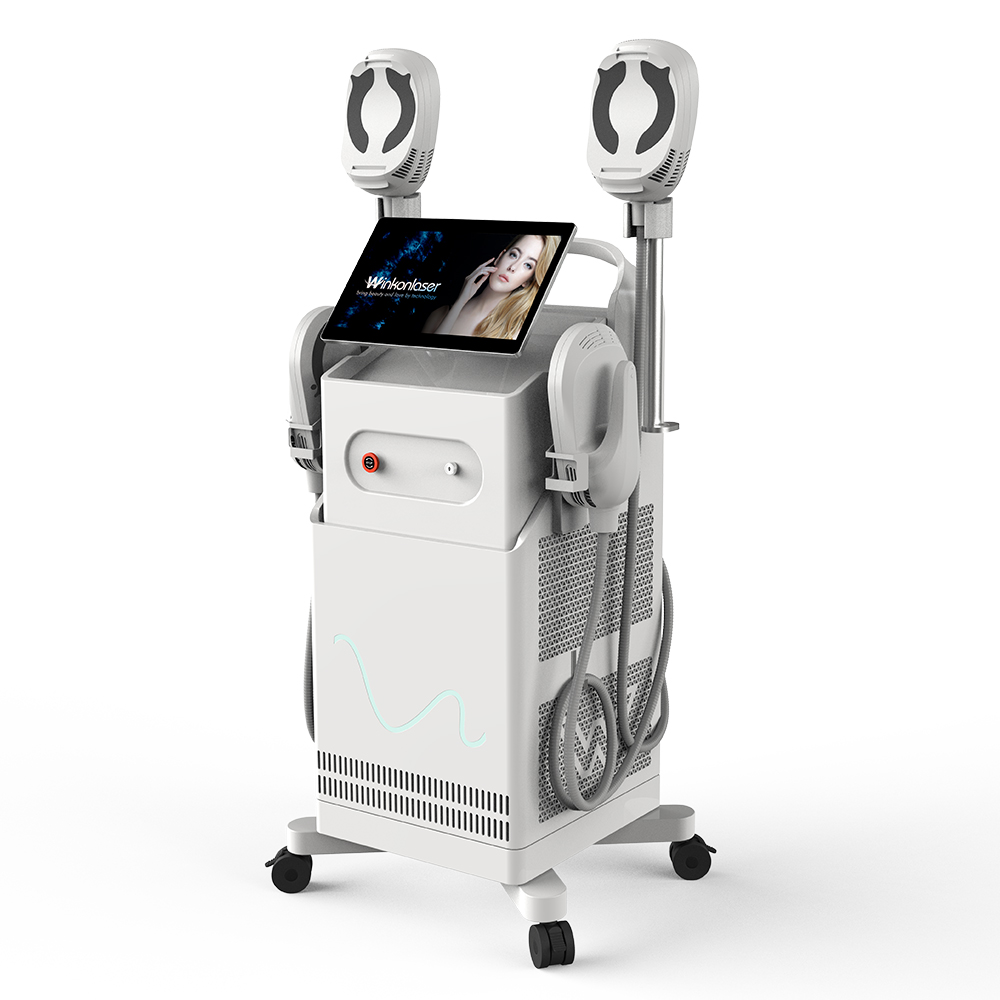



Do EMS Body Sculpting Machines Work?
The box sat in my hallway for three days before I opened it. Not because I was busy — I walked past it maybe twenty times. I just couldn’t decide if I’d made an expensive mistake. My girlfriend eventually lost patience. “You’re going to return it, right? Just open the damn box and decide.” She was convinced I’d been scammed by a YouTube ad. She’s not wrong about how it sounds. Body sculpting machine. It’s a terrible name. Sounds like a kitchen gadget.
I didn’t buy it from a YouTube ad. I bought it after a physical therapist I know — she runs a rehab clinic in Shanghai, mostly post-surgical patients — mentioned she’d been using something called HIEMT on patients with core muscle atrophy. I’d never heard of it. She said it stands for High-Intensity Focused Electromagnetic Therapy. I said that sounded made up. She laughed and told me to look it up on PubMed. I did.
What I found surprised me. There were actual studies. Not marketing whitepapers — peer-reviewed stuff in dermatology journals. The mechanism made sense on paper. But reading about electromagnetic muscle stimulation at 2 a.m. and strapping electrodes to your abdomen are very different things. I wanted to know if these machines actually do anything for a normal person — not a study subject, not a fitness influencer, not someone who’s already 8% body fat and just needs a tiny edge. A guy in his mid-30s who sits too much and exercises just enough to not feel guilty about it.
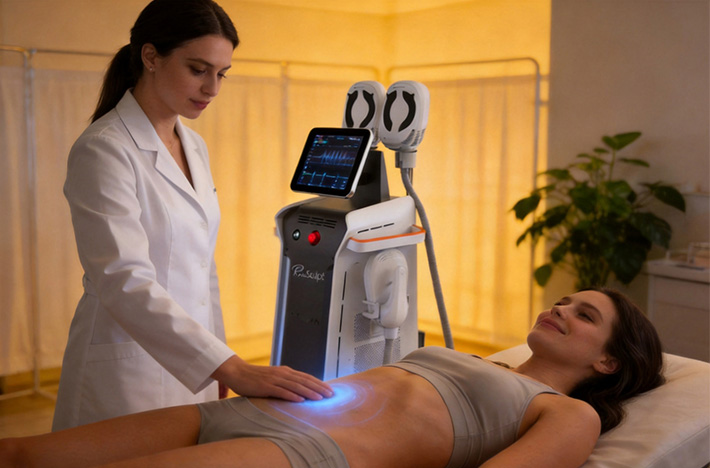
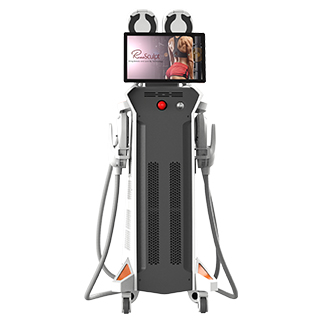
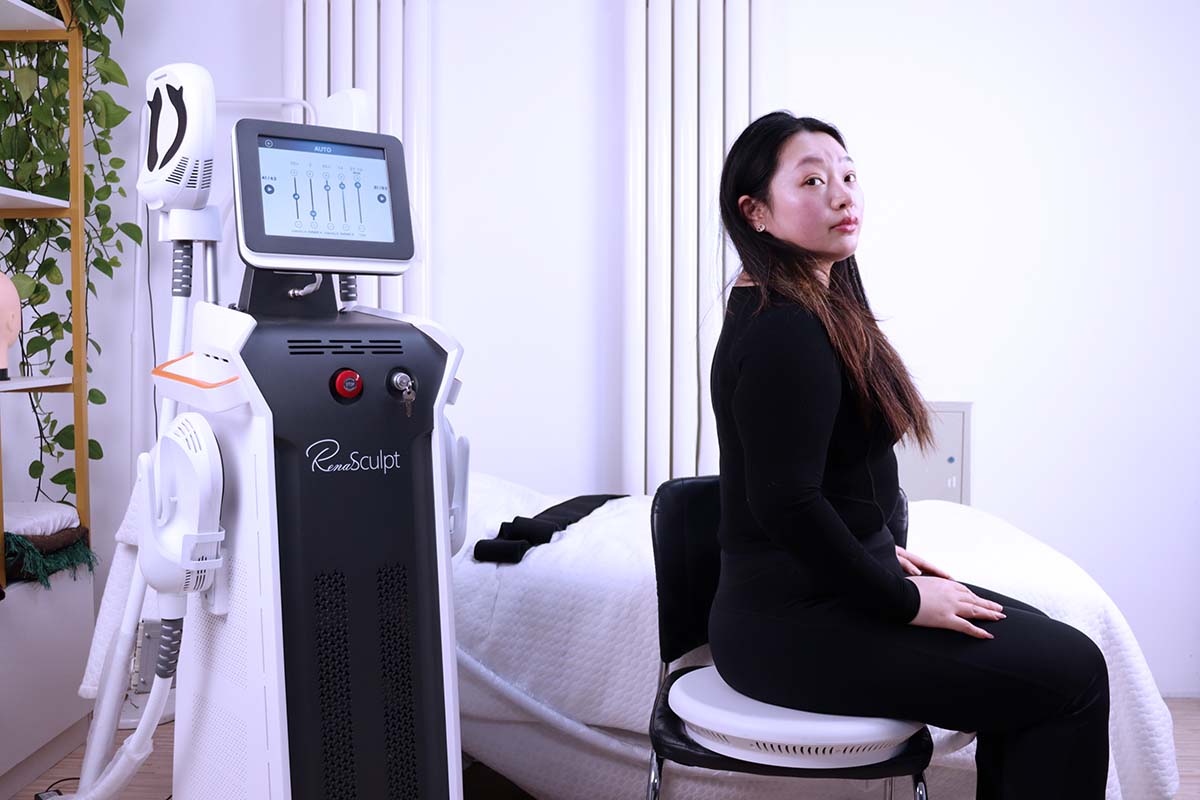
So I tried one. The Renasculpt FE60, specifically. It’s a 3-in-1 platform: HIEMT for muscle contractions, radiofrequency for skin tightening, and traditional EMS. Commercial-grade — the kind of machine a medspa would buy, not the kind you impulse-order after three drinks. I’ve now done twelve sessions over four months. Measured everything. Took stupid mirror photos my girlfriend refused to participate in after week two. Here’s what I learned.
The physics is weirder than I expected
I read the manual and about seven PubMed abstracts. Most of it went over my head but here’s the part that stuck: the machine makes a magnetic field that switches on and off thousands of times a second. Your nerves don’t know the difference between a magnetic field and a brain signal — they just fire when electricity tells them to. So when this field hits your motor neurons, your muscles contract. All of them. At once. Your brain isn’t involved.
That last part matters more than it sounds. Your nervous system has a limiter — during any voluntary movement, your brain caps recruitment at roughly 65% of your available muscle fibers. It’s a safety thing. If you actually fired everything during a deadlift, you’d tear something. The machine doesn’t have that limiter because it doesn’t go through your brain. It talks directly to the nerve. Everything fires.
The FE60 packs more than 20,000 of these contractions into a 30-minute session, at an intensity you can’t match voluntarily. The number sounded fake to me too. I checked. They measure this stuff with EMG electrodes during treatment, and the motor unit recruitment patterns are genuinely supramaximal. Whether 20,000 forced contractions actually makes you look different — that’s a separate question, and I’ll get to it. But the mechanism isn’t pseudo-science.
Someone online compared it to a TENS unit and I need to shut that down immediately. A TENS unit — or a $50 ab belt from Amazon, same technology — uses surface electrodes to push low-frequency current through your skin. It penetrates maybe a centimeter. It makes your skin tingle and your superficial muscles twitch. HIEMT uses a magnetic field, not direct current, and magnetic fields don’t give a damn about skin resistance or fat thickness. They pass through everything until they hit conductive tissue — like motor neurons — and then induce current at depth. If a $50 ab belt is yelling at your muscles from outside the house, HIEMT is inside the house, shaking the foundation. They share the word “stimulation” and basically nothing else.
The FE60 adds radiofrequency to this. While the magnetic pulses are forcing contractions, RF energy heats your dermis to about 41-43°C. Hot enough to make collagen fibers contract immediately and, over weeks, trigger your fibroblasts to produce new collagen. I didn’t care about this part at first. I figured muscle definition was the whole point. Then I remembered that loose skin over defined muscle looks weird — like putting a fitted sheet over a mattress that’s slightly too small — and I started paying more attention to the RF component.
Four months of being electrocuted, voluntarily
.jpg)
The first session was absurd. I lay on a treatment bed in our office — we have one for demos — with gel-covered paddles strapped to my abdomen. The technician dialed up the intensity slowly, and somewhere around 40% my entire rectus abdominis started contracting and releasing in a rhythm I had zero control over. I laughed. Not a chuckle — full, involuntary laughter, the kind where you can’t explain why you’re laughing. My brain was processing “muscles moving without permission” as either hilarious or terrifying and it had apparently chosen hilarious.
By the third session I’d gotten used to the sensation and could tolerate higher intensities. Week one I maxed at around 55%. The FE60 adjusts from 0 to 100%, which corresponds to 0 to 15 Tesla at the applicator surface. The key thing nobody told me: don’t try to prove anything on day one. The muscle adapts. By week two I was at 75%. By the end of the first month I could handle 90% without gripping the sides of the bed. There’s a weird pride in this that I’m slightly embarrassed about, like being proud of tolerating a dental cleaning.
Something happened around week two that I didn’t expect: my posture changed. I wasn’t holding my stomach differently on purpose. I’d just notice, standing in line for coffee or waiting for the elevator, that my core was engaged in a way it normally wasn’t. My physical therapist friend — the one who started all this — told me this is actually one of the more reliable effects of HIEMT. It strengthens the deep stabilizers: transverse abdominis, internal obliques, the muscles that hold your guts in and keep your spine neutral. Crunches don’t really touch these. The machine does.
I measured everything at week four. Waist down 3.8 centimeters. Weight unchanged. Diet unchanged — I tracked it deliberately to avoid the “I started eating better because I’m paying attention to my body” confound. Exercise routine unchanged (twice a week, nothing heroic). Sleep unchanged. The only variable was six 30-minute HIEMT sessions.
I should be clear about what I saw versus what I didn’t see. I did not develop visible abs. I still have a thin layer of subcutaneous fat that covers whatever muscular definition is underneath. But when I flexed — and I found myself flexing in the bathroom mirror more than I want to admit — there was something there that hadn’t been there before. Denser. The tissue under the fat felt different to the touch. The FE60 claims a 35% increase in muscle thickness and a 50% reduction in fat in the treated area after a full protocol. My experience was directionally consistent with those numbers, with a huge asterisk: “50% fat reduction” means 50% relative to the fat in that specific treatment zone, not 50% of your total body fat. Those are wildly different things, and I’ve seen multiple Reddit threads where people confused them.
I got lazy around week eight and skipped two weeks entirely. When I restarted, the post-session soreness was worse than week one — not a heavy deadlift day, more like I’d been punched in the stomach forty times. I spent the next day holding my abdomen when I coughed. Which got me thinking: if this much muscle trauma is normal for healthy tissue, imagine what happens if someone with a pacemaker tries it. Or a copper IUD. The magnetic field doesn’t ask what’s in your body before it starts firing. It just fires. Those contraindications in the manual — pregnancy, implants, epilepsy — they’re not legal department ass-covering. They’re there because bad things have happened. More on this later, but the thought crossed my mind at a very specific moment: lying on the floor of my living room, questioning my life choices after doing six sessions and then taking two weeks off like an idiot. I got back on schedule when I noticed my waist had crept back up about half a centimeter. Motivation is a funny thing.
The studies are encouraging and the marketing is dishonest
If you actually read the clinical literature on HIFEM — not the summaries on manufacturer websites, the actual papers — a consistent picture emerges. The technology does what it claims, within limits that marketing departments hate acknowledging.
A 2020 multicenter trial in the Journal of Cosmetic Dermatology put 75 subjects through four abdominal HIFEM sessions. At three-month follow-up, the average reduction in subcutaneous abdominal fat was 19%, and the average increase in rectus abdominis muscle thickness was 16%. A separate 2021 randomized controlled trial tested HIFEM plus radiofrequency against HIFEM alone. The combination group — which is essentially what the FE60’s 3-in-1 architecture does — showed 32% greater fat thickness reduction compared to HIFEM monotherapy. Patient satisfaction at six months was 89% in the combination group versus 71% in the HIFEM-only group.
Those numbers are real and statistically significant. They are also from carefully selected populations: BMI under 30, no contraindications, full protocol compliance, controlled settings. The gap between “19% fat reduction in a clinical trial with screened subjects” and “what happens when a 34-year-old with inconsistent gym attendance uses the machine while checking Slack between sessions” is where most of the internet arguments live.
I found a 2019 systematic review in Aesthetic Surgery Journal that was unusually candid about something the industry doesn’t like to discuss. The placebo effect in body contouring is large. Subjects in sham-treatment control groups — they thought they were getting real HIFEM but the machine wasn’t actually activated — consistently reported subjective improvements just from believing they’d been treated. They stood differently in follow-up photos. They ate slightly less. They rated their appearance higher. The measured, objective changes in the real treatment groups were genuine — muscle hypertrophy on ultrasound, fat layer reduction on caliper — but patient-reported outcomes exaggerated objective measurements by roughly 1.5 to 2 times.
None of this means HIFEM is a scam. It means the machine does specific, measurable things to specific tissues, and the rest is psychology. You’ll stand taller because your core is stronger. You’ll flex in the mirror more because you’re paying attention. You might eat one fewer snack because you’ve invested money in this thing and don’t want to sabotage it. Are those real outcomes? Sure. Are they caused directly by the magnetic pulses? No.
The price gap between clinic and consumer is mostly about business models, not physics
Emsculpt NEO is the benchmark in this space. FDA-cleared, HIFEM plus radiofrequency, excellent clinical data, sessions that run $750-$1,000 each. A full abdomen protocol costs $3,000-$4,000 out of pocket. If you have the money and want the known quantity, it’s the obvious choice. It’s also, from a physics standpoint, doing essentially the same thing as other 15-Tesla HIEMT platforms. The magnetic field doesn’t know what brand is printed on the housing.
At the opposite end, Slendertone and similar consumer ab belts operate on traditional electrical muscle stimulation. These max out at maybe 50-100 milliamps of surface current. They make your skin tingle. If you use one daily for six months, you might see some toning — a 2005 study in the Journal of Sports Science and Medicine found a 9% increase in abdominal muscle endurance after eight weeks of daily EMS belt use, which is something but not much. Nobody is confusing these with Emsculpt. The pricing reflects the capability.
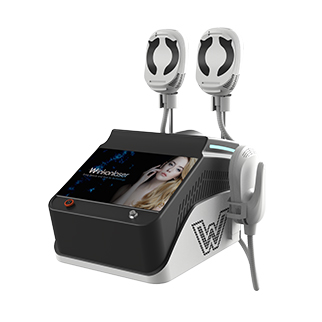
I ended up with the Renasculpt FE60 because it delivers the same core specifications as the clinic-premium devices — 15 Tesla peak output, dual handpieces for simultaneous treatment of two areas, integrated bipolar RF for skin tightening — but it’s engineered as a commercial workhorse rather than a branded experience. That means no per-session disposables (the paddles are reusable, just gel and cleaning between patients), no locked-down treatment cartridges that force you into the manufacturer’s consumable ecosystem, and the flexibility to combine modalities. A clinic can run EMS on one patient and cryolipolysis on another from the same investment pool. That matters more than most buyers realize — a machine that does one thing well but sits idle 60% of the time is worse math than a platform that can flex across treatment types.
The per-session cost to the provider, once the machine is paid for, is basically gel and electricity. That’s why clinics can price EMS sessions competitively and still make strong margins. Compare that to Emsculpt NEO where the consumable cartridges add roughly $50-$80 per session in hard cost. The patient doesn’t see this they just see what the sessions cost but it limits how clinics can price things.
I should note: the FE60 has FDA, CE, and ISO 13485 certifications. For body contouring devices, this matters. A lot of machines on Alibaba claim “FDA cleared” but are actually registered as cosmetic devices, not medical devices, which severely limits what you can legally claim in your marketing. The FE60 is registered as a Class II medical device with cleared indications for muscle stimulation and body contouring. If you’re evaluating equipment, verify this independently — ask for the 510(k) number and check it on the FDA database. If they won’t give you the number, walk.
Who shouldn’t go near these things
I’ll keep this section short because it’s mostly common sense, but the consequences of getting it wrong are serious enough to spell it out.
Pregnant? Do not use. The effects of high-intensity magnetic fields on fetal development are unknown and will stay unknown because you can’t ethically study that. Trying to conceive? Same. If you have a pacemaker, defibrillator, insulin pump, cochlear implant, or any other implanted electronic device, HIEMT is an absolute contraindication — the field can interfere with device function. Metal implants in or near the treatment zone are also a no. IUDs, surgical screws, plates. Magnetic fields heat metal. If you have a copper IUD and do abdominal HIEMT, you’re risking a thermal injury to tissue that you really don’t want thermally injured.
Active cancer, epilepsy, severe cardiac conditions, recent surgery — all contraindicated. Diastasis recti is a nuanced case. Mild to moderate separation often responds well; the machine essentially re-educates the abdominal muscles to reapproximate the midline. But severe cases need surgical repair, not electromagnetic stimulation. Get a physician’s assessment first.
For everyone else, the side effects are what you’d expect from doing the most intense workout of your life without actually moving. Muscle soreness for 24-48 hours after the first session or two. Some people get mild redness at the applicator site from the RF heating — it resolves in a few hours. A small number of users report temporary muscle spasms afterward. I had two days of ab soreness after session one, comparable to what I’d feel after returning to the gym after a month off. By session three, nothing. I never had skin irritation or bruising. The gel smells like a doctor’s office and is a minor annoyance to wash off. That’s about it.
Would I recommend it?
That depends entirely on why you’re asking. I’ve noticed that when people Google “do EMS body sculpting machines work,” they’re usually asking one of five different questions without realizing it.
Some people want to lose weight. To them I’d say: no, and you’re asking the wrong question. HIEMT doesn’t burn meaningful calories. It doesn’t touch visceral fat. It won’t change the number on the scale. If weight loss is your actual goal, you need a calorie deficit, and no machine is going to create one for you. I cannot emphasize this enough. I read the same claims you’re reading — “burns fat!” — and the clinical reality is that the fat reduction is secondary, a metabolic byproduct of extreme muscle activity, concentrated in the tiny zone directly adjacent to the contracting muscle. It’s not weight loss. It’s a few millimeters of subcutaneous fat gone from a specific spot. If you have actual weight to lose, buy a food scale and walking shoes. Come back to EMS when you’re lean.
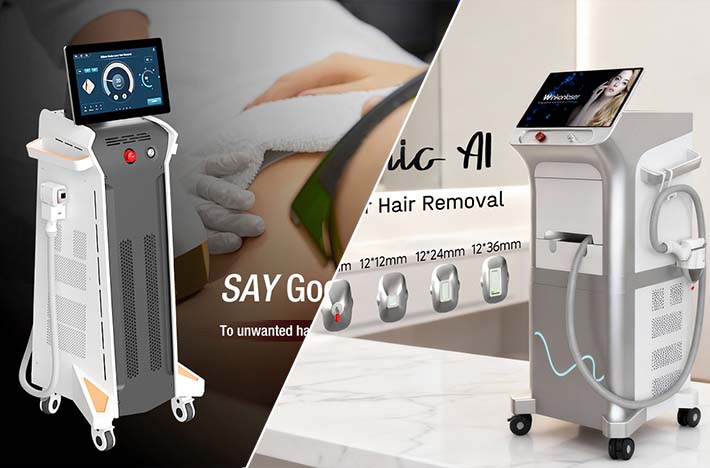
Other people have a stubborn fat pocket — love handles, lower belly pooch, the thing that doesn’t budge no matter how much they diet. Those people should look at cryolipolysis, not EMS. Fat freezing actually destroys adipocytes through apoptosis; the elimination is permanent. EMS reduces fat as a side effect of muscle metabolism, which is less predictable and less complete. I know Winkonlaser sells both technologies, and I know this sounds like I’m just trying to sell you a second machine. But the tissue biology doesn’t lie. If your primary complaint is pinchable fat, treat the fat first. Then use EMS to build the muscle underneath once the fat is gone. Different layers, different tools.
Then there are the people EMS was actually designed for: relatively lean individuals (BMI under 28, ideally under 26) who want better muscle definition and core strength than they can get from voluntary exercise alone. If you’ve ever thought “I do crunches three times a week and still don’t have visible abs,” you are this person. The machine overrides the neurological limit that prevents full muscle fiber recruitment. Voluntary exercise literally cannot match what HIEMT does to your muscle tissue at the cellular level. This is not marketing. It’s motor unit physiology that’s been documented in EMG studies since the 1990s.
Postpartum women with core weakness or mild diastasis recti are another strong candidate group. The deep transverse abdominis — the body’s internal corset — responds particularly well to electromagnetic stimulation, and restoring that layer can flatten the abdominal profile even without fat loss. This is one of the few non-invasive options that actually targets the right tissue for the “mommy tummy” problem. Again: physician clearance first, especially if the separation is more than two finger-widths.
And if you’re a clinic or medspa owner reading this while doing equipment research — different decision entirely. EMS sculpting has the highest per-session revenue of any non-invasive body contouring modality right now, attracts men (30-40% of patients, versus maybe 15% for most aesthetic services), and generates predictable repeat visits. The FE60 specifically makes sense if you want a multi-modality platform rather than a single-trick machine — add cryolipolysis later and you’ve got a full body contouring suite from one vendor. The economics work.
I keep coming back to what that physical therapist told me before I unboxed the machine: the question isn’t whether it works. It’s whether it works for what you think it does. Four months in, my waist is 4.2 centimeters smaller than when I started. My core is stronger. My posture is better. I still don’t have visible abs. If I’d bought this expecting a six-pack in a box, I’d be writing a very different article — probably an angry one. But I bought it understanding the mechanism, and the FE60’s mechanism did what it’s supposed to, mostly.
The machine did its job. The rest was on me the whole time — diet, consistency, realistic expectations — and I was average at best on all three. I can live with that.